SEED | Robin:AI 科学家走进湿实验 SEED | Robin closes the lab discovery loop AI-assisted · reviewed
FutureHouse、University of Oxford、Fordham University 与合作者的 Ali Essam Ghareeb、Andrew D. White、Michaela M. Hinks、Samuel G. Rodriques 团队近期报道 Robin,一个把文献检索、治疗假说生成、湿实验数据分析和下一轮候选生成连接成闭环的多智能体系统,并在 dry age-related macular degeneration 中发现和验证了 RPE phagocytosis 相关候选药物与机制线索。
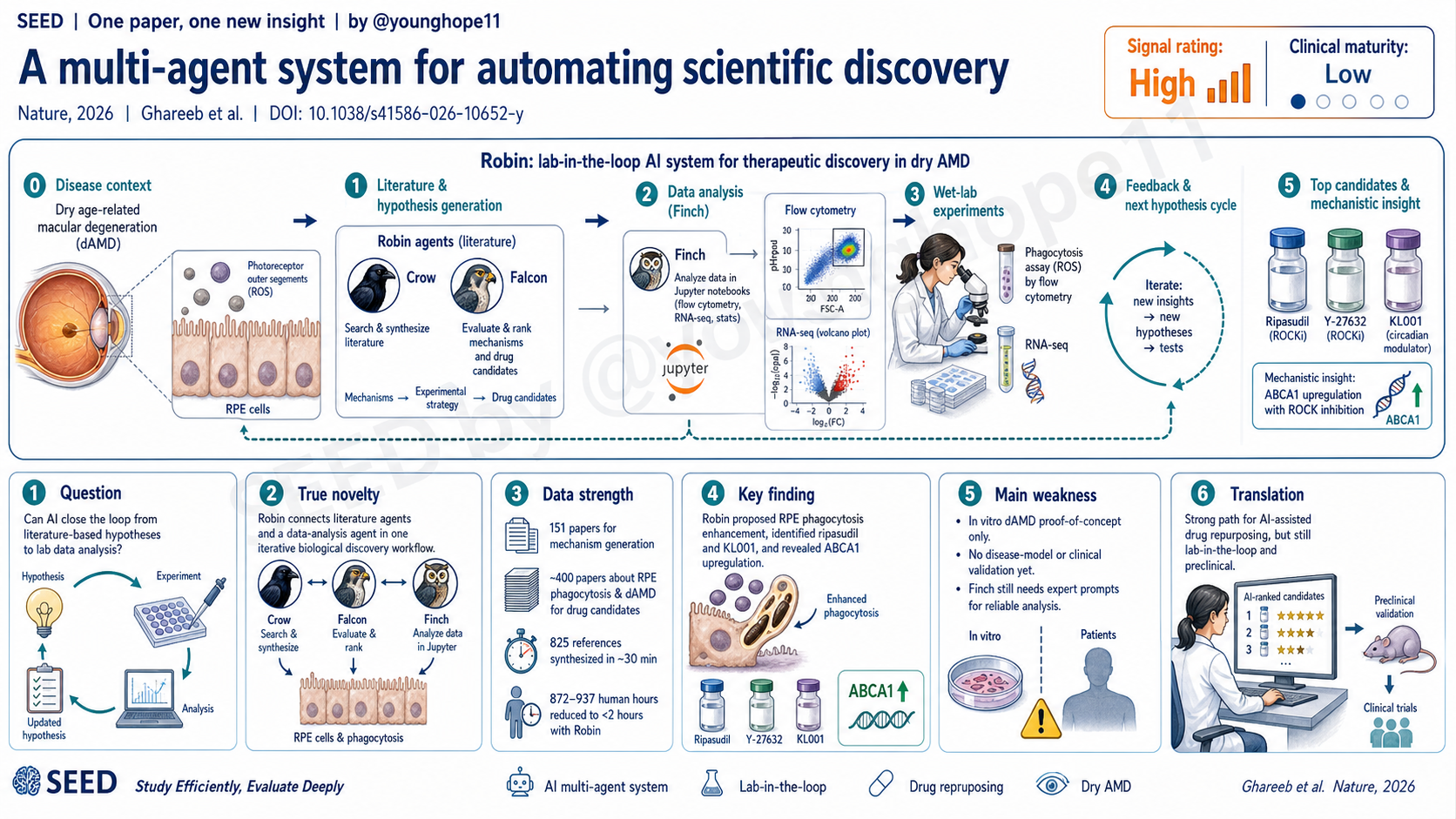
研究问题是什么?
这篇论文问的是:AI 能不能不只提出生物医学假说,还能在实验结果回来后分析数据、解释结果,并生成下一轮更好的假说?
很多 AI for science 系统停留在文献总结或一次性 hypothesis generation。Robin 的目标更具体:让 AI 参与科学发现的闭环,包括机制选择、实验策略、候选药物生成、flow cytometry/RNA-seq 数据分析和基于结果的下一轮候选。
作者选择 dry age-related macular degeneration 作为 proof-of-concept,因为 dAMD 是发达国家失明的重要原因之一,治疗选择有限,而 retinal pigment epithelium phagocytosis dysfunction 与疾病机制相关。
真正的新意是什么?
真正的新意是 Robin 把两个以前分开的 AI 能力接在一起:literature-grounded hypothesis generation 和 experimental data analysis。
Robin 由多个 agents 组成。Crow 和 Falcon 基于 PaperQA2 做文献检索、机制总结和候选药物评估;Finch 是 Jupyter-native data analysis agent,用于 flow cytometry 和 RNA-seq 分析。科学家执行湿实验后,把原始或半处理数据交给 Robin,Robin 再用 Finch 分析结果,并把实验洞见反馈给下一轮假说生成。
这不是完全无人实验室,而是 lab-in-the-loop。人类仍然做实验、决定可执行方案和最终解释,但 Robin 承担了大量阅读、候选生成、数据分析和迭代推理。
数据强在哪里?
第一层是 workflow 效率。Robin 先审阅 151 篇论文,提出 10 个 dAMD disease mechanisms 和实验策略;随后围绕 RPE phagocytosis 和 dry AMD therapeutic landscape 检索约 400 篇论文,提出 30 个候选药物。按作者估算,一个典型 Robin run 会触发 45 次 Crow 和 30 次 Falcon calls,约分析 825 references,在约 30 分钟完成;整个 discovery cycle 的认知劳动从 872-937 人小时降到少于 2 小时。
第二层是实验闭环。Robin 选择增强 RPE phagocytosis 作为策略,建议用 RPE phagocytosis flow cytometry assay 测试候选。第一轮 top candidates 包括 Exendin-4、Fingolimod、MFGE8、Y-27632 和 AICAR/TUDCA combination。实验完成后,Finch 自动分析 flow cytometry 数据,结果经人类分析确认。
第三层是机制洞见。Robin 随后建议对 Y-27632-treated RPE cells 做 RNA-seq。Finch 分析显示 ROCK inhibition 不仅影响 F-actin 和 phagocytic cup,还伴随 actin filament organization、small GTPase signaling 和 autophagy pathways 的表达变化。最突出的结果是 ABCA1 上调约 3 倍,adjusted p=2.13x10-83,这为 dAMD 中 lipid handling 和 RPE function 提供了新线索。
第四层是候选药物验证。第二轮候选中,ripasudil 这个日本已批准用于 glaucoma 的 ROCK inhibitor 在 ARPE-19 中使 RPE phagocytosis 比 DMSO 增加 1.89 倍,人类分析为 1.75 倍,并且比 Y-27632 更有 potency。作者又在 >60 岁供体来源 primary human RPE-SC 中用 bovine rod outer segments 重新筛选,ripasudil 和 Y-27632 再次成为 hits,ripasudil 仍更强。KL001 也在 RPE-SC 中成为 hit;据作者所知,此前没人提出 KL001 可增强 RPE phagocytosis。RPE-SC 中 ripasudil 处理也再次上调 ABCA1。
最大弱点是什么?
最大弱点是生物学验证仍是 in vitro proof-of-concept。dAMD 是复杂慢性疾病,RPE phagocytosis 是重要机制,但药物能增强体外 RPE 吞噬并不等于能改变患者疾病进程。还需要 disease model、体内药效、眼部递送、长期安全和临床终点验证。
第二个弱点是实验仍由人类大量翻译和执行。Robin 能生成实验 outlines,但还不能直接生成完全可执行、无需人工转换的 protocols。科学家仍要决定细胞模型、底物、剂量、实验流程和结果解释。
第三个弱点是 Finch 仍依赖 expert prompt。它在本文给定任务上的 RNA-seq 和 flow cytometry rubric 表现很好,分别为 86% 和 100%,但在更困难的 BixBench 问题上总体准确率只有 22.8%,尽管高于基础模型的 1.6%。这说明 agent harness 很有用,但复杂多步数据分析仍不稳。
第四个弱点是验证范围窄。Robin 在 dAMD 上表现强,但是否能推广到其他疾病、其他 assay、negative results 和更难的机制问题,还需要更多独立实验。
是否有临床转化意义?
有,但非常早期。最直接的转化线索是 ripasudil:它已有 ocular use 的安全背景,比 Y-27632 这种研究化合物更接近 repurposing 起点。KL001 和 ABCA1 则更像机制与新方向信号。
如果后续在更接近 dAMD 的模型中验证,RPE phagocytosis enhancement 可能成为一个可测试的治疗策略。但现在还不能把 ripasudil 或 KL001 解读为 dAMD 治疗候选,更不能作为临床建议。
更大的意义是 workflow:Robin 展示了 AI 可以把文献综合、候选生成、湿实验数据分析和下一轮假说连接起来。对于 drug repurposing 和低成本早期验证,这种 lab-in-the-loop 系统可能很有价值。
Yang 的信号评级:High
理由:我会把科研信号评为 High。Robin 的关键贡献不是某一个药物,而是它证明了 AI 可以在一个真实生物学问题中参与闭环:读文献、选机制、提候选、分析实验数据、再提出下一轮候选。
这个 High 有实验支撑:ripasudil、Y-27632、KL001、ABCA1 和 primary RPE-SC validation 让它超过纯概念系统。但它的临床成熟度仍是 Low,因为证据主要来自体外细胞模型,还没有疾病模型和人体数据。
我会把它看作“AI-assisted discovery workflow 的强信号”,而不是“dry AMD 新疗法已经接近临床”的信号。最值得跟踪的是这种闭环能否在更多疾病和实验平台中稳定复现。
Ali Essam Ghareeb, Andrew D. White, Michaela M. Hinks, Samuel G. Rodriques and colleagues at FutureHouse, the University of Oxford, Fordham University and partner institutions recently reported Robin, a multi-agent system that connects literature search, therapeutic hypothesis generation, wet-lab data analysis and follow-up candidate generation into a discovery loop, identifying and validating RPE-phagocytosis-related drug and mechanism leads for dry age-related macular degeneration.
What is the research question?
This paper asks whether AI can do more than propose biomedical hypotheses. Can it analyze experimental results, interpret them and generate the next round of stronger hypotheses?
Many AI-for-science systems stop at literature synthesis or one-shot hypothesis generation. Robin aims at a more specific loop: mechanism selection, experimental strategy, drug-candidate generation, flow-cytometry and RNA-seq analysis, then new hypotheses based on the data.
The authors choose dry age-related macular degeneration as the proof of concept because dAMD is a major cause of blindness in developed countries, treatment options are limited and retinal pigment epithelium phagocytosis dysfunction is relevant to the disease mechanism.
What is truly new?
The novelty is that Robin connects two AI capabilities that are often separate: literature-grounded hypothesis generation and experimental data analysis.
Robin uses multiple agents. Crow and Falcon, based on PaperQA2, perform literature search, mechanism synthesis and candidate-drug evaluation. Finch is a Jupyter-native data-analysis agent for flow cytometry and RNA-seq. After human scientists perform wet-lab experiments, the raw or semi-processed data are given back to Robin, Finch analyzes them and the resulting insights feed the next hypothesis cycle.
This is not a fully autonomous lab. It is lab-in-the-loop. Humans still run experiments, choose feasible protocols and interpret final meaning, but Robin handles a large amount of reading, candidate generation, data analysis and iterative reasoning.
Where is the data strongest?
The first layer is workflow efficiency. Robin reviewed 151 papers to propose 10 dAMD disease mechanisms and experimental strategies. It then searched about 400 papers on RPE phagocytosis and the dry AMD therapeutic landscape to propose 30 drug candidates. The authors estimate that a typical Robin run triggers 45 Crow and 30 Falcon calls, analyzes about 825 references in roughly 30 minutes and reduces the cognitive labor for one discovery cycle from 872-937 human hours to less than two hours.
The second layer is the experimental loop. Robin selected RPE phagocytosis enhancement as the therapeutic strategy and suggested a flow-cytometry assay. The first top candidates included Exendin-4, Fingolimod, MFGE8, Y-27632 and an AICAR/TUDCA combination. After the experiment, Finch analyzed the flow-cytometry data and the results were confirmed by human analysis.
The third layer is mechanistic insight. Robin then recommended RNA-seq on Y-27632-treated RPE cells. Finch found that ROCK inhibition affected not only F-actin and phagocytic cup biology, but also expression programs involving actin filament organization, small GTPase signaling and autophagy pathways. The most striking result was about threefold upregulation of ABCA1, with adjusted p=2.13x10-83, pointing to lipid handling and RPE function as a disease-relevant lead.
The fourth layer is drug validation. In a second candidate cycle, ripasudil, a ROCK inhibitor approved in Japan for glaucoma, increased RPE phagocytosis in ARPE-19 cells by 1.89-fold versus DMSO in Finch analysis and 1.75-fold in human analysis. It was also more potent than Y-27632. The authors then repeated screening in primary human RPE-SC from a donor over 60 years old using bovine rod outer segments; ripasudil and Y-27632 were again hits, with ripasudil stronger. KL001 also emerged as a hit in RPE-SC, and the authors state that KL001 had not previously been proposed as an enhancer of RPE phagocytosis. Ripasudil also upregulated ABCA1 again in RPE-SC.
What is the biggest weakness?
The biggest weakness is that the biology remains an in vitro proof of concept. dAMD is a complex chronic disease. Enhancing RPE phagocytosis in vitro does not mean a drug will alter disease progression in patients. Disease models, in vivo efficacy, ocular delivery, long-term safety and clinical endpoints are still needed.
A second weakness is that humans still translate and execute much of the experiment. Robin generates experimental outlines, but not yet fully executable protocols that require minimal human conversion. Scientists still decide the cell model, substrate, dose, workflow and interpretation.
A third weakness is that Finch still depends on expert prompts. It performs well on the paper’s task-specific RNA-seq and flow-cytometry rubrics, at 86% and 100%, but on harder BixBench questions its overall accuracy is 22.8%, although still higher than the base model at 1.6%. This shows that the agent harness helps, but complex multi-step analysis remains fragile.
A fourth weakness is scope. Robin works well in this dAMD demonstration, but generalization to other diseases, assays, negative results and harder mechanisms still needs independent testing.
Is there translational or clinical relevance?
Yes, but very early. The most direct translational lead is ripasudil: it has ocular-use safety context and is therefore closer to a repurposing starting point than a research compound such as Y-27632. KL001 and ABCA1 are more mechanistic and directional signals.
If future work validates RPE phagocytosis enhancement in more disease-relevant models, the strategy could become testable for dAMD. But the current data should not be read as showing that ripasudil or KL001 are dAMD therapies, and it should not be used as clinical advice.
The larger translational value is the workflow. Robin shows how AI can connect literature synthesis, candidate generation, wet-lab data analysis and follow-up hypothesis generation. For drug repurposing and low-cost early validation, this lab-in-the-loop architecture could be valuable.
Yang’s signal rating: High
Reason: I would rate the scientific signal as High. Robin’s main contribution is not one drug candidate. It shows that AI can participate in a real biological discovery loop: reading literature, selecting a mechanism, proposing candidates, analyzing experimental data and generating the next cycle.
This High is supported by experiments: ripasudil, Y-27632, KL001, ABCA1 and primary RPE-SC validation make the paper stronger than a pure concept system. But clinical maturity remains Low because the evidence is mainly from in vitro cell models, without disease-model or human data.
I would read this as a strong signal for AI-assisted discovery workflows, not as a signal that a dry AMD therapy is close to the clinic. The next key question is whether this loop works reproducibly across more diseases and experimental platforms.