SEED | PE-LNP:把 prime editing 送进肝脏 SEED | PE-LNPs bring prime editing into the liver AI-assisted · reviewed
Broad Institute、Harvard University、MIT、University of Pennsylvania 和 Howard Hughes Medical Institute 的 Allen Y. Jiang、Ana Cristian 与 David R. Liu、Kiran Musunuru 团队近期报道,通过系统优化 prime editor mRNA、epegRNA 3’ motif、三组分 RNA-LNP 配比和 RNA 纯化,建立全 RNA PE-LNP 平台,在小鼠肝脏实现高效、瞬时、非病毒 prime editing,并在 PAH R408W PKU 小鼠模型中把血清 phenylalanine 降到治疗相关水平,为肝脏遗传病的体内 prime editing 提供了新的递送框架。
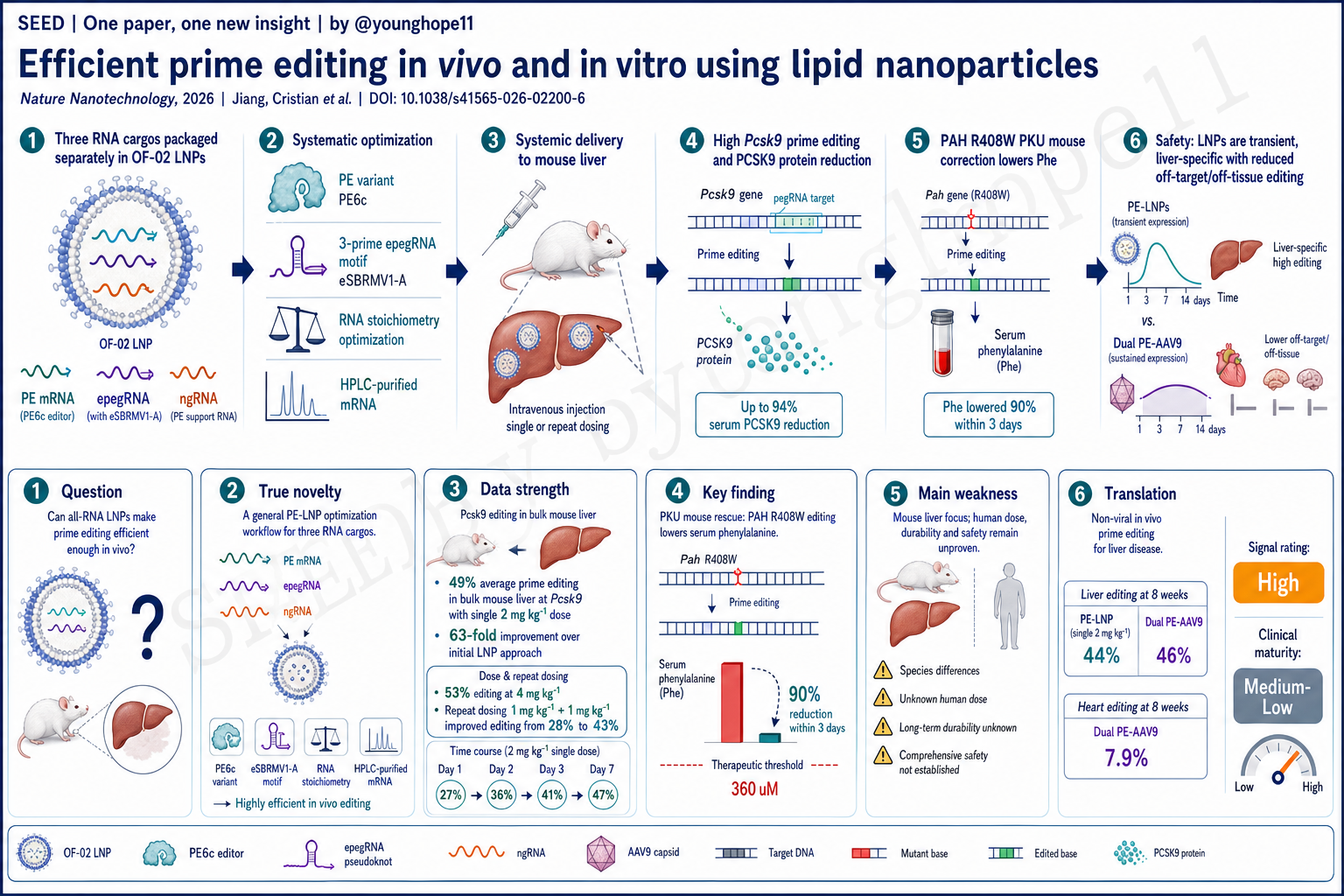
研究问题是什么?
这篇文章问的是体内 prime editing 走向治疗应用时的核心递送问题:能否不用病毒,而用全 RNA lipid nanoparticle 在体内把 prime editor、pegRNA/epegRNA 和 nicking gRNA 三个组分协调送入肝脏,并达到足够高的编辑效率?
Prime editing 的优势是可以在不制造 double-strand break、不依赖 donor DNA 的情况下完成多种精确替换、小插入和小删除。但它比 nuclease editing 或 base editing 更复杂:PE protein 要先由 mRNA 翻译出来,pegRNA 要在细胞内保持足够稳定,ngRNA 要按合适比例配合,所有组分还必须在同一细胞、同一时间窗口内达到有效浓度。
此前 LNP 已经能有效递送 Cas9 或 base editor mRNA,但 PE-LNP 的体内效率普遍偏低。已有路线包括三周 3 mg/kg LNP 给药得到约 8% bulk liver editing,AAV9 表达 epegRNA 加 LNP 递送 PE mRNA 达到约 16%,以及 PE7-LNP 两次 4 mg/kg 给药达到最高约 23%。这些结果证明方向可行,但离简单、非病毒、单剂、高效的体内 prime editing 还有距离。
因此,这篇论文的核心不是发明一个全新的 editor,而是系统拆解 PE-LNP 的限制因素:PE variant、epegRNA 稳定结构、RNA stoichiometry、mRNA 纯度和 LNP cargo 物理性质,最后把这些优化组合成可复用的工作流。
真正的新意是什么?
真正的新意是作者把 PE-LNP 从“经验性配方”推进到“可迭代优化的平台”。
第一步是解决 pegRNA 稳定性。作者用 OF-02 LNP 分别包载 PE mRNA、(e)pegRNA 和 ngRNA,再按比例混合给药。在 Pcsk9 +1 TTAC insertion 这个测试位点,Hepa1-6 细胞中 HM-pegRNA 最高约 31% editing,而 epegRNA 达到 70%;小鼠 bulk liver 中,HM-pegRNA 只有 0.8%,换成 epegRNA 后提高到 3.8%。这说明 LNP 场景下 pegRNA 稳定性是首要瓶颈之一。
第二步是优化 editor。作者比较 PEmax、PE6a、PE6b、PE6c 和 PE6d,发现 PE6c 在 Pcsk9 位点表现最好,2 mg/kg 下 bulk liver editing 达 11%,高于 PEmax 的 2.3%。进一步 ELISA 显示,PE6c 在肝脏中产生的 editor 蛋白量高于 PEmax,提示效率提升不仅来自酶活,也来自 mRNA 翻译和蛋白表达层面。
第三步是优化 epegRNA 3’ motif。相比 tevopreQ1,eSBRMV1-A motif 把 Pcsk9 bulk liver editing 从 17% 提高到 26%,并在早期时间点表现出更好的 epegRNA abundance 和 editing。作者认为,这可能来自 epegRNA 稳定性提升、PE-epegRNA RNP 组装更有效,或 RNA template reverse transcription 构象更有利。
第四步是优化 stoichiometry 和 RNA 纯化。mRNA:gRNA 比例在 2:1 到 1:4 范围内差异不极端,但作者选择 1:2 mRNA:gRNA,等价于最终 1:1.8:0.2 的 mRNA:epegRNA:ngRNA 总 RNA 质量比。更关键的是,使用带优化 UTR 且 HPLC 去除 dsRNA 污染的 GenScript PE6c mRNA 后,s3 PE-LNP 在 2 mg/kg 单剂下 Pcsk9 bulk liver editing 达到 49%,比 in-house mRNA 的 26% 提高 1.9 倍。
这个组合让 PE-LNP 不只是某个位点的偶然成功,而是一套工作流:先选 PE variant,再选 3’ epegRNA motif,再调三组分比例,最后控制 mRNA/epegRNA 纯度。
数据强在哪里?
数据最强在三个层面:Pcsk9 高效编辑、PKU 疾病模型救援、以及与 AAV 的递送安全对照。
在 Pcsk9 位点,优化后的 s3 PE-LNP 在小鼠 bulk liver 达到 49% 平均 prime editing,且是单剂 2 mg/kg。相比最初 HM-pegRNA 路线的 0.8%,这是 63 倍提升;相比 epegRNA 起点的 3.8%,是 13 倍提升。剂量反应也清楚:0.5 到 4 mg/kg 呈剂量依赖,4 mg/kg 达到 53% editing,并带来最高 94% serum PCSK9 降低。
药效动力学也有说服力。2 mg/kg s3 PE-LNP 给药后,bulk liver editing 在第 1 天已达 27%,第 2 天 36%,第 3 天 41%,第 7 天 47%;serum PCSK9 也在第 1、2、3 天分别下降 56%、71%、76%,第 7 天达 90%。这说明 RNA-LNP 的优势不是长期表达,而是快速、短暂地产生足够编辑窗口。
重复给药是另一个亮点。单次 1 mg/kg s3 PE-LNP 的 Pcsk9 editing 为 28%,两次 1 mg/kg、间隔 7 天后提高到 43%;加 dexamethasone 预处理从 31% 提高到 45%,但 DEX 并非必要。对应的 PCSK9 降低也从约 70% 进一步提高到 83-84%。这与 AAV 难以重复给药形成清楚对比。
疾病模型验证更重要。作者把工作流转到 PAH c.1222C>T, p.R408W 这个常见 PKU 致病变异,在带 humanized Pah R408W 的小鼠中单剂 4 mg/kg 给药。s2 PE-LNP 在 bulk liver genomic DNA 中实现 15% correction,cDNA 中达到 23%;s3 PE-LNP 分别为 12% 和 19%。血清 phenylalanine 方面,s2 PE-LNP 在 3 天内降低 90%,第 7 天时除低效 s0.2 外,各 PE-LNP 组 Phe 都降到 360 µM 治疗干预阈值以下。
安全和特异性数据也支撑平台价值。s3 PE-LNP 在 liver 达到 49% Pcsk9 editing,非肝组织未观察到编辑;血液和 liver non-parenchymal cells 中也没有 Pcsk9 editing,提示 OF-02 PE-LNP 主要作用于 hepatocytes。ALT 在 2 mg/kg 给药后第 1 天轻度、短暂升高,第 3 天回到接近 untreated control;PKU 小鼠中第 3 天 ALT/AST 没有比 day 0 增加。
与 dual PE-AAV9 的对照很关键。8 周后,2 mg/kg PE-LNP 和 1e12 vg dual PE-AAV9 在 liver 的 Pcsk9 editing 分别为 44% 和 46%,总体相当;但 dual PE-AAV9 在 heart 也产生 7.9% editing,而 PE-LNP 显示更肝脏特异。14 个 CIRCLE-seq 候选 off-target 位点中,两个系统都只在 OT13 观察到 above-background off-target,但 dual PE-AAV9 在 OT13 的频率显著高于 PE-LNP。这直接支持瞬时 RNA-LNP 表达可以降低 off-target / off-tissue 风险。
最大弱点是什么?
最大弱点是模型和组织范围仍然很窄。文章证明的是小鼠肝脏中的 PE-LNP,而不是人体、多组织或非肝靶向的普适 prime editing 平台。LNP 天然偏向肝脏,这既是优势也是边界;要扩展到 CNS、肌肉、肺、免疫细胞或 HSC,还需要完全不同的 LNP chemistry、tropism 和安全验证。
第二个弱点是 PKU rescue 仍是短期小鼠数据。Phe 在 3-7 天内快速下降非常有力,但这不能替代长期疗效、耐久性、肝细胞 turnover、饮食条件下 Phe 控制、发育期治疗窗口和长期肝毒性评估。临床上 PKU 是终身代谢病,单剂体内编辑是否能稳定维持足够 PAH activity,还需要更长随访。
第三个弱点是剂量和转化窗口仍待证明。Pcsk9 benchmark 在 2 mg/kg 已很强,但 PKU R408W correction 用到 4 mg/kg。小鼠 LNP 剂量、肝脏体积、免疫反应、体重 scaling 和人体可耐受 RNA/LNP burden 不能简单换算。尤其 PE 系统需要大 mRNA 加两条 gRNA,cargo complexity 比 base editor-LNP 更高。
第四个弱点是“低 off-target”还不是 genome-wide 安全闭环。文章在已知 HEK4 off-target 和 Pcsk9 CIRCLE-seq 候选位点做了 targeted amplicon sequencing,显示 PE-LNP 优于 plasmid 和 dual AAV。这是强信号,但临床级安全仍需要 unbiased genome-wide off-target、large deletion、chromosomal rearrangement、RNA innate immune activation、repeat-dose immunogenicity 和 biodistribution 的更系统评估。
第五个弱点是优化流程依赖 cargo manufacturing quality。HPLC-purified mRNA 和 epegRNA 对效率影响很大,这对转化是好事也是难点:真实药物开发不仅要设计 guide,还要稳定控制 RNA purity、truncated epegRNA、dsRNA contamination、LNP batch consistency 和三组分 admixing。
是否有临床转化意义?
有,尤其对肝脏遗传病和个体化体内编辑非常有意义。
第一,它说明 PE-LNP 可以接近甚至达到 AAV prime editing 的肝脏效率,同时保留 LNP 的短暂表达和可重复给药优势。对体内 gene editing 来说,这非常关键:如果不需要 AAV,就可以避免包装容量限制、长期 editor 表达、AAV 免疫屏障和部分整合风险。
第二,它扩大了 LNP gene editing 的可治疗突变范围。Base editing 对 transition mutation 很强,但 prime editing 可以覆盖更多替换、小插入和小删除。PKU R408W 是一个很好的例子:不是所有患者都适合同一种 base editor,而 PE-LNP 理论上更适合做 mutation-specific 或 personalized liver editing。
第三,它提供了一套开发路线,而不仅是一个配方。对任何新靶点,作者建议按 PE variant、epegRNA motif、stoichiometry 和 RNA purity 逐步优化。这种 workflow 对未来公司或实验室开发 liver PE-LNP 产品很实用,因为不同 prime edit 的 pegRNA、PBS/RTT、局部序列和细胞内 kinetics 会强烈影响效率。
第四,它与最近 human base editing LNP 治疗案例构成连续谱:LNP 递送编辑器已经开始进入临床,而 prime editing 是下一层复杂度。这篇论文把 PE-LNP 从低效 proof-of-concept 推近到可治疗小鼠疾病的水平,说明体内 PE-LNP 不再只是概念。
但临床上还不能直接跳到人体。真正进入临床前,需要回答 human hepatocyte editing、large animal dose scaling、repeat-dose tolerability、manufacturing reproducibility、guide-specific off-target、long-term durability、Phe control under diet challenge,以及是否能为不同 PAH variants 快速定制并监管放行。
Yang 的信号评级:High
理由:我会把这篇论文的科研和平台信号评为 High。它解决的是 prime editing 体内应用中一个真实瓶颈:三组分 RNA cargo 的 LNP 递送效率。49% Pcsk9 bulk liver editing、63 倍优化提升、PKU R408W 小鼠 Phe 90% 快速下降、以及与 dual PE-AAV9 相近 liver editing 但更低 off-tissue/off-target 的对照,让这篇文章明显超过普通递送优化论文。
这个 High 是“平台信号 High”,不是“临床就绪 High”。它证明了全 RNA PE-LNP 可以在小鼠肝脏达到治疗相关效率,也证明优化路线可复用;但它还没有证明人体可用剂量、长期安全和多突变个体化生产。
临床成熟度我会评为 Medium-Low。它已经接近 liver-directed in vivo editing translational pipeline 的前沿,但仍停留在 mouse disease model。下一步最重要的是在 human hepatocyte models、humanized liver mice 或 large animals 中验证 dose-response、durability、immune response 和 unbiased safety,同时测试更多 PAH 或肝脏遗传病变异,判断这套 workflow 是否真的能支撑可扩展的个体化 prime editing 药物开发。
Allen Y. Jiang, Ana Cristian and the team of David R. Liu and Kiran Musunuru at the Broad Institute, Harvard University, MIT, the University of Pennsylvania and HHMI recently reported an all-RNA PE-LNP platform built through systematic optimization of prime editor mRNA, epegRNA 3’ motifs, three-component RNA-LNP stoichiometry and RNA purification. The platform enables efficient, transient and non-viral prime editing in mouse liver and lowers serum phenylalanine to therapeutically relevant levels in a PAH R408W PKU mouse model, providing a new delivery framework for in vivo prime editing of liver genetic diseases.
What is the research question?
This paper asks a central delivery question for therapeutic in vivo prime editing: can an all-RNA lipid nanoparticle system deliver prime editor, pegRNA/epegRNA and nicking gRNA into the liver in a coordinated way and reach high enough editing efficiency without using viral vectors?
Prime editing can install precise substitutions, small insertions and small deletions without double-strand breaks or donor DNA. But it is more complex than nuclease editing or base editing. The PE protein must be translated from mRNA, the pegRNA must remain stable long enough, the ngRNA must be present at the right level, and all components must coexist in the same cell within a short effective window.
LNPs have already delivered Cas9 and base editor mRNA efficiently in vivo, but PE-LNP efficiency has remained limited. Prior approaches included about 8% bulk liver editing after three weekly 3 mg/kg LNP doses, about 16% liver editing using AAV9-expressed epegRNA plus LNP-delivered PE mRNA, and up to about 23% liver editing with PE7-LNPs after two 4 mg/kg doses. These studies made the direction plausible, but not yet simple, non-viral, single-dose and high-efficiency.
The central contribution of this paper is therefore not a new editor alone. It is a systematic dissection of PE-LNP bottlenecks: PE variant, epegRNA stabilizing motif, RNA stoichiometry, mRNA purity and the physical properties of different RNA-LNP cargos.
What is truly new?
The real novelty is that the authors move PE-LNPs from an empirical formulation problem toward an iterative optimization platform.
The first step is pegRNA stability. The authors formulate PE mRNA, (e)pegRNA and ngRNA separately into OF-02 LNPs and admix them before treatment. At the Pcsk9 +1 TTAC insertion test site, HM-pegRNA gives up to 31% editing in Hepa1-6 cells, whereas epegRNA reaches 70%. In mouse bulk liver, HM-pegRNA gives only 0.8%, while epegRNA increases editing to 3.8%. This identifies pegRNA stability as an early limiting factor in the LNP setting.
The second step is editor optimization. Comparing PEmax, PE6a, PE6b, PE6c and PE6d, the authors find that PE6c performs best at Pcsk9, reaching 11% bulk liver editing at 2 mg/kg compared with 2.3% for PEmax. ELISA further shows higher PE6c editor protein levels in liver than PEmax, suggesting that the gain reflects both enzyme performance and mRNA translation or protein production.
The third step is the epegRNA 3’ motif. Compared with tevopreQ1, the eSBRMV1-A motif improves Pcsk9 bulk liver editing from 17% to 26% and shows better early epegRNA abundance and editing. The authors suggest that this may reflect improved epegRNA stability, more efficient PE-epegRNA RNP assembly or more favorable conformations for reverse transcription.
The fourth step is stoichiometry and RNA purity. Within the tested range, mRNA:gRNA ratios from 2:1 to 1:4 do not create extreme differences, but the authors select 1:2 mRNA:gRNA, corresponding to a final 1:1.8:0.2 mRNA:epegRNA:ngRNA total RNA mass ratio. The more decisive improvement comes from GenScript PE6c mRNA with optimized UTRs and HPLC removal of dsRNA contaminants. With this mRNA, s3 PE-LNPs reach 49% average Pcsk9 bulk liver editing after a single 2 mg/kg dose, compared with 26% using in-house mRNA.
Together, this makes the work more than a one-site success. It becomes a workflow: select the PE variant, choose the 3’ epegRNA motif, tune the three-component ratio and control mRNA/epegRNA purity.
Where is the data strongest?
The data are strongest across three layers: high-efficiency Pcsk9 editing, PKU disease-model rescue and delivery-specific safety comparisons with AAV.
At Pcsk9, optimized s3 PE-LNPs reach 49% average prime editing in mouse bulk liver after a single 2 mg/kg dose. Compared with the initial HM-pegRNA route at 0.8%, this is a 63-fold improvement; compared with the epegRNA starting point at 3.8%, it is a 13-fold improvement. Dose response is clear: 0.5 to 4 mg/kg gives dose-dependent editing, with 4 mg/kg reaching 53% editing and up to 94% serum PCSK9 reduction.
The pharmacodynamics are also compelling. After 2 mg/kg s3 PE-LNP dosing, bulk liver editing reaches 27% at day 1, 36% at day 2, 41% at day 3 and 47% at day 7. Serum PCSK9 falls by 56%, 71% and 76% at days 1, 2 and 3, reaching 90% reduction at day 7. The advantage of RNA-LNP delivery is not prolonged expression; it is rapid transient production of enough editor to create an editing window.
Repeat dosing is another important result. A single 1 mg/kg s3 PE-LNP dose gives 28% Pcsk9 editing, while two 1 mg/kg doses 7 days apart improve editing to 43%. With dexamethasone pretreatment, editing goes from 31% after one dose to 45% after two doses, although DEX is not required. Serum PCSK9 reduction follows the same pattern, improving from roughly 70% after one dose to 83-84% after two doses. This contrasts with the redosing limitations of AAV.
The disease-model validation is more important than the reporter benchmark. The authors move the workflow to PAH c.1222C>T, p.R408W, a common PKU-causing variant, and treat humanized Pah R408W mice with a single 4 mg/kg dose. s2 PE-LNPs achieve 15% correction in bulk liver genomic DNA and 23% correction in cDNA; s3 PE-LNPs achieve 12% and 19%, respectively. Serum phenylalanine falls by 90% within 3 days with s2 PE-LNPs, and by day 7 all PE-LNP groups except the low-performing s0.2 group fall below the 360 uM therapeutic intervention threshold.
The safety and specificity data also support the platform. s3 PE-LNPs produce 49% Pcsk9 editing in liver and no observed editing in non-hepatic tissues. Whole blood and liver non-parenchymal cells also show no Pcsk9 editing, suggesting that OF-02 PE-LNP editing is largely restricted to hepatocytes. ALT rises mildly and transiently at day 1 after 2 mg/kg dosing and returns near untreated-control levels by day 3; in PKU mice, ALT and AST do not increase at day 3 compared with day 0.
The comparison with dual PE-AAV9 is especially informative. At 8 weeks, 2 mg/kg PE-LNPs and 1e12 vg dual PE-AAV9 produce similar liver Pcsk9 editing, 44% and 46%, respectively. But dual PE-AAV9 also produces 7.9% Pcsk9 editing in the heart, while PE-LNPs remain more liver-specific. Across 14 CIRCLE-seq-nominated candidate off-target sites, both systems show above-background off-target editing only at OT13, but dual PE-AAV9 is significantly higher than PE-LNP at that site. This directly supports the idea that transient RNA-LNP expression can reduce off-target and off-tissue risk.
What is the biggest weakness?
The biggest weakness is that the model and tissue scope remain narrow. The paper demonstrates PE-LNPs in mouse liver, not a general in vivo prime editing platform for humans, multiple organs or non-hepatic targets. LNP liver tropism is both the strength and the boundary. Extending this to CNS, muscle, lung, immune cells or HSCs will require different LNP chemistry, tropism and safety validation.
A second limitation is that PKU rescue is still short-term mouse data. The rapid Phe drop over 3-7 days is powerful, but it does not replace long-term efficacy, durability, hepatocyte turnover, dietary Phe challenge, developmental treatment-window studies or chronic liver safety. PKU is a lifelong metabolic disease, and it remains to be shown whether one in vivo editing dose can sustain enough PAH activity over time.
A third limitation is dose translation. The Pcsk9 benchmark is strong at 2 mg/kg, but the PKU R408W correction uses 4 mg/kg. Mouse LNP dose, liver size, immune response, body-weight scaling and tolerable human RNA/LNP burden do not translate simply. The PE system also requires a large mRNA plus two guide RNAs, making the cargo more complex than many base editor-LNP programs.
A fourth limitation is that low off-target signal is not yet a genome-wide safety package. The authors perform targeted amplicon sequencing at known HEK4 off-target sites and Pcsk9 CIRCLE-seq candidates, showing PE-LNP advantages over plasmid and dual AAV delivery. That is a strong signal, but clinical-grade safety will still require unbiased genome-wide off-target analysis, large deletion and chromosomal rearrangement assessment, RNA innate immune activation profiling, repeat-dose immunogenicity and broader biodistribution studies.
A fifth limitation is that the workflow depends strongly on cargo manufacturing quality. HPLC-purified mRNA and epegRNA substantially affect performance. That is good for translation because it identifies controllable variables, but it also raises the bar: a real product must control RNA purity, truncated epegRNA, dsRNA contamination, LNP batch consistency and three-component admixing.
Is there translational or clinical relevance?
Yes, especially for liver genetic diseases and personalized in vivo editing.
First, the paper shows that PE-LNPs can approach AAV prime editing efficiency in liver while preserving the advantages of transient expression and redosing. For in vivo gene editing, that matters. Avoiding AAV can reduce packaging constraints, prolonged editor expression, AAV immune barriers and some integration-related concerns.
Second, it expands the treatable mutation space for LNP gene editing. Base editing is powerful for transition mutations, but prime editing can address a broader range of substitutions, small insertions and small deletions. PKU R408W is a strong example: not every patient variant will fit one base editor, whereas PE-LNPs are conceptually better suited for mutation-specific or personalized liver editing.
Third, it offers a development workflow rather than only a formulation. For each new target, the authors recommend optimizing PE variant, epegRNA motif, stoichiometry and RNA purity. That is practically useful for future companies and laboratories because pegRNA design, PBS/RTT sequence, local sequence context and intracellular kinetics can strongly affect prime editing efficiency.
Fourth, it fits into the broader trajectory of human LNP editing. Base editor-LNPs have already begun entering the clinic, and prime editing is the next level of complexity. This paper moves PE-LNPs from low-efficiency proof of concept toward disease-rescue-level editing in mice, making in vivo PE-LNP therapy more plausible.
But the work should not be read as human-ready. Before clinical translation, the field needs human hepatocyte editing data, large-animal dose scaling, repeat-dose tolerability, manufacturing reproducibility, guide-specific off-target profiling, long-term durability, Phe control under dietary challenge, and evidence that different PAH or liver-disease variants can be rapidly customized and regulated.
Yang’s signal rating: High
Reason: I would rate the scientific and platform signal of this paper as High. It addresses a real bottleneck in therapeutic in vivo prime editing: efficient LNP delivery of three RNA cargos. The combination of 49% Pcsk9 bulk liver editing, a 63-fold optimization gain, rapid 90% serum Phe reduction in PKU R408W mice, and a head-to-head comparison showing liver editing comparable to dual PE-AAV9 but with lower off-tissue and off-target signal makes this more than an incremental delivery paper.
This High means platform signal High, not clinical readiness High. The work shows that all-RNA PE-LNPs can reach therapeutically relevant editing levels in mouse liver and that the optimization workflow is reusable. It does not yet prove human dose feasibility, long-term safety or scalable personalized manufacturing.
I would rate clinical maturity as Medium-Low. The platform is close to the leading edge of liver-directed in vivo editing, but it remains a mouse disease-model study. The next decisive step is to validate dose-response, durability, immune response and unbiased safety in human hepatocyte models, humanized liver mice or large animals, while testing additional PAH and liver-disease variants to determine whether this workflow can truly support scalable personalized prime editing drug development.