SEED | Conditioning 可能从大面积杀伤走向 CD45 定向照射 SEED | Conditioning may move from broad injury to CD45-directed irradiation AI-assisted · reviewed
Fred Hutchinson Cancer Center 的 Stefan Radtke、George S. Laszlo、Hans-Peter Kiem 与 Roland B. Walter 团队近期报道,humanized CD45 antibody HuBC8 搭载 alpha emitter astatine-211 可作为自体 HSPC 基因治疗前 conditioning,在 4 只非人灵长类中支持 multiplex-edited autologous HSPC 的快速血液恢复、长期多谱系植入和高频单细胞编辑读出。
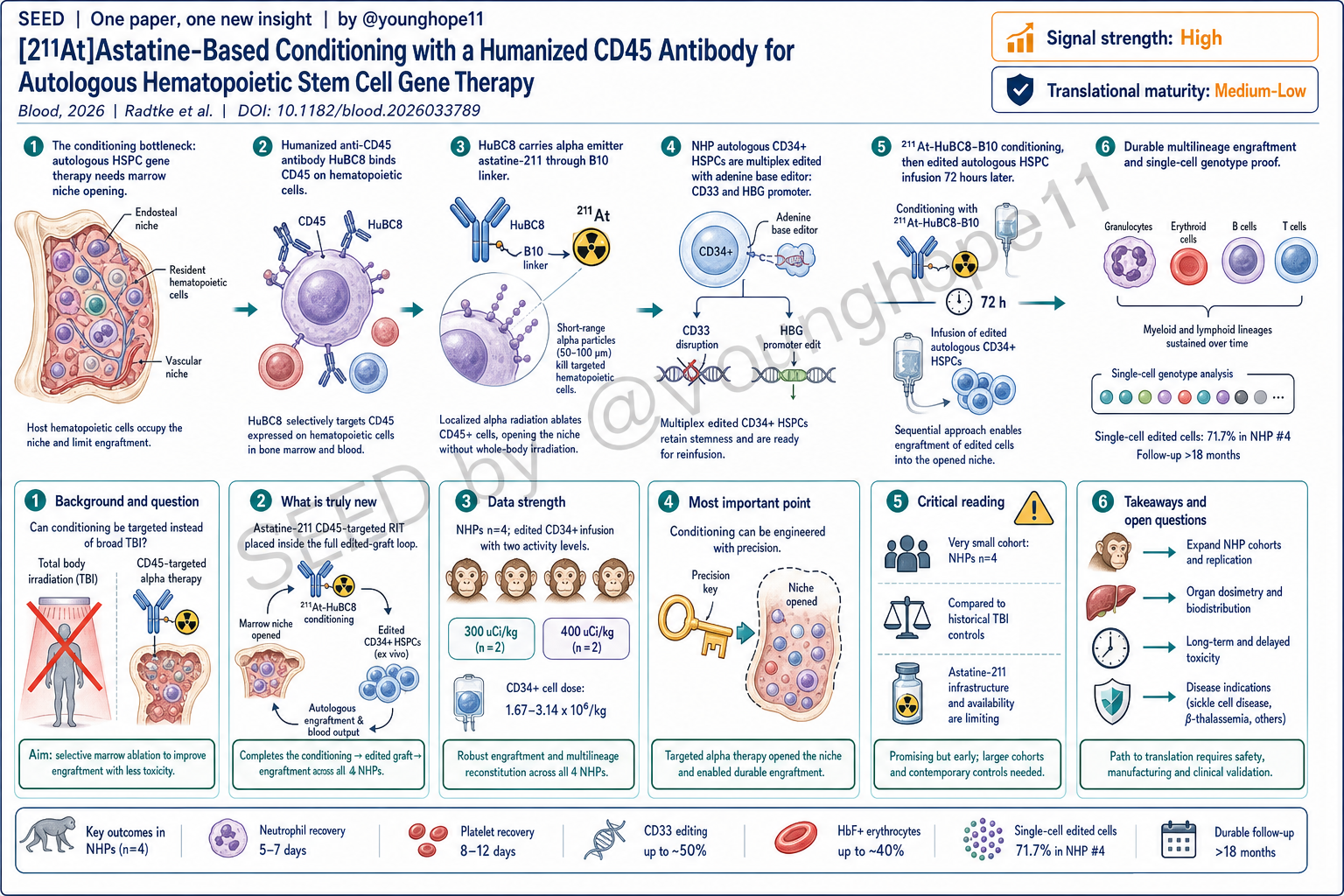
自体 HSPC gene therapy 的隐形门槛是 conditioning
很多 HSPC gene therapy 讨论聚焦在编辑本身,但能否让 edited HSPC 真正替换骨髓 stem cell compartment,往往取决于 conditioning。传统 myeloablative conditioning 或 total body irradiation 可以打开生态位,却带来非造血组织毒性、输血需求和长期安全负担。
这篇论文的问题是:能否用 CD45-directed radioimmunotherapy 把辐射更集中地送到造血系统,从而在大动物自体基因治疗模型中替代高剂量 TBI,并支持 edited HSPC 的长期植入。
新意在于把 211At-CD45 RIT 放进基因编辑自体移植闭环
作者先 humanize 了 BC8 anti-CD45 antibody,形成 HuBC8,并用 B10 linker 标记 astatine-211。作为模型,NHP 自体 CD34+ HSPC 经 adenine base editor multiplex editing:一条编辑 CD33,另一条编辑 HBG promoter 以 reactivating HbF。随后动物接受 211At-HuBC8-B10 conditioning,再回输编辑后的自体 HSPC。
设计上最关键的是它不是单独证明抗体能靶向 CD45,也不是单独证明 HSPC 能编辑,而是把 targeted conditioning、edited graft、血液恢复、长期多谱系贡献和单细胞基因型读出连在一起。
数据强在 NHP、长期随访和单细胞植入证明
研究纳入 4 只 NHP。2 只接受 300 uCi/kg 211At,2 只接受 400 uCi/kg 211At;72 小时后回输 cryopreserved gene-modified CD34+ HSPC。输注细胞量为 1.67-3.14 x 10^6 CD34+ cells/kg,其中 53-74% 表达 CD90。
移植物本身的编辑质量较高:冷冻保存后的 multiplex-edited CD34+ cells 在 CD33 位点有 50-75% allelic editing,在 HBG1/2 位点有 15-56% editing。conditioning 后,中性粒细胞恢复到 >500/uL 需 5-7 天,血小板恢复到 >50K/uL 需 8-12 天;肝功能未受影响,动物几乎不依赖输血,非造血组织毒性没有明显信号。
植入读出是这篇的强项。400 uCi/kg 组 blood granulocytes CD33 表达最多降低 50%,bulk WBC 看到 CD33/SIGLEC22P 位点最高约 50% allelic editing;HbF+ erythrocytes 最高约 40%,高于历史 TBI 对照的 10-20%。新建立的单细胞测序显示,NHP #4 中至少一个 captured allele 被编辑的总细胞频率达到 71.7%,接近 infusion product,提示 bone marrow stem cell compartment 近乎完全替换。
最重要的一点:conditioning 也可以被工程化
这篇论文最重要的信息是,conditioning 不一定只能是化疗或 TBI 这种系统性损伤工具。CD45 是造血系统高表达靶点,用 alpha emitter 把短程、高能量辐射集中到造血细胞,理论上可以更精准地清空生态位。
如果这条路线成立,它对 HSC gene therapy 的意义很大:编辑效率提高只解决 graft quality,定向 conditioning 才解决 edited graft 能否成为长期造血主体。该研究用单细胞基因型和谱系信息证明 edited HSPC 不是短暂出现,而是长期、多谱系参与造血。
批判性阅读:样本量非常小,历史对照不能替代随机比较
局限首先是 N=4。剂量探索和安全性信号很有价值,但无法对毒性、植入优势或与 TBI 的优越性做严格统计判断。论文多处与 historical TBI controls 比较,这适合早期大动物研究,但不能当作直接头对头证据。
第二,NHP 序列与人类差异限制了 off-target editing 分析,作者也说明没有做相关 off-target analysis。第三,211At 的生产、运输、放射药物基础设施和临床可及性仍是实际转化门槛。第四,模型使用 CD33/HBG multiplex editing 作为 readout,并不等同于已证明某个具体人类疾病适应症的治疗获益。
对基因治疗平台的启发
后续最重要的是扩大 NHP 数量、延长随访、系统评估器官剂量学和迟发毒性,并在更接近临床适应症的 edited graft 中验证。临床上还需要回答:哪些 HSPC gene therapy 最适合用 211At-CD45 RIT,剂量窗口多宽,是否能减少不孕、黏膜损伤、感染和输血负担。
方法学上,这篇文章还强调单细胞 genotype plus phenotype readout 的价值。bulk sequencing 会低估真正被替换的细胞比例,而 conditioning 的成败需要在 stem/progenitor compartment 和成熟谱系中同时证明。
Yang 的信号评级:High
轴一,信号强度:High。理由:NHP 大动物模型、targeted conditioning、快速恢复、>18 个月稳定、单细胞多谱系 edited HSPC 贡献形成了很强的平台级信号。
轴二,转化成熟度:Medium-Low。理由:仍是 4 只 NHP 的早期研究,依赖历史对照,211At 基础设施、长期安全和具体适应症选择仍未解决。
一句话总结:这篇论文把 HSPC gene therapy 的瓶颈从“怎么编辑细胞”推进到“怎么精准打开骨髓生态位”。
Stefan Radtke, George S. Laszlo, Hans-Peter Kiem, and Roland B. Walter at Fred Hutchinson Cancer Center recently reported that a humanized CD45 antibody, HuBC8, labeled with the alpha emitter astatine-211 can condition nonhuman primates for autologous HSPC gene therapy, enabling rapid hematologic recovery, durable multilineage engraftment, and high-frequency single-cell editing readouts after infusion of multiplex-edited autologous HSPCs.
The hidden barrier in autologous HSPC gene therapy is conditioning
Many HSPC gene therapy discussions focus on editing itself, but durable replacement of the marrow stem cell compartment depends on conditioning. Conventional myeloablative conditioning and total body irradiation can open niches, but they carry non-hematologic toxicity, transfusion needs, and long-term safety costs.
This paper asks whether CD45-directed radioimmunotherapy can concentrate radiation within the hematopoietic system and replace high-dose TBI in a large-animal autologous gene therapy model.
The novelty is putting 211At-CD45 RIT into the full edited-graft loop
The authors humanized the BC8 anti-CD45 antibody, generated HuBC8, and labeled it with astatine-211 through a B10 linker. As a model, autologous NHP CD34+ HSPCs were multiplex edited with an adenine base editor: one guide targeted CD33, and another modified the HBG promoter to reactivate fetal hemoglobin. The animals then received 211At-HuBC8-B10 conditioning before edited autologous HSPC infusion.
The key design feature is that this is not only an antibody-targeting study and not only an HSPC editing study. It connects targeted conditioning, edited graft quality, blood recovery, long-term multilineage contribution, and single-cell genotype readouts.
The strongest data are NHP engraftment and single-cell proof
The study enrolled four NHPs. Two received 300 uCi/kg and two received 400 uCi/kg of 211At. Cryopreserved gene-modified CD34+ HSPCs were infused 72 hours later. The infused dose ranged from 1.67 to 3.14 x 10^6 CD34+ cells/kg, with 53-74% of cells expressing CD90.
The edited graft quality was substantial: cryopreserved multiplex-edited CD34+ cells showed 50-75% allelic editing at CD33 and 15-56% editing at HBG1/2. After conditioning, neutrophils recovered to >500/uL within 5-7 days and platelets to >50K/uL within 8-12 days. Liver function was not affected, transfusion needs were minimal, and there was no clear non-hematopoietic toxicity signal.
The engraftment readout is the strongest part. In the 400 uCi/kg group, CD33 expression on blood granulocytes fell by up to 50%, and bulk WBC sequencing showed up to about 50% allelic editing at CD33/SIGLEC22P. HbF+ erythrocytes reached up to about 40%, compared with 10-20% in historical TBI-conditioned controls. A new single-cell sequencing assay showed that in NHP #4, 71.7% of cells carried at least one edit among the captured alleles, close to the infusion product and consistent with near-complete replacement of the marrow stem cell compartment.
The important point: conditioning can also be engineered
The major message is that conditioning does not have to remain a blunt chemotherapy or TBI tool. CD45 is highly expressed in hematopoietic cells, and an alpha emitter can deliver short-range, high-energy radiation more directly to that compartment.
If this approach translates, the implication for HSPC gene therapy is large. Editing efficiency solves graft quality; targeted conditioning solves whether that graft can become the durable source of hematopoiesis. This study uses single-cell genotype and lineage information to show that edited HSPCs were not transient passengers, but durable multilineage contributors.
Critical reading: very small cohort and historical comparators
The first limitation is sample size: N=4. The dose exploration and safety signals are valuable, but they cannot establish rigorous superiority over TBI or define rare toxicity risk. Much of the comparison relies on historical TBI controls, which is appropriate for early NHP work but not equivalent to a direct head-to-head study.
Second, sequence differences between NHP and human genomes limited off-target editing analysis, and the authors did not perform it. Third, astatine-211 production, delivery, radiopharmacy infrastructure, and access remain real translational bottlenecks. Fourth, CD33/HBG multiplex editing is a useful model readout, but it does not prove therapeutic benefit for a specific human disease indication.
What this should trigger next
The next work should expand NHP numbers, extend follow-up, quantify organ dosimetry and delayed toxicity, and test clinically relevant edited grafts. Clinically, the field needs to know which HSPC gene therapies are best matched to 211At-CD45 RIT, how wide the dose window is, and whether it can reduce infertility, mucosal injury, infection, and transfusion burden.
Methodologically, the study also makes a case for single-cell genotype plus phenotype readouts. Bulk sequencing can underestimate the true fraction of replaced cells, and successful conditioning must be demonstrated in both the stem/progenitor compartment and mature lineages.
Yang’s signal rating: High
Signal strength: High. NHP data, targeted conditioning, rapid recovery, stability beyond 18 months, and single-cell multilineage edited-HSPC contribution create a strong platform-level signal.
Translational maturity: Medium-Low. The work remains an early four-animal NHP study with historical comparators, and astatine-211 infrastructure, long-term safety, and indication selection remain unresolved.
One-sentence summary: This paper shifts the HSPC gene therapy bottleneck from “how do we edit cells?” to “how do we precisely open marrow niches?”