SEED | CAR-T 制造的细胞因子旋钮 SEED | The cytokine knobs in CAR-T manufacturing AI-assisted · reviewed
LMU Munich 等机构的 Mar Guaza-Lasheras、Johanna Nimmerfroh、Dominic Schwarz 与通讯作者 Sebastian Kobold 团队近期在 Nature Biomedical Engineering 发表 Perspective,系统梳理了 CAR-T 制造中 cytokines 的临床使用、预临床替代方案和下一代工程策略,提出 cytokines 正从培养基里的扩增因子,变成定义 CAR-T 产品质量、体内扩增和安全控制的工程变量。
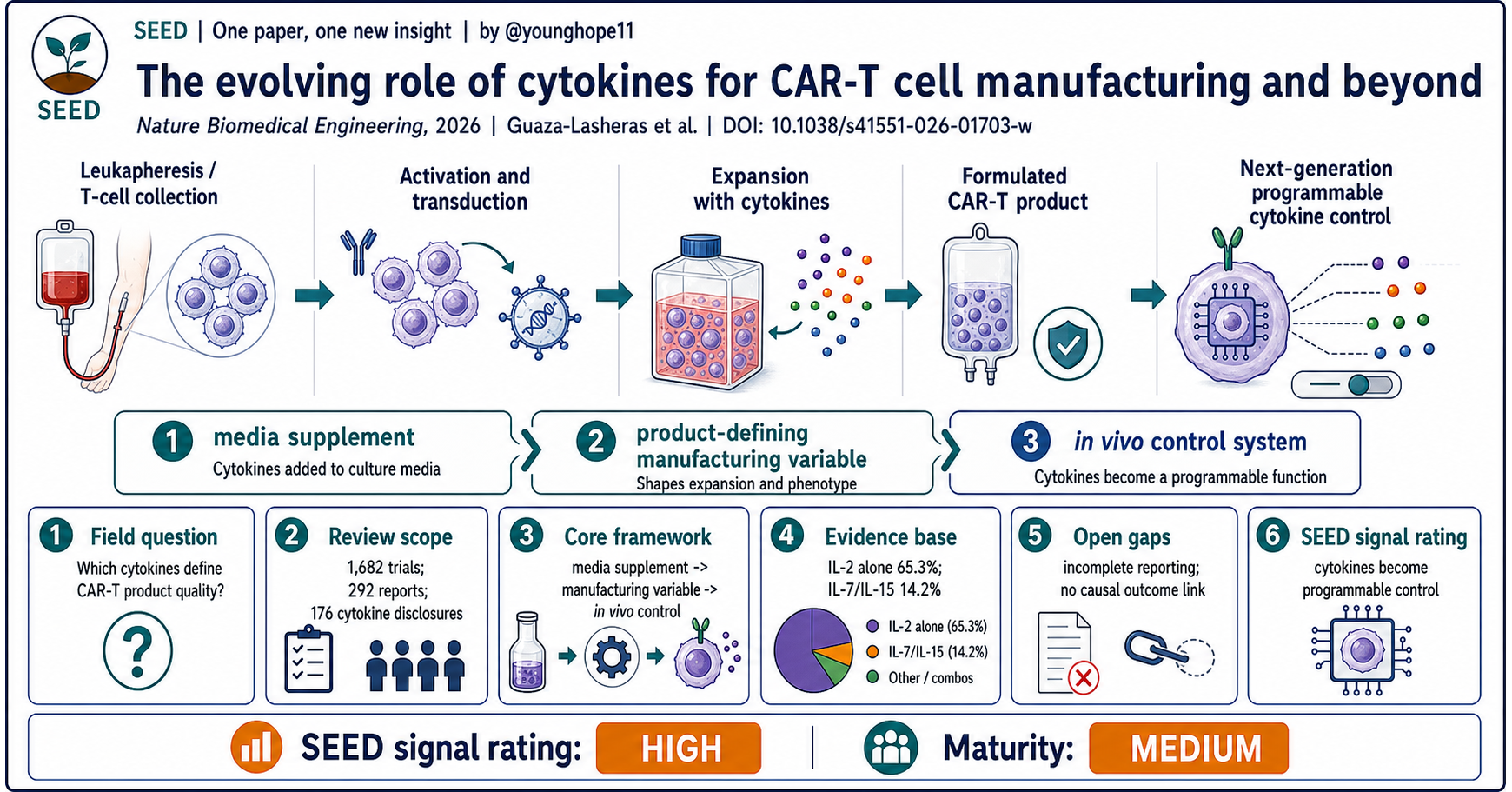
CAR-T 的 cytokine 问题,不只是扩增细胞
CAR-T 是一种活细胞药物。它不是一个化学分子,也不是一个固定结构的抗体,而是一群被采集、激活、转导、扩增、回输的 T cells。也因此,制造过程本身会塑造最终产品:细胞是更像早期记忆 T cell,还是更像终末分化效应 T cell;是更容易在体内持续,还是更容易耗竭;是更适合血液肿瘤,还是更有机会进入实体瘤或自身免疫疾病。
这篇 Perspective 问的是一个被临床转化长期低估的问题:CAR-T 制造里加的 cytokines,到底只是让细胞长得更多,还是在定义产品本身?
传统上,IL-2、IL-7、IL-15、IL-21 这类 cytokines 很容易被当作培养基配方的一部分。可是对 CAR-T 来说,cytokines 会影响 T-cell activation、memory phenotype、metabolic state、exhaustion、persistence 和 toxicity risk。也就是说,它们不只是“营养补充”,而是制造过程里的生物学旋钮。
Sebastian Kobold 团队的核心判断是:CAR-T 领域已经进入一个阶段,cytokines 必须从辅助试剂上升为 product-defining manufacturing variable。未来更进一步,它们还会变成 CAR-T 细胞自身携带的 payload、switch receptor 或 orthogonal control system,用来调控体内扩增、肿瘤微环境和安全性。
框架是三层:培养基、制造过程和体内控制
这篇文章不是一项新的临床试验,而是一篇 Perspective。它的价值不在于给出一个“哪种 cytokine 最好”的简单答案,而在于把分散在制造、临床报告和工程免疫学里的证据重新组织成一个三层框架。
第一层是最传统的角色:cytokines 作为 ex vivo culture supplement。CAR-T 制造需要激活和扩增 T cells,IL-2 长期是默认选择,因为它能强力推动 T-cell proliferation。但 IL-2 的问题也很清楚:剂量和暴露时间过高时,可能推动终末分化、activation-induced cell death 和 exhaustion,并削弱早期记忆样细胞比例。
第二层是产品定义变量。IL-7、IL-15、IL-21 等 cytokines 被越来越多地用于维持 central memory、stem-like memory 或更好的 metabolic fitness。不同 cytokine 组合不只是改变产量,也可能改变最终 CAR-T 产品的 phenotype 和 persistence。这意味着制造流程里的 cytokine 选择,应当像 costimulatory domain、vector、activation method 一样被严肃报告和比较。
第三层是下一代工程控制。CAR-T 可以被设计成分泌 cytokines、表达 membrane-bound cytokines、携带 inducible cytokine payload、使用 switch receptors,或依赖 orthogonal cytokine-receptor systems。这时 cytokines 不再只是制造阶段的外源添加物,而是 CAR-T 功能的一部分。
为了把这个框架放回真实临床语境,作者还系统梳理了 ClinicalTrials.gov 和 PubMed 中 CAR-modified cell therapy 的制造信息。截至 2024 年 12 月 15 日,ClinicalTrials.gov 上有 1,682 项 CAR-T 相关临床研究;作者从公开文献中筛出 292 篇独立临床报告进行 metadata extraction,其中 176 篇披露了制造过程使用的具体 cytokines。
证据链强在临床制造地图和预临床工程逻辑
这篇 Perspective 的强数据,不是来自一个随机对照试验,而是来自两类证据的拼接:一类是临床 CAR-T 制造参数地图,另一类是 cytokine biology 和工程策略的机制证据。
临床制造地图首先揭示了一个事实:CAR-T 制造细节仍然披露不足。292 篇临床报告只覆盖了全部注册 CAR-T 试验的大约 17%,其中只有 176 篇明确说明制造时使用了哪些 cytokines。即便如此,这仍然是一个很有价值的窗口,因为它显示了真实临床转化中 cytokine 使用的主流格局。
在这 176 篇披露 cytokines 的报告中,IL-2 alone 仍然占 65.3%,是最常见方案;IL-7/IL-15 占 14.2%;IL-2/IL-7/IL-15 占 10.2%;IL-2/IL-15 占 5.7%。更少数报告使用 IL-7/IL-15/IL-21、IL-15 alone 或 IL-2/IL-21。换句话说,领域已经意识到 IL-2 之外的组合很重要,但临床制造主流仍然高度依赖 IL-2。
另一个重要趋势是 IL-2 暴露正在下降。作者看到,临床制造中 IL-2 用量逐渐向较低剂量收敛,中位数大约在 200 IU/ml。这个趋势符合基础研究对 IL-2 的担忧:过强或过久的 IL-2 信号会让 T cells 更快进入效应化和耗竭状态。不过文章也提醒,IL-2 不能被简单读成“坏 cytokine”。有研究从 IL-7/IL-15 切回 IL-2 后反而观察到更好的长期 persistence,说明 cytokine 的效果依赖细胞来源、激活方式、培养时长、CAR 结构和疾病场景。
预临床和工程证据则提供了第二条逻辑线。IL-7、IL-15 和 IL-21 被反复证明可以支持更早期记忆样状态和更好的代谢适应性;IL-12、IL-18、IL-9、IL-4 等 cytokines 在不同 CAR-T engineering 场景中被用于增强炎症功能、抗肿瘤活性或特定 T-cell program。尤其是 orthogonal IL-2/IL-2Rβ 系统,代表了一个很重要的方向:不是全身给 cytokine,而是让工程细胞只响应定制 cytokine,从而实现选择性扩增和控制。
最大局限是制造细节没有被充分公开
这篇文章最需要批判性阅读的地方,是它无法证明某一种 cytokine regimen 会直接带来更好的临床结局。作者自己也很明确:在公开资料中,制造参数平均只有不到一半被报告;cytokine 使用也只有 176/292 篇临床报告披露。缺失数据如此多时,很难把制造过程和疗效、安全性、长期 persistence 做出可靠因果连接。
第二个限制是临床异质性太高。CAR target、肿瘤类型、疾病负荷、既往治疗、T-cell starting material、activation method、vector、costimulatory domain、培养时长、回输剂量、淋巴清除方案和后续管理都会影响结果。如果没有可比人群和标准化制造参数,跨试验比较 cytokines 很容易得到误导性结论。
第三个限制是直接临床比较非常少。文章提到,IL-2 与 IL-7/IL-15 的正面临床比较只在少数试验中设置过,且结果尚未充分报告。也就是说,很多关于 IL-7/IL-15/IL-21 更优的判断,仍然主要来自 preclinical data、制造表型和间接临床观察,而不是成熟的临床比较。
第四个限制是机构和实验室效应。某些 cytokine 的使用与特定中心、特定 protocol 或特定疾病方向高度绑定。例如数据集中 IL-21 的报告明显受到单一中心实践影响,这意味着不能把某个 cytokine 的出现频率直接读成全领域共识。
第五,利益冲突需要放在背景里读。Sebastian Kobold 团队和多位作者披露了与 CAR-T、细胞治疗、制药公司、专利和许可相关的关系。这样的 Perspective 很适合提供领域框架和转化判断,但读者在评估具体工程路线、商业平台或临床可推广性时,仍然需要独立数据和更透明的制造报告。
转化意义是把 cytokine 当成可编程控制层
这篇文章最有启发的地方,是把 cytokines 从“培养基配方”推进到“控制层”。
如果 CAR-T 制造越来越短,甚至转向 in vivo CAR-T engineering,那么 ex vivo 培养里的 cytokine optimization 可能会变少,但 cytokine biology 不会消失。相反,问题会转移到体内:工程细胞如何扩增、如何持续、如何避免系统性炎症、如何在肿瘤微环境中保持功能、如何在需要时被关闭。
因此,未来的 cytokine 问题可能不是“IL-2 还是 IL-7/IL-15”,而是更精细的设计问题:cytokine 信号应该作用在哪一类细胞上?应该在什么时候打开?应该是 autocrine、paracrine、membrane-bound,还是 orthogonal ligand/receptor?应该增强抗肿瘤效应,还是保护 stem-like memory pool?应该提高 persistence,还是降低长期不可控扩增风险?
对研究者来说,最重要的下一步不是再做更多零散配方比较,而是建立可比较的数据结构。CAR-T 论文和临床试验应该系统报告 T-cell source、activation method、vector、culture medium、cytokine type、dose、timing、duration、cell phenotype、release criteria、persistence 和 clinical endpoint。没有这些信息,领域很难知道是 CAR design 在起作用,还是制造过程在决定产品命运。
对工程 CAR-T 来说,orthogonal cytokine systems、inducible payloads、cis-targeted cytokines 和 switch receptors 是值得重点追踪的方向。但它们也会带来新的安全问题:CRS、ICANS、局部炎症、off-tumor activation、长期 persistence 和免疫调控失衡。下一代 CAR-T 不只是要更强,还要更可控。
Yang 的信号评级:High
轴一,信号强度:High。 这篇 Perspective 给出了一个对领域有用的结构化信号:cytokines 正在从 CAR-T 制造的辅助添加物,变成影响产品身份、体内扩增和下一代控制逻辑的关键变量。它把 1,682 项注册试验、292 篇临床报告和 176 篇 cytokine 制造披露放到同一张地图里,也把 IL-2、IL-7、IL-15、IL-21 和 cytokine engineering 的证据放进同一个转化框架。
轴二,成熟度:Medium。 成熟的部分是 CAR-T 制造中 cytokine 使用已经非常普遍,IL-2 和 IL-7/IL-15 等方案有大量制造与预临床基础;不成熟的部分是临床因果证据不足,制造参数披露不完整,很多 engineered cytokine circuits 仍停留在早期临床或预临床阶段。
一句话总结:这篇文章最值得记住的是,CAR-T 里的 cytokine 不再只是“让细胞长起来”的添加剂,而是决定产品身份和下一代控制逻辑的工程旋钮。
Mar Guaza-Lasheras, Johanna Nimmerfroh, Dominic Schwarz, corresponding author Sebastian Kobold and colleagues from LMU Munich and collaborating institutions recently published a Perspective in Nature Biomedical Engineering that maps cytokine use in CAR-T manufacturing, preclinical alternatives and next-generation engineering strategies. Their central argument is that cytokines are moving from culture-media growth factors to engineering variables that define CAR-T product quality, in vivo expansion and safety control.
The cytokine question is no longer just cell expansion
CAR-T therapy is a living drug. It is not a chemical compound or a fixed antibody structure, but a population of T cells that has been collected, activated, transduced, expanded and reinfused. That means the manufacturing process itself can shape the final product: whether cells resemble early memory T cells or terminal effector cells, whether they persist or exhaust, and whether they are better suited for haematologic malignancies, solid tumours or emerging autoimmune indications.
This Perspective asks a problem that has often been underweighted in clinical translation: are cytokines in CAR-T manufacturing simply there to expand cells, or do they help define the product itself?
IL-2, IL-7, IL-15 and IL-21 are often treated as part of the culture recipe. But in CAR-T manufacturing, cytokines affect T-cell activation, memory phenotype, metabolic state, exhaustion, persistence and toxicity risk. They are therefore not just nutritional support. They are biological knobs inside the manufacturing process.
The Sebastian Kobold team’s core judgment is that the field has reached a point where cytokines should be treated as product-defining manufacturing variables. Looking ahead, they may also become CAR-T-encoded payloads, switch-receptor inputs or orthogonal control systems that regulate in vivo expansion, tumour microenvironment activity and safety.
The framework has three layers: media, process and in vivo control
This paper is not a new clinical trial. It is a Perspective. Its value is not a simple answer to which cytokine is best, but a framework that reorganizes evidence scattered across manufacturing, clinical reporting and engineered immunology.
The first layer is the traditional role: cytokines as ex vivo culture supplements. CAR-T manufacturing requires T-cell activation and expansion, and IL-2 has long been the default because it strongly drives T-cell proliferation. But IL-2 also has clear trade-offs. High dose or prolonged exposure can promote terminal differentiation, activation-induced cell death and exhaustion, while reducing early memory-like cells.
The second layer is cytokines as product-defining variables. IL-7, IL-15 and IL-21 are increasingly used to support central memory, stem-like memory or improved metabolic fitness. Different cytokine combinations may change not only yield, but the phenotype and persistence of the final CAR-T product. Cytokine choice should therefore be reported and compared with the same seriousness as costimulatory domain, vector and activation method.
The third layer is next-generation engineering control. CAR-T cells can be designed to secrete cytokines, express membrane-bound cytokines, carry inducible cytokine payloads, use switch receptors or rely on orthogonal cytokine-receptor systems. At that point, cytokines are no longer external additives during manufacturing. They become part of CAR-T function.
To anchor this framework in real clinical practice, the authors reviewed CAR-modified cell therapy manufacturing information from ClinicalTrials.gov and PubMed. As of 15 December 2024, ClinicalTrials.gov listed 1,682 CAR-T-related clinical studies. The authors extracted metadata from 292 independent clinical reports, and 176 of those reports disclosed the specific cytokines used during manufacturing.
The strongest evidence is a clinical-manufacturing map plus engineering logic
The strongest data in this Perspective do not come from a randomized trial. They come from the combination of two evidence streams: a map of clinical CAR-T manufacturing parameters and mechanistic evidence from cytokine biology and cell-engineering strategies.
The clinical manufacturing map first shows that CAR-T manufacturing details remain underreported. The 292 clinical reports cover only about 17% of all registered CAR-T trials, and only 176 of them specify which cytokines were used in manufacturing. Even with that limitation, this is still a valuable window into how cytokines are actually being used in clinical translation.
Among those 176 reports, IL-2 alone remained the most common regimen at 65.3%. IL-7/IL-15 accounted for 14.2%, IL-2/IL-7/IL-15 for 10.2%, and IL-2/IL-15 for 5.7%. Smaller numbers used IL-7/IL-15/IL-21, IL-15 alone or IL-2/IL-21. In other words, the field recognizes the importance of cytokine combinations beyond IL-2, but mainstream clinical manufacturing still relies heavily on IL-2.
Another important trend is reduced IL-2 exposure. The authors observed that clinical manufacturing protocols have gradually converged toward lower IL-2 concentrations, with a median around 200 IU/ml. This is consistent with basic concerns that excessive or prolonged IL-2 signalling can push T cells toward effector differentiation and exhaustion. But the paper also cautions against reading IL-2 as simply bad. At least one study that switched from IL-7/IL-15 back to IL-2 observed improved long-term persistence, suggesting that cytokine effects depend on starting material, activation method, culture duration, CAR construct and disease setting.
Preclinical and engineering evidence provides the second logical line. IL-7, IL-15 and IL-21 repeatedly support earlier memory-like states and improved metabolic fitness. IL-12, IL-18, IL-9 and IL-4 have been used in different CAR-T engineering contexts to enhance inflammatory function, anti-tumour activity or specific T-cell programs. Orthogonal IL-2/IL-2Rβ systems are especially important because they shift the logic from systemic cytokine exposure to selective expansion and control of engineered cells.
The main limitation is missing manufacturing metadata
The most important critical point is that this paper cannot prove that one cytokine regimen directly improves clinical outcome. The authors are clear about this. Public reports disclose less than half of manufacturing parameters on average, and cytokine use was specified in only 176 of 292 clinical reports. With that much missing data, it is hard to establish causal links between manufacturing choices and efficacy, safety or long-term persistence.
The second limitation is clinical heterogeneity. CAR target, tumour type, disease burden, prior therapy, starting T-cell material, activation method, vector, costimulatory domain, culture duration, infused dose, lymphodepletion and post-infusion management can all affect outcome. Without comparable populations and standardized manufacturing metadata, cross-trial cytokine comparisons can easily mislead.
The third limitation is the lack of direct clinical comparisons. The paper notes that head-to-head clinical comparisons of IL-2 versus IL-7/IL-15 have been built into only a small number of trials, and the results have not yet been fully reported. Much of the claim that IL-7, IL-15 or IL-21 may be superior still rests on preclinical data, product phenotype and indirect clinical observation rather than mature clinical evidence.
The fourth limitation is institutional and laboratory effects. Some cytokine choices are strongly tied to specific centres, protocols or disease programs. For example, IL-21 reporting in the dataset is influenced by a particular institutional practice, so cytokine frequency cannot be read directly as field-wide consensus.
Finally, competing interests matter as context. The Sebastian Kobold team and multiple authors disclose relationships with CAR-T, cell-therapy, pharmaceutical, patent and licensing interests. That does not weaken the evidence, but it does mean that readers should look for independent data and more transparent manufacturing disclosure when evaluating specific engineering routes, platform claims or clinical generalizability.
The translational signal is programmable cytokine control
The most useful idea in this Perspective is that cytokines are moving from culture recipe to control layer.
If CAR-T manufacturing becomes shorter, or if the field moves toward in vivo CAR-T engineering, ex vivo cytokine optimization may shrink. But cytokine biology will not disappear. The question will move into the body: how engineered cells expand, persist, avoid systemic inflammation, function in the tumour microenvironment and shut down when needed.
The future cytokine question may therefore not be simply IL-2 versus IL-7/IL-15. It will be a design problem. Which cell type should receive the signal? When should the signal turn on? Should it be autocrine, paracrine, membrane-bound or mediated through an orthogonal ligand-receptor pair? Should it increase anti-tumour function, preserve a stem-like memory pool, improve persistence or reduce the risk of uncontrolled long-term expansion?
For researchers, the next practical step is not more scattered recipe comparison. It is comparable data structure. CAR-T papers and clinical trials should systematically report T-cell source, activation method, vector, culture medium, cytokine type, dose, timing, duration, cell phenotype, release criteria, persistence and clinical endpoints. Without this information, the field cannot know whether the CAR design or the manufacturing process is shaping product fate.
For engineered CAR-T, orthogonal cytokine systems, inducible payloads, cis-targeted cytokines and switch receptors are key directions to track. But they also bring new safety questions: CRS, ICANS, local inflammation, off-tumour activation, long-term persistence and immune-regulatory imbalance. Next-generation CAR-T cells need to be not only stronger, but more controllable.
Yang’s signal rating: High
Axis 1, signal strength: High. This Perspective provides a useful field-level signal: cytokines are moving from auxiliary CAR-T manufacturing additives to key variables that shape product identity, in vivo expansion and next-generation control logic. It puts 1,682 registered trials, 292 clinical reports and 176 cytokine-disclosing manufacturing reports on one map, while integrating IL-2, IL-7, IL-15, IL-21 and cytokine engineering into a single translational framework.
Axis 2, maturity: Medium. The mature part is that cytokines are already widely used in CAR-T manufacturing, and IL-2, IL-7/IL-15 and related strategies have substantial manufacturing and preclinical support. The immature part is that clinical causal evidence remains limited, manufacturing metadata are incomplete, and many engineered cytokine circuits are still in early clinical or preclinical stages.
One-sentence summary: The point to remember is that cytokines in CAR-T are no longer just additives that make cells grow; they are engineering knobs that shape product identity and next-generation control logic.