SEED | INSTALL:免疫隐身的大段 DNA 写入 SEED | INSTALL makes large DNA writing immune-evasive AI-assisted · reviewed
Massachusetts General Hospital、Full Circles Therapeutics 等机构的 Connor J. Tou、Keqiang Xie 与通讯作者 Connor J. Tou、Hao Wu、Benjamin P. Kleinstiver 团队近期在 Nature 报道 INSTALL,核心做法是把 immune-evasive circular single-stranded DNA (cssDNA) donor 与 recombinase 结合,让 kilobase-scale DNA insertion 不再完全依赖高免疫原性的 double-stranded DNA donor。这项研究为非病毒、可重复给药、recombinase-driven genome writing 提供了一个新的工程入口。
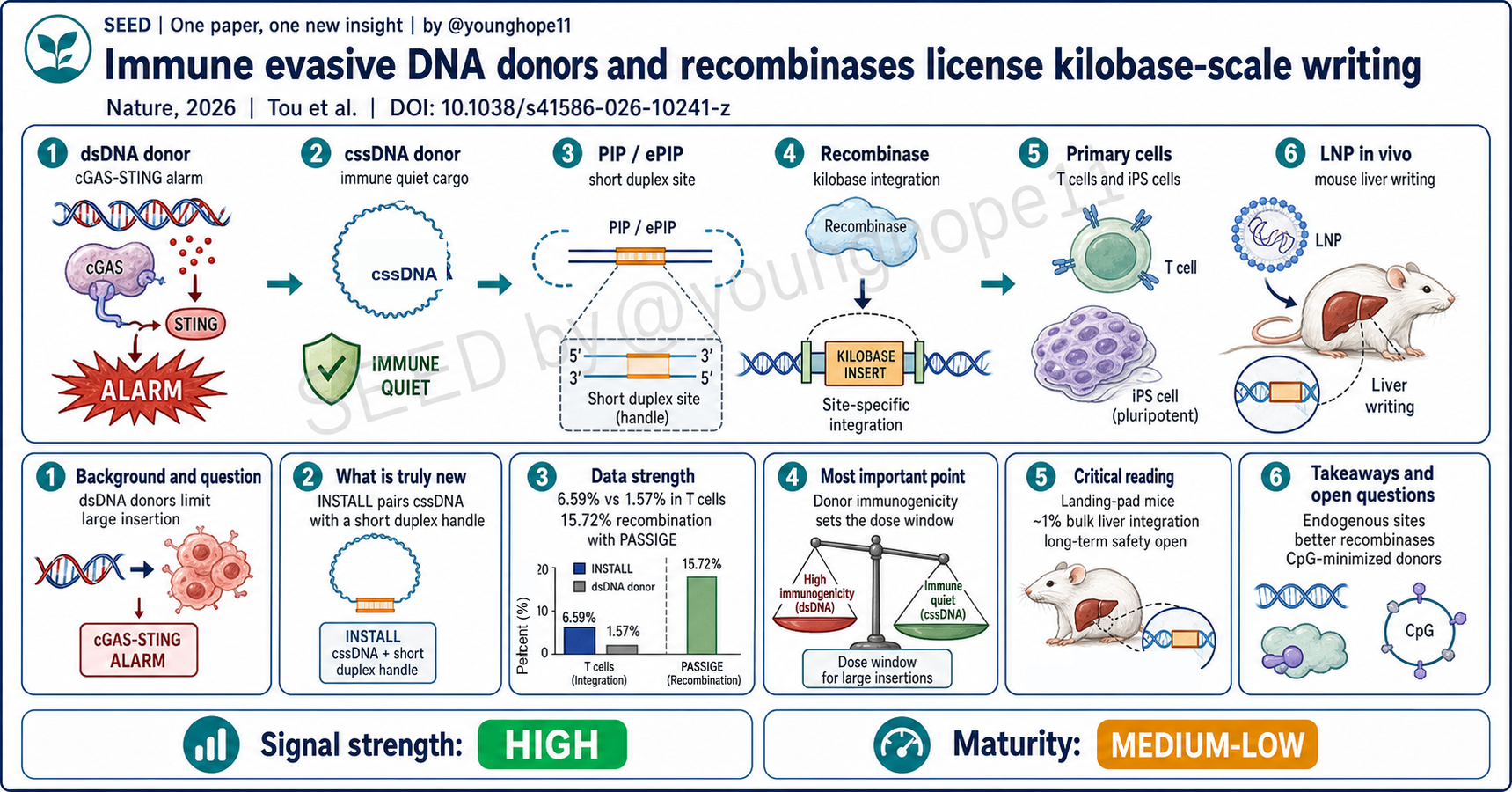
大段写入的瓶颈,是 donor 先触发了免疫报警
大段 DNA 写入一直是基因编辑领域最难的一类任务。Base editing 和 prime editing 很适合点突变、小片段替换或较短插入,但如果要把几 kb 的治疗相关 cargo 精确写入基因组,recombinase、transposase 或 prime-editing-assisted recombinase 系统更有吸引力。
问题在于,这些酶通常需要 double-stranded DNA (dsDNA) donor。dsDNA 对哺乳动物细胞来说不是中性的材料。胞质 dsDNA 会被 cGAS、AIM2、IFI16 等 DNA sensor 识别,触发 STING、inflammasome、type I interferon、cytokine release 和细胞毒性。对 ex vivo 细胞工程来说,这会降低细胞状态和整合效率;对 in vivo delivery 来说,这会直接限制可耐受剂量。
过去解决这个问题的常见路径是用病毒载体,尤其是 AAV,把 donor 更有效地送进细胞核,减少暴露在胞质中的 dsDNA。但 AAV 又带来 cargo size、随机整合、免疫、redosing、制造成本和 viral sequence 等问题。
这篇文章真正问的是:能不能把 recombinase 需要的“可识别双链位点”和细胞不喜欢的“大段 dsDNA donor”拆开,只给 recombinase 一个很短的双链抓手,而让主要 cargo 以更免疫隐身的 cssDNA 形式进入细胞?
新意在 INSTALL-2e:短双链位点加单链环形 cargo
作者提出了三个层次的 INSTALL 设计。
INSTALL-1 使用 circular ssDNA donor,让 donor 先进入细胞核,再由宿主 primase 和 DNA polymerase 合成第二链,随后被 recombinase 识别并整合。这条路线的优点是 donor 大部分时间不是 dsDNA,缺点是依赖细胞内 second-strand synthesis,效率会受细胞类型影响。
INSTALL-2 则更关键。作者把一个 short DNA oligonucleotide,称为 partial-duplex integration polynucleotide (PIP),预先 anneal 到 cssDNA 上,形成 oligo-annealed cssDNA (oDNA)。这样 donor 绝大部分仍是 single-stranded circular DNA,但 recombinase recognition sequence 处形成一个通常小于 50 bp 的局部双链区域。这个长度低于 cGAS 有效识别长 dsDNA 的范围,却足够让 recombinase 抓住 donor。
INSTALL-2e 是进一步优化版本。作者在 PIP 末端加入 phosphorothioate、inverted dT 和 RNA base 设计,形成 enhanced PIP (ePIP),降低 exonuclease 降解,并允许 RNase H2 在细胞核内产生可延伸的 3’ hydroxyl。这个版本在 TREX1-proficient primary human T cells 中表现最明显。
研究设计也不只是一个 proof-of-concept。作者测试了 Bxb1、多种 large serine recombinases、human genome-targeting recombinase Dn29/superDn29、RNA-programmable bridge recombinases、engineered Piv invertase、PiggyBac transposase,以及与 prime editing/PASSIGE 和 click editing 的组合;模型覆盖 HEK293T、HeLa、HCT116、primary human T cells、human iPS cells、primary human hepatocytes 和小鼠体内 LNP delivery。
数据强在把免疫、效率和体内剂量连到一起
第一组强数据证明 cssDNA 本身确实更免疫安静。在 primary human T cells 中,同等质量 dsDNA donor 诱导 TNF 上升约 4.6 倍,并在高剂量时使 viable cells 下降约 25%;cssDNA 则接近 mock。6 周龄 CD-1 mice 中,5 microgram dsDNA 经 hydrodynamic tail-vein injection 后诱导 IL-6 约 41 倍上升,而 cssDNA 只带来很低的 IL-6 activation。
第二组强数据说明 oDNA 可以让 recombinase 在不需要完整 dsDNA donor 的情况下工作。体外 Bxb1 反应中,dsDNA 与 oDNA 的 integration 分别达到约 7.20% 和 6.35%,而 cssDNA alone 只有 0.028%,比 oDNA 低约 225 倍。HEK293T 中,cssDNA 和 oDNA 的整合产物经 long-read sequencing 显示高保真,提示第二链合成并没有引入明显高错误负担。
第三组强数据来自多酶和多细胞类型。INSTALL 与 Bxb1、Pa01、BceINT、SacINT、Dn29/superDn29、bridge recombinase、engineered Piv 和 PiggyBac 都表现出兼容性。在 superDn29 靶向 endogenous attH1 site 的实验中,oDNA 约 4.0% integration,高于 dsDNA 的 2.7%。
第四组强数据来自免疫胜任细胞。Primary human T cells 的 one-pot RAB11A integration 中,INSTALL-2e 达到 6.59% integration,而 dsDNA 为 1.57%,约 4.2 倍提升。Human iPS cells 中,INSTALL-2e 带来 8.49% GFP+ cells,dsDNA 为 4.57%。在 primary human T cells 的 PASSIGE 体系中,结合 engineered St.eeBxb1 后,INSTALL-2e 达到 15.72% recombination of PE-installed attachment sites 和 2.19% integration,相比 dsDNA 的 0.04% integration 是 54.8 倍提升。
第五组强数据是体内剂量窗口。P3 attP mice 中,0.7 或 1.4 mg/kg oDNA 加 1 mg/kg Bxb1 mRNA 的 INSTALL-2e LNP delivery 7 天内耐受良好;同剂量 dsDNA 组在 day 3 或 day 1 前完全致死。redosing 方案中,INSTALL-2e 小鼠全部耐受,而 dsDNA 即使用更低 donor dose 仍有 31.3% fatality。肝脏 bulk tissue 中,St.reBxb1 + INSTALL-2e 的 integration 接近 1%,dsDNA 组则很低或不可检测。
第六组强数据是机制闭环。RNA-seq 显示,dsDNA 在 primary human T cells 和 THP-1-derived macrophages 中分别引起 586 和 134 个基因超过 2 倍差异表达,富集病毒防御、innate immune activation、apoptosis 和 inflammatory signalling;INSTALL-2e 只引起 30 和 8 个基因变化。小鼠肝脏 p-STING 染色、CD68+ cells、血浆 IL-6、IFNalpha、IFNgamma、TNF、CXCL2、IL22 等免疫指标也一致显示,INSTALL 明显低于 dsDNA。进一步 CpG-minimized oDNA 还可以把残余免疫激活进一步压低。
最重要的信息:大段写入先要解决核酸材料本身
这篇文章最重要的点,不是又找到一个更强的 recombinase,也不是单纯把 LNP 用在大段 donor 上。真正改变视角的是:大段基因写入的限制,很多时候不是酶不能写,而是 donor 在写入之前已经让细胞或动物无法承受。
dsDNA donor 的问题不是一个附带副作用,而是会改变整个可实验空间。它降低 primary cell viability,改变 transcriptome,限制 in vivo dose,让 redosing 变得危险,也让本来有潜力的 recombinase 系统只能停留在 ex vivo 或 immune-deficient contexts。
INSTALL 的非显然之处,是把 recombinase 对双链 attachment site 的需求缩小到一个局部短双链区域,同时让大部分 cargo 保持 circular ssDNA 的免疫隐身特征。这样,recombinase 仍然能识别 donor,细胞却不必承受整段 dsDNA 的 cGAS-STING 负担。
换句话说,这篇文章把 kilobase-scale genome writing 的核心工程问题,从“如何找到更强的写入酶”扩展为“如何同时设计酶、donor 结构、核酸免疫性和递送剂量窗口”。
不能把它读成体内大段基因治疗已经成熟
这项研究很强,但必须谨慎读。
第一,很多关键实验仍依赖 pre-installed recombinase landing pad。小鼠体内实验使用的是 Rosa26 locus 带 Bxb1 attP site 的 transgenic model,不是直接在野生型小鼠内源疾病位点完成治疗性写入。因此,它证明了体内非病毒 recombinase integration 的可行性和耐受性,但还没有证明可以在自然内源位点高效治疗疾病。
第二,体内整合效率仍然是早期水平。INSTALL-2e 在 bulk liver 中接近 1% integration,这是非常重要的 proof of concept,但距离许多疾病所需的治疗阈值可能还很远。primary human hepatocytes 中也能看到功能,但作者明确说 attP writing 和 cargo integration efficiencies 仍较低。
第三,安全性需要更长、更深的验证。文章做了 off-target integration 分析,并在 PASSIGE primary T cell 实验中未看到明显 genome-wide off-target reads;但临床前开发还需要长期随访、更多组织、不同年龄、不同免疫背景、重复给药、germline 风险、random donor capture、large rearrangement 和 insertional mutagenesis 的系统评估。
第四,制造和监管并不会简单。cssDNA、oDNA、ePIP、CpG-minimized cargo、LNP、mRNA recombinase 和化学修饰 PIP 组合在一起,给质量控制、杂质、批间一致性、scale-up 和 CMC 都提出新问题。
第五,利益冲突需要放在背景里看。作者披露,Connor J. Tou 和 Benjamin P. Kleinstiver 是 MGB 关于 INSTALL 专利申请的发明人;Connor J. Tou、Joana Ferreira da Silva 和 Benjamin P. Kleinstiver 还涉及 MGB 的其他相关 genome engineering 专利;Keqiang Xie、Richard Shan 和 Hao Wu 涉及 Full Circles Therapeutics 的 cssDNA 专利;多位作者为 Full Circles Therapeutics 当前或前员工。Benjamin P. Kleinstiver 也与多家基因编辑公司有咨询、顾问和股权关系。这不削弱论文数据,但会影响后续平台推广、试剂可及性和独立复现的判断。
下一步是把 INSTALL 从 landing pad 推向内源位点
这篇文章最直接的下一步,是把 INSTALL 和更好的 endogenous-site recombinase 结合。只要仍需要先放置 attP/attB landing pad,系统复杂度就很高。真正的转化价值会来自能直接靶向安全 harbor 或疾病相关 endogenous locus 的 recombinase、bridge recombinase 或 modular integrase。
第二步,是提高体内效率。LNP organ tropism、mRNA dose、donor dose、redosing cadence、recombinase half-life、nuclear localization、oDNA stability、CpG minimization 和 ePIP chemistry 都有优化空间。文章最后也明确指出,oDNA engineering、optimized delivery 和 engineered enzymes 是 INSTALL 的下一代改进方向。
第三步,是做疾病相关 cargo。ABCD1 4.8 kb cargo 的细胞实验说明 INSTALL 可以表达治疗相关蛋白,但疾病模型还需要在相关组织、相关突变、相关内源表达环境中证明功能恢复。对 mutation-agnostic editing 来说,能否用一个大段 cDNA 或 gene cassette 覆盖大量致病变异,是一个值得继续测试的方向。
第四步,是建立核酸免疫设计规则。mRNA 治疗的发展告诉我们,免疫逃逸不是“越低越好”这么简单,而是要在表达、剂量、耐受性和可重复给药之间找到窗口。INSTALL 可能会推动 DNA therapeutics 形成类似的规则:什么样的 donor topology、CpG content、局部 duplex 长度和化学修饰,最适合体内写入。
Yang 的信号评级:High
轴一,信号强度:High。 这篇文章的信号很强,因为它解决的是大段基因写入的底层瓶颈:dsDNA donor 触发先天免疫,直接限制 recombinase integration 的剂量、效率和体内适用性。INSTALL 用 cssDNA/oDNA/ePIP 把 donor 免疫性、recombinase recognition 和 kilobase-scale cargo 整合到一个平台中,并在 primary human cells 与小鼠体内给出了连贯证据链。
轴二,技术成熟度:Medium-Low。 理由是这已经超出概念验证,包含多种酶、多种细胞、PASSIGE 组合、LNP 体内递送和免疫机制验证;但体内模型仍主要依赖 pre-installed landing pad,bulk liver integration 接近 1% 仍属早期水平,长期安全、内源位点靶向、制造放大和疾病疗效都还没有完成。
一句话总结:INSTALL 的核心信息是,大段基因写入要先让 donor 对免疫系统“安静下来”,酶的潜力才有机会在体内释放。
Connor J. Tou, Keqiang Xie, corresponding authors Connor J. Tou, Hao Wu and Benjamin P. Kleinstiver, and colleagues at Massachusetts General Hospital, Full Circles Therapeutics and collaborating institutions recently reported INSTALL in Nature. The core idea is to pair immune-evasive circular single-stranded DNA (cssDNA) donors with recombinases so that kilobase-scale DNA insertion no longer depends entirely on highly immunogenic double-stranded DNA donors. The study offers a new engineering entry point for non-viral, redosable, recombinase-driven genome writing.
The bottleneck is that the donor triggers the alarm before writing begins
Large DNA insertion remains one of the hardest problems in genome editing. Base editing and prime editing are powerful for point mutations, short replacements and small insertions, but inserting a multi-kilobase therapeutic cargo usually requires recombinases, transposases or prime-editing-assisted recombinase systems.
The difficulty is that these enzymes usually require double-stranded DNA donors. In mammalian cells, dsDNA is not an inert material. Cytosolic dsDNA can be detected by cGAS, AIM2, IFI16 and other DNA sensors, activating STING, inflammasome pathways, type I interferon, cytokine release and cellular toxicity. In ex vivo engineering, this reduces cell fitness and integration efficiency. In vivo, it directly limits the tolerable dose.
The usual way around this has been viral delivery, especially AAV, which can traffic donor DNA into the nucleus and reduce cytosolic dsDNA exposure. But AAV introduces its own constraints: cargo size, random integration, immunity, redosing barriers, manufacturing cost and viral sequences.
The paper asks a precise question: can the recombinase’s need for a double-stranded recognition site be separated from the cell’s intolerance of a large dsDNA donor, giving the enzyme a short duplex handle while keeping most of the cargo in an immune-evasive cssDNA format?
The new design is INSTALL-2e: a short duplex site on circular ssDNA
The authors build three layers of INSTALL.
INSTALL-1 uses a circular ssDNA donor that enters the nucleus and is converted into a duplex substrate by host primase and DNA polymerase before recombinase-mediated integration. The advantage is that the donor is mostly not dsDNA. The limitation is that efficiency depends on cell-type-specific second-strand synthesis.
INSTALL-2 is the key conceptual step. The authors anneal a short DNA oligonucleotide, called a partial-duplex integration polynucleotide (PIP), onto the cssDNA to make oligo-annealed cssDNA (oDNA). Most of the donor remains circular ssDNA, but the recombinase recognition sequence becomes a local duplex region, usually shorter than 50 bp. That is short enough to remain below the effective sensing range of cGAS, yet sufficient for the recombinase to bind the donor.
INSTALL-2e further optimizes this design. The enhanced PIP (ePIP) includes phosphorothioate, inverted dT and an RNA base to reduce exonuclease degradation and allow RNase H2 to generate an extendable 3’ hydroxyl in the nucleus. This version is especially beneficial in TREX1-proficient primary human T cells.
The study is not a single proof of concept. The authors test Bxb1, multiple large serine recombinases, Dn29 and superDn29 human genome-targeting recombinases, RNA-programmable bridge recombinases, engineered Piv invertase, PiggyBac transposase, and combinations with prime editing/PASSIGE and click editing. Models include HEK293T, HeLa, HCT116, primary human T cells, human iPS cells, primary human hepatocytes and in vivo mouse LNP delivery.
The strongest data connect immune quieting, efficiency and dose range
The first strong dataset shows that cssDNA is intrinsically quieter immunologically. In primary human T cells, an equal mass of dsDNA donor induced about a 4.6-fold increase in TNF and reduced viable cells by about 25% at high dose, whereas cssDNA stayed close to mock treatment. In 6-week-old CD-1 mice, 5 micrograms of dsDNA delivered by hydrodynamic tail-vein injection induced about a 41-fold increase in IL-6, whereas cssDNA caused minimal IL-6 activation.
The second strong dataset shows that oDNA can make recombinases work without a full dsDNA donor. In an in vitro Bxb1 reaction, dsDNA and oDNA reached about 7.20% and 6.35% integration, respectively, while cssDNA alone reached only 0.028%, about 225-fold lower than oDNA. In HEK293T cells, long-read sequencing showed high-fidelity integration products with cssDNA and oDNA, suggesting that second-strand synthesis does not introduce a major error burden.
The third strong dataset is enzyme and cell-type breadth. INSTALL is compatible with Bxb1, Pa01, BceINT, SacINT, Dn29/superDn29, bridge recombinases, engineered Piv and PiggyBac. In experiments using superDn29 to target the endogenous attH1 site, oDNA achieved about 4.0% integration versus 2.7% with dsDNA.
The fourth strong dataset comes from immune-competent primary cells. In a one-pot RAB11A integration experiment in primary human T cells, INSTALL-2e reached 6.59% integration compared with 1.57% for dsDNA, a 4.2-fold improvement. In human iPS cells, INSTALL-2e yielded 8.49% GFP-positive cells versus 4.57% with dsDNA. In primary human T-cell PASSIGE experiments, combining INSTALL-2e with engineered St.eeBxb1 reached 15.72% recombination of prime-edited attachment sites and 2.19% integration, a 54.8-fold improvement over dsDNA at 0.04% integration.
The fifth strong dataset is the in vivo dose window. In P3 attP mice, INSTALL-2e LNP delivery with 0.7 or 1.4 mg/kg oDNA plus 1 mg/kg Bxb1 mRNA was well tolerated for 7 days. The same doses of dsDNA were completely lethal by day 3 or day 1. In a redosing regimen, all INSTALL-2e mice tolerated treatment, whereas dsDNA caused 31.3% fatality despite a lower donor dose. In bulk liver, St.reBxb1 plus INSTALL-2e achieved integration approaching 1%, while dsDNA produced minimal to undetectable integration.
The sixth strong dataset closes the immune mechanism. RNA-seq showed that dsDNA caused more than twofold differential expression of 586 genes in primary human T cells and 134 genes in THP-1-derived macrophages, enriched for viral defence, innate immune activation, apoptosis and inflammatory signalling. INSTALL-2e changed only 30 and 8 genes, respectively. Mouse liver p-STING staining, CD68-positive cells and plasma IL-6, IFNalpha, IFNgamma, TNF, CXCL2 and IL22 all pointed in the same direction: INSTALL is far less inflammatory than dsDNA. CpG-minimized oDNA further reduced residual immune activation.
The field-level message is that large writing starts with donor design
The most important point is not simply that the authors found a stronger recombinase or used LNPs for a large donor. The real shift is that large gene insertion is often limited not because the enzyme cannot write, but because the donor makes the cell or animal intolerant before writing can happen.
The dsDNA donor is not a minor side effect. It changes the entire experimental space. It lowers primary-cell viability, reshapes the transcriptome, restricts in vivo dosing, makes redosing dangerous and confines otherwise promising recombinase systems to ex vivo or immune-deficient contexts.
INSTALL’s non-obvious move is to shrink the recombinase’s requirement for a duplex attachment site into a short local duplex region, while keeping most of the cargo in an immune-evasive circular ssDNA form. The recombinase can still recognize the donor, but the cell no longer has to tolerate a full-length dsDNA cargo.
In other words, the paper expands kilobase-scale genome writing from an enzyme engineering problem into a joint design problem involving the enzyme, donor topology, nucleic-acid immunogenicity and delivery dose window.
This is not yet mature in vivo large-gene therapy
The study is strong, but it needs a careful reading.
First, many key experiments still rely on a pre-installed recombinase landing pad. The in vivo mouse work uses a transgenic model with a Bxb1 attP site at Rosa26, not direct therapeutic insertion at a native disease locus in wild-type mice. It proves feasibility and tolerability of non-viral in vivo recombinase integration, but not yet efficient therapy at natural endogenous loci.
Second, in vivo integration efficiency remains early. INSTALL-2e approaches 1% integration in bulk liver, which is an important proof of concept, but may be far below the therapeutic threshold for many diseases. In primary human hepatocytes, the authors also observe function but note low attP writing and cargo integration efficiencies.
Third, safety needs longer and deeper testing. The paper includes off-target integration analysis and finds no obvious genome-wide off-target reads in PASSIGE primary T-cell experiments, but development will still require long-term follow-up, more tissues, different ages, different immune backgrounds, repeat dosing, germline-risk assessment, random donor capture, large rearrangement analysis and insertional-mutagenesis profiling.
Fourth, manufacturing and regulation do not become simple. cssDNA, oDNA, ePIP, CpG-minimized cargo, LNP, mRNA recombinase and chemically modified PIPs create new requirements for quality control, impurity testing, batch consistency, scale-up and CMC.
Fifth, the competing-interest context matters. The authors disclose that Connor J. Tou and Benjamin P. Kleinstiver are inventors on an MGB patent application describing INSTALL; Connor J. Tou, Joana Ferreira da Silva and Benjamin P. Kleinstiver are inventors on additional MGB patents or applications related to genome engineering technologies; Keqiang Xie, Richard Shan and Hao Wu are inventors on Full Circles Therapeutics patent applications related to cssDNA production and use; and several authors are current or former Full Circles Therapeutics employees. Benjamin P. Kleinstiver also has consulting, advisory and financial relationships with several genome-editing companies. This does not weaken the data, but it matters for platform adoption, reagent access and independent replication.
The next step is moving INSTALL from landing pads to endogenous loci
The most direct next step is to pair INSTALL with better endogenous-site recombinases. As long as the system needs a pre-installed attP or attB landing pad, complexity remains high. The real translational value will come from recombinases, bridge recombinases or modular integrases that can directly target safe harbors or disease-relevant endogenous loci.
The second step is improving in vivo efficiency. LNP organ tropism, mRNA dose, donor dose, redosing cadence, recombinase half-life, nuclear localization, oDNA stability, CpG minimization and ePIP chemistry are all tunable. The paper’s own forward-looking framework points to oDNA engineering, optimized delivery and engineered enzymes as the next generation of INSTALL.
The third step is disease-relevant cargo testing. The ABCD1 4.8-kb cargo experiment shows that INSTALL can express a therapeutically relevant protein in cells, but disease models need to show functional rescue in the right tissue, mutation context and endogenous expression environment. For mutation-agnostic editing, the important question is whether one large cDNA or gene cassette can cover many pathogenic variants.
The fourth step is building rules for DNA immunogenicity. The development of mRNA therapeutics showed that immune evasion is not simply about being as silent as possible; it is about balancing expression, dose, tolerability and redosing. INSTALL may push DNA therapeutics toward a similar rulebook: donor topology, CpG content, local duplex length and chemical modification will all matter for in vivo writing.
Yang’s signal rating: High
Axis 1, signal strength: High. The signal is strong because the paper addresses a foundational bottleneck in large gene insertion: dsDNA donors activate innate immunity and directly constrain recombinase integration dose, efficiency and in vivo applicability. INSTALL integrates cssDNA, oDNA, ePIP, recombinase recognition and kilobase-scale cargo into one platform, with a coherent evidence chain across primary human cells and mice.
Axis 2, technical maturity: Medium-Low. This is beyond a simple concept, with multiple enzymes, multiple cell types, PASSIGE combinations, in vivo LNP delivery and immune-mechanism validation. But the in vivo system still largely depends on a pre-installed landing pad, bulk liver integration near 1% remains early, and long-term safety, endogenous-site targeting, manufacturing scale-up and disease efficacy are still unresolved.
One-sentence summary: INSTALL’s core message is that large genome writing first needs the donor to become immunologically quiet before the enzyme’s potential can be released in vivo.