SEED | 蛋白结构域筛选的磁分选放大器 SEED | Magnetic separation scales protein-domain screening AI-assisted · reviewed
Abby R. Thurm 与通讯作者 Josh Tycko、Nicole DelRosso、Gaelen T. Hess、Lacramioara Bintu 团队近期在 Nature Protocols 发表一篇 Protocol,系统描述了如何用磁分选替代 FACS,来做大规模蛋白结构域功能筛选。它的目标不是发现一个新的生物机制,而是把 transcriptional regulation、post-transcriptional RNA regulation 和 membrane-domain insertion 这类 pooled mammalian-cell screens,变成一个更容易扩展、成本更低、并且可用测序定量的实验流程。
瓶颈是 FACS 通量,不是结构域库本身
蛋白结构域筛选的基本问题很清楚:很多细胞功能不是由整条蛋白质决定,而是由局部结构域、短 motif、disordered region 或 transmembrane segment 决定。要系统找到这些功能片段,就需要把大量候选序列放进细胞中,用一个报告系统读出每个片段对转录、RNA 稳定性、表面展示或其他表型的影响。
传统路线常用 fluorescence-activated cell sorting (FACS)。如果一个候选结构域让 reporter 变亮,就把亮细胞分出来;如果让 reporter 变暗,就把暗细胞分出来;然后通过测序比较不同 fraction 里的 barcode 或 insert abundance。这条路线直观、灵敏,也能做多档 fluorescence binning。
但 FACS 的问题是物理通量。文章给出的估算很直接:即使用每小时 10-20 million cells 的速度排序,2 小时内能处理的细胞数量仍然限制了 library size 和 per-member coverage。如果想保持每个 library member 至少数百到上千个细胞覆盖,FACS 很快会把可筛选规模压到几十万以下,实际操作中常常更低。
这篇 Protocol 问的就是:能不能把需要 sorting 的单细胞读出,改造成一个磁珠可捕获的表面读出,让 pooled protein-domain screens 从流式仪器的通量瓶颈中解放出来?
真正的新意是把表面读出改成磁分选读出
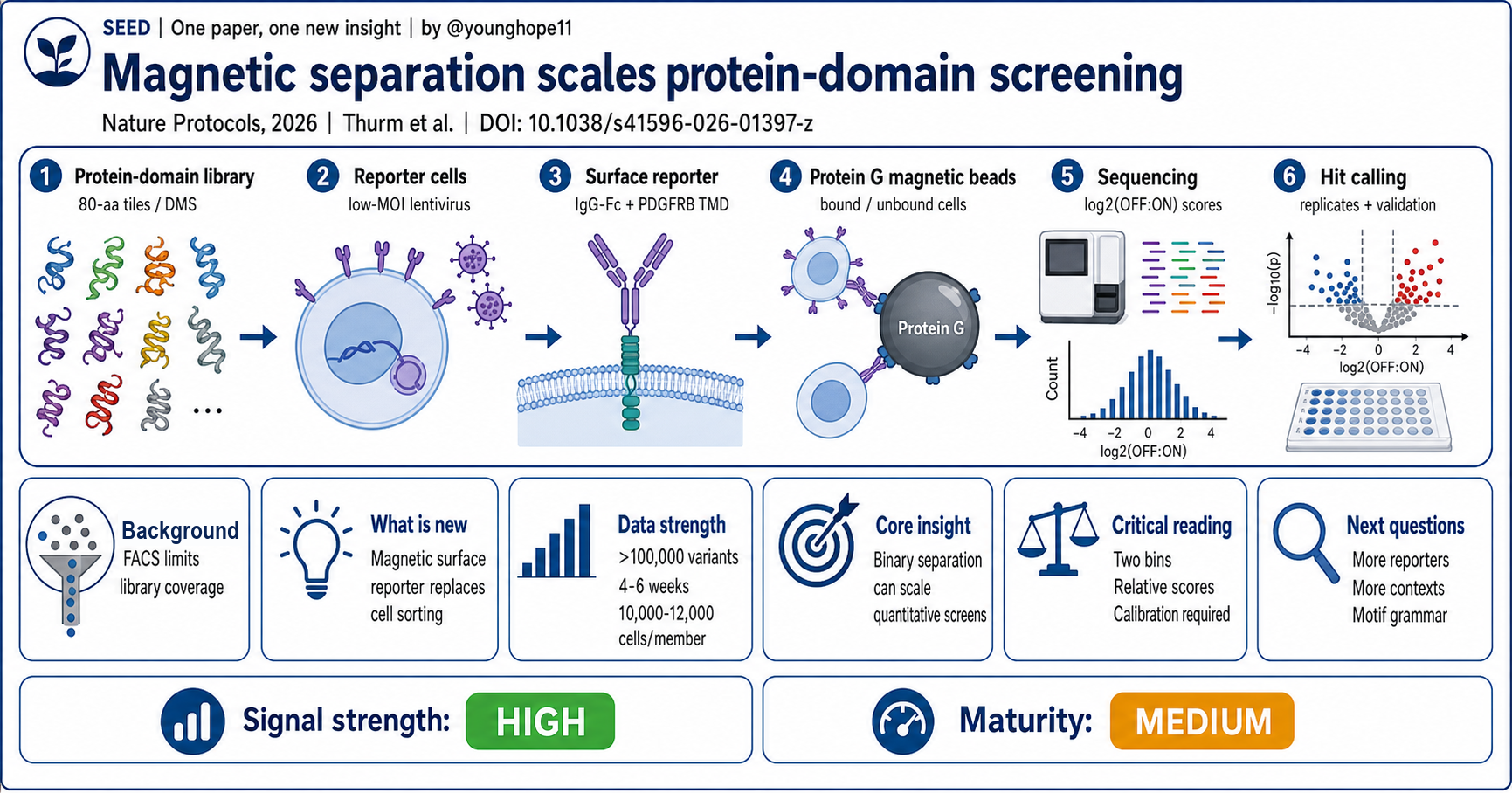
这套方法的核心,是一个 modular synthetic surface marker。作者把 human IgG Fc region、IgK leader sequence 和 PDGFRβ transmembrane domain 组合成一个可在细胞表面展示的 reporter。只要目标 regulatory domain 让 reporter 表达上升,细胞表面就会出现更多 Fc tag;Protein G-coated magnetic beads 就能把这些 reporter-high cells 捕获出来。
这个设计的关键不是磁珠本身,而是把原本需要 FACS 识别的 fluorescence state,转译成磁珠可分离的 surface state。这样,细胞不再需要一个个通过流式喷嘴,而是可以在 bulk suspension 中和磁珠结合,再分成 bound 和 unbound 两组。
Protocol 给出了完整实验链条:先根据问题选择或构建 reporter cell line;再设计 protein-domain library,可以是 unbiased tiling library、rational domain library 或 deep mutational scanning library;随后把 pooled library 克隆进载体,通过 lentiviral delivery 以低 MOI 感染 reporter cells;经过选择、诱导和足够扩增后,进行磁分选;最后从 bound/unbound fractions 提取 gDNA,做 sequencing library,并用 read counts 计算每个成员的 enrichment score。
因此,这篇文章的新意不是单一试剂,而是一套可复制的操作系统:把结构域功能、表面报告器、磁珠分离、pooled sequencing 和统计分析接成一个可以在 4-6 周内完成的 workflow。
数据和流程强在覆盖度、时间尺度和校准规则
第一组强信息来自通量。摘要明确说,这套方法可以 reproducibly screen 超过 100,000 个 protein domain variants。正文中,作者还把它与 FACS 做了直接比较:在同样约 2 小时的 separation time 内,FACS 的处理量受每小时细胞数限制;磁分选的上限则更多取决于 cell number、bead amount 和样本处理能力。Protocol 还提到,磁分选可以支持 200,000 members 或更多、多个条件并行的实验设计。
第二组强信息来自覆盖度要求。作者没有只说“更高通量”,而是给出 practical coverage rules。对于定量 screen,separation stage 建议达到约 10,000-12,000 cells per library member;PCR coverage 建议约 1,000x per member;sequencing depth 建议约 500-1,000x reads per member。典型实验还包括两个 biological replicates,并分别测 bound 和 unbound fractions。
第三组强信息来自实验尺度和时间。完整流程从 library design 到 data analysis 通常需要 4-6 周;如果 reporter cell line 已经准备好,screen 本身大约 1 个月可以完成。对一个包含 pooled cloning、lentivirus production、mammalian cell culture、magnetic separation 和 sequencing analysis 的方法来说,这个时间尺度是可执行的。
第四组强信息来自适用范围。作者不是只给一个 transcriptional activation reporter,而是把应用场景扩展到 transcriptional effector screens、RNA regulator screens 和 transmembrane domain insertion screens。文章还给出 human transcription factors and chromatin regulators 的 80-aa tiling library 设计例子,使用 10-aa sliding window 可以产生 128,545 tiles 这样的规模。
第五组强信息来自质量控制。Protocol 明确要求用 reporter ON/OFF controls 和 flow cytometry 校准 dynamic range,建议用 random controls 估计 log2(OFF:ON) score 背景分布,并把 threshold 设在 random-control mean 加 2.5-3 standard deviations。对于真正 active 的 library members,作者预期 replicate Pearson’s r 通常应大于 0.5;如果 hits 之间不相关,或 positive dynamic range 小于 2 log2(OFF:ON) units,就需要谨慎解释。
最重要的一点:二分读出也能放大定量筛选
这篇 Protocol 最值得记住的一点,是它重新定义了“高通量功能读出”的最低必要条件。很多时候,研究者会默认 FACS 更好,因为 FACS 可以按 fluorescence intensity 做多档分箱,理论上能保留更细的表型梯度。磁分选看起来只有 bound 和 unbound 两类,似乎信息量更低。
但在大规模 pooled screen 中,限制往往不是每个细胞的测量精细度,而是能不能让每个 library member 保持足够覆盖度。一个很精细但 coverage 不足的 FACS screen,可能产生高噪音、低复现性、library bottleneck 和假阴性。一个只有两组 fraction、但能维持 10,000 cells/member 级别覆盖度的磁分选 screen,反而可能给出更稳的相对 enrichment。
这也是这套方法的核心洞见:当实验目标是给上万到十几万个结构域变体排序时,二分读出加深覆盖度,可能比精细分箱但低覆盖度更有价值。
文章并没有声称磁分选能替代所有 FACS 应用。它更准确的定位是:当研究问题主要需要找出 active domains、inactive controls、relative ranks 和 motif-level rules 时,magnetic separation 提供了一个更可扩展、更容易并行化的入口。
读这篇 Protocol,要盯住覆盖度和适用边界
第一,磁分选不是天然“更准”,它只是把通量瓶颈换了位置。实验质量仍然取决于 library delivery、cell growth、selection pressure、reporter dynamic range、magnetic capture efficiency、gDNA recovery、PCR sampling 和 sequencing depth。任何一个环节造成 bottleneck,都会让后续 enrichment score 变得不稳定。
第二,bound/unbound readout 只有两个 bin。它适合找强效调控结构域、比较相对 enrichment、发现 motif pattern;但如果研究目标需要细分多个表型强度层级,或者需要精确拟合 continuous dose-response,FACS 的多档分选仍然有优势。
第三,Protocol 强调 enrichment values 是 relative scores,不是 absolute activity measurements。同一个结构域的 log2(OFF:ON) score 会受到 library composition、分离效率和 sequencing depth 影响。因此,跨 screen 比较必须做 calibration,关键 hits 也应该用 flow cytometry 或其他低通量 assay 验证。
第四,成本并没有消失。文章提到,如果处理 1 billion cells,Protein G magnetic beads 的成本可能达到每个样本约 1,000 美元。这个成本对大型 screen 仍可能低于 FACS facility time 和人力,但它不是免费放大。
第五,利益冲突也需要看到。作者披露,A.R.T.、J.T.、C.H.L.、N.V.D.、G.T.H.、M.C.B. 和 L.B. 提交了与 magnetic separation-mediated protein domain screening applications 相关的专利申请;Lacramioara Bintu、Michael C. Bassik 和 Josh Tycko 是 Stylus Medicine 的共同创始人;Connor H. Ludwig 目前在 Octant, Inc. 工作。这不否定方法价值,但读者在评估推广性和 reagent access 时应把这一点纳入背景。
下一步是把磁分选接入更多功能读出
这篇文章对 functional genomics 和 protein engineering 的启发,是把“可筛选”与“可扩展”分开来看。很多 reporter system 可以被设计出来,但不一定能在 100,000-member library、多个 replicate、多个 condition 下保持足够 coverage。磁分选提供的是一个放大接口。
第一步,是把更多 cell-state reporters 接到 surface marker 上。现在的 Protocol 已覆盖 transcription、RNA regulation 和 membrane-domain insertion。未来更有意思的问题,是能否把 signaling pathway activity、stress response、protein localization、secretory pathway load 或 cell-cell interaction reporter 也转成磁珠可分离的表面状态。
第二步,是把它用于更系统的 motif grammar 学习。文章中的 deep mutational scanning 例子显示,NR box LxxLL motif 的 activation 与 repression 可以有不同的 mutation sensitivity。这类结果说明,大规模结构域 screen 不只是在找 hit,也是在读功能 motif 的语法。
第三步,是与机器学习结合。高覆盖度、pooled sequencing 和相对 enrichment score 本身就是适合建模的数据结构。随着更多 protein-domain libraries 被测量,这类磁分选数据可以用来训练模型,预测哪些 low-complexity regions、short linear motifs 或 transmembrane segments 会产生特定调控功能。
第四步,是建立跨实验室标准。Protocol 已经给出 coverage、replicate correlation、random-control threshold 和 validation 建议。下一阶段如果有更多实验室用同样标准做 screens,磁分选可能从单个实验技巧变成 protein-domain function atlas 的生产方式。
Yang 的信号评级:High
轴一,信号强度:High。 这篇文章的信号强在它解决了一个真实的实验瓶颈:FACS 的细胞处理速度限制了大规模 protein-domain screens 的 library size 和 coverage。磁分选 reporter 把这个问题改写成 bulk capture + sequencing quantification,使超过 100,000 个结构域变体的功能读出变得更可执行。
轴二,成熟度:Medium。 这已经是一篇可操作的 Nature Protocols 方法文章,有明确步骤、覆盖度规则、时间表、质量控制和应用案例;但它仍依赖 engineered reporter、lentiviral pooled delivery、足够细胞量、磁珠成本和后续 flow-cytometry validation。它是成熟的方法入口,不是无需校准的通用读出平台。
一句话总结:这篇 Protocol 的核心价值,是把蛋白结构域筛选从“流式仪能处理多少细胞”推进到“系统能不能维持足够覆盖度并用测序稳健排序”。
Abby R. Thurm and corresponding authors Josh Tycko, Nicole DelRosso, Gaelen T. Hess and Lacramioara Bintu recently published a Nature Protocols article describing how to use magnetic separation instead of FACS for large-scale protein-domain functional screens. The aim is not to report a new biological mechanism, but to turn pooled mammalian-cell screens for transcriptional regulation, post-transcriptional RNA regulation and membrane-domain insertion into a workflow that is more scalable, lower in technical burden and quantifiable by sequencing.
The bottleneck is FACS throughput, not the domain library
The basic problem in protein-domain screening is clear: many cellular functions are controlled not by whole proteins, but by local domains, short motifs, disordered regions or transmembrane segments. To systematically identify these functional elements, large sets of candidate sequences need to be placed into cells and linked to a reporter that reads out transcription, RNA stability, surface display or another phenotype.
The conventional route often uses fluorescence-activated cell sorting. If a candidate domain makes a reporter bright, bright cells are sorted. If it represses the reporter, dim cells are sorted. Sequencing then compares barcode or insert abundance across fractions. This is intuitive, sensitive and can support multiple fluorescence bins.
The problem is physical throughput. The article gives a practical estimate: even at 10-20 million cells per hour, a two-hour FACS experiment limits both library size and per-member coverage. If each library member needs hundreds to thousands of cells to preserve quantitative signal, FACS quickly constrains the workable scale to tens or low hundreds of thousands of variants, and often less in practice.
The question asked by this Protocol is therefore specific: can a single-cell sorting readout be converted into a bead-capturable surface readout, so pooled protein-domain screens are no longer primarily limited by flow-cytometer throughput?
The novelty is converting a surface readout into magnetic separation
The core of the method is a modular synthetic surface marker. The authors combine a human IgG Fc region, an IgK leader sequence and a PDGFRβ transmembrane domain to create a reporter displayed on the cell surface. When a regulatory domain increases reporter expression, cells display more Fc tag; Protein G-coated magnetic beads can then capture those reporter-high cells.
The key idea is not the bead itself. It is the translation of a fluorescence state that FACS would normally detect into a surface state that magnetic beads can separate. Cells no longer need to pass one by one through a sorter nozzle. They can be handled in bulk suspension, bound to beads and split into bound and unbound fractions.
The Protocol lays out the full experimental chain: choose or build a reporter cell line; design a protein-domain library, such as an unbiased tiling library, rational domain library or deep mutational scanning library; clone the pooled library into a vector; deliver it by lentivirus at low MOI; expand, select and induce cells as needed; perform magnetic separation; extract gDNA from bound and unbound fractions; prepare sequencing libraries; and compute enrichment scores for each member.
The novelty is therefore not a single reagent. It is a reproducible operating system that connects domain function, a surface reporter, magnetic separation, pooled sequencing and statistical analysis into a workflow that can be completed in about four to six weeks.
The data and workflow are strong on coverage, timing and calibration
The first strong point is throughput. The abstract states that the method can reproducibly screen more than 100,000 protein-domain variants. In the main text, the authors directly compare it with FACS: over a similar separation time of about two hours, FACS is limited by cells processed per hour, whereas magnetic separation is more constrained by cell number, bead amount and sample handling. The Protocol also describes designs with 200,000 or more members across multiple conditions.
The second strong point is coverage guidance. The paper does not merely say “higher throughput.” It gives practical rules. For quantitative screens, the separation stage should maintain about 10,000-12,000 cells per library member. PCR coverage should be around 1,000x per member, and sequencing depth should be about 500-1,000 reads per member. A typical screen includes two biological replicates and measures both bound and unbound fractions.
The third strong point is feasibility. The full workflow, from library design to data analysis, usually takes four to six weeks. If the reporter cell line is already available, the screen itself can be completed in about one month. For a method involving pooled cloning, lentivirus production, mammalian cell culture, magnetic separation and sequencing analysis, that is a practical timeline.
The fourth strong point is scope. The authors do not only describe one transcriptional activation reporter. The applications include transcriptional effector screens, RNA regulator screens and transmembrane-domain insertion screens. The article also gives an example of an 80-amino-acid tiling library across human transcription factors and chromatin regulators, where a 10-amino-acid sliding window yields 128,545 tiles.
The fifth strong point is quality control. The Protocol requires reporter ON/OFF controls and flow-cytometry calibration of dynamic range. It recommends using random controls to estimate the background distribution of log2(OFF:ON) scores and setting a hit threshold at the random-control mean plus 2.5-3 standard deviations. For truly active library members, replicate Pearson’s r is generally expected to exceed 0.5; poor hit correlation or a positive dynamic range below 2 log2(OFF:ON) units should trigger caution.
The key point is that binary separation can still scale quantitative screens
The most important point is that this Protocol reframes the minimum requirement for a high-throughput functional readout. Researchers often assume FACS is superior because it can divide cells into multiple fluorescence-intensity bins and, in principle, preserve finer phenotypic gradients. Magnetic separation appears to have only two outputs, bound and unbound, and therefore less information per cell.
But in large pooled screens, the limiting factor is often not the precision of each individual cell measurement. It is whether each library member retains enough coverage. A finely binned FACS screen with insufficient coverage can produce noise, poor reproducibility, library bottlenecks and false negatives. A two-fraction magnetic screen that maintains roughly 10,000 cells per member may provide more stable relative enrichment.
That is the core insight: when the goal is to rank tens of thousands to more than 100,000 domain variants, binary separation with deep coverage can be more useful than fine binning with inadequate coverage.
The article does not claim that magnetic separation replaces all FACS applications. Its more precise role is as a scalable entry point when the study mainly needs to identify active domains, inactive controls, relative ranks and motif-level rules.
Read the Protocol by watching coverage and boundaries
First, magnetic separation is not automatically more accurate. It moves the throughput bottleneck, but data quality still depends on library delivery, cell growth, selection pressure, reporter dynamic range, magnetic capture efficiency, gDNA recovery, PCR sampling and sequencing depth. A bottleneck at any of these steps can destabilize the final enrichment scores.
Second, the bound/unbound readout has only two bins. It is well suited to finding strong regulatory domains, comparing relative enrichment and discovering motif patterns. If the question requires multiple phenotype levels or precise continuous dose-response modeling, FACS binning can still be better.
Third, the Protocol emphasizes that enrichment values are relative scores, not absolute activity measurements. A domain’s log2(OFF:ON) score can depend on library composition, separation efficiency and sequencing depth. Cross-screen comparisons therefore require calibration, and key hits should be validated with flow cytometry or another low-throughput assay.
Fourth, cost is not eliminated. For a sample containing 1 billion cells, the article notes that Protein G magnetic beads may cost up to about US$1,000 per sample. That can still be competitive with FACS facility time and labor for large screens, but the scale-up is not free.
Fifth, the competing-interest context matters. The authors disclose that A.R.T., J.T., C.H.L., N.V.D., G.T.H., M.C.B. and L.B. have filed patent applications related to magnetic-separation-mediated protein-domain screening applications; Lacramioara Bintu, Michael C. Bassik and Josh Tycko are co-founders of Stylus Medicine; and Connor H. Ludwig is currently an employee of Octant, Inc. This does not diminish the method, but it matters when judging general adoption and reagent access.
The next step is connecting magnetic separation to more functional readouts
The lesson for functional genomics and protein engineering is to separate “screenable” from “scalable.” Many reporter systems can be built, but not all of them preserve enough coverage across a 100,000-member library, multiple replicates and multiple conditions. Magnetic separation provides a scale-up interface.
The first next step is connecting more cell-state reporters to surface markers. The current Protocol covers transcription, RNA regulation and membrane-domain insertion. The more interesting question is whether signaling pathway activity, stress responses, protein localization, secretory pathway load or cell-cell interaction reporters can also be converted into bead-separable surface states.
The second step is using the approach to learn motif grammar more systematically. The deep mutational scanning example shows that activation and repression can have different mutation sensitivities for the NR box LxxLL motif. Large-scale domain screens are not only hit-finding tools; they can also read the syntax of functional motifs.
The third step is machine learning. High coverage, pooled sequencing and relative enrichment scores are naturally model-ready. As more protein-domain libraries are measured, magnetic-separation datasets could train models that predict which low-complexity regions, short linear motifs or transmembrane segments produce specific regulatory functions.
The fourth step is cross-lab standardization. The Protocol already provides guidance on coverage, replicate correlation, random-control thresholds and validation. If more laboratories use comparable standards, magnetic separation could become not just an experimental trick, but a way to produce protein-domain function atlases.
Yang’s signal rating: High
Axis 1, signal strength: High. The signal is strong because the article addresses a real experimental bottleneck: FACS cell-processing speed limits both library size and coverage in large protein-domain screens. The magnetic surface reporter reframes the task as bulk capture plus sequencing quantification, making functional readouts for more than 100,000 domain variants more practical.
Axis 2, maturity: Medium. This is an operational Nature Protocols method with concrete steps, coverage rules, timelines, quality controls and application examples. But it still depends on an engineered reporter, lentiviral pooled delivery, sufficient cell numbers, bead cost and downstream flow-cytometry validation. It is a mature entry point, not a calibration-free universal readout.
One-sentence summary: The core value of this Protocol is that it moves protein-domain screening from “how many cells can the sorter handle?” to “can the system preserve enough coverage to rank variants robustly by sequencing?”