SEED | CAR-T 从疗法走向平台 SEED | CAR-T moves from therapy to platform AI-assisted · reviewed
The University of Texas MD Anderson Cancer Center 的 Hind Rafei、Ranjan Upadhyay 与通讯作者 Padmanee Sharma 团队近期在 Nature Reviews Immunology 发表 Review,系统梳理 CAR-T 从 T cell biology、synthetic receptor 设计和首个临床批准,走向自身免疫、实体瘤、allogeneic manufacturing 与 in vivo engineering 的路线图。它的价值不在报告新实验,而是在把 CAR-T 读成一个正在平台化的免疫工程系统。
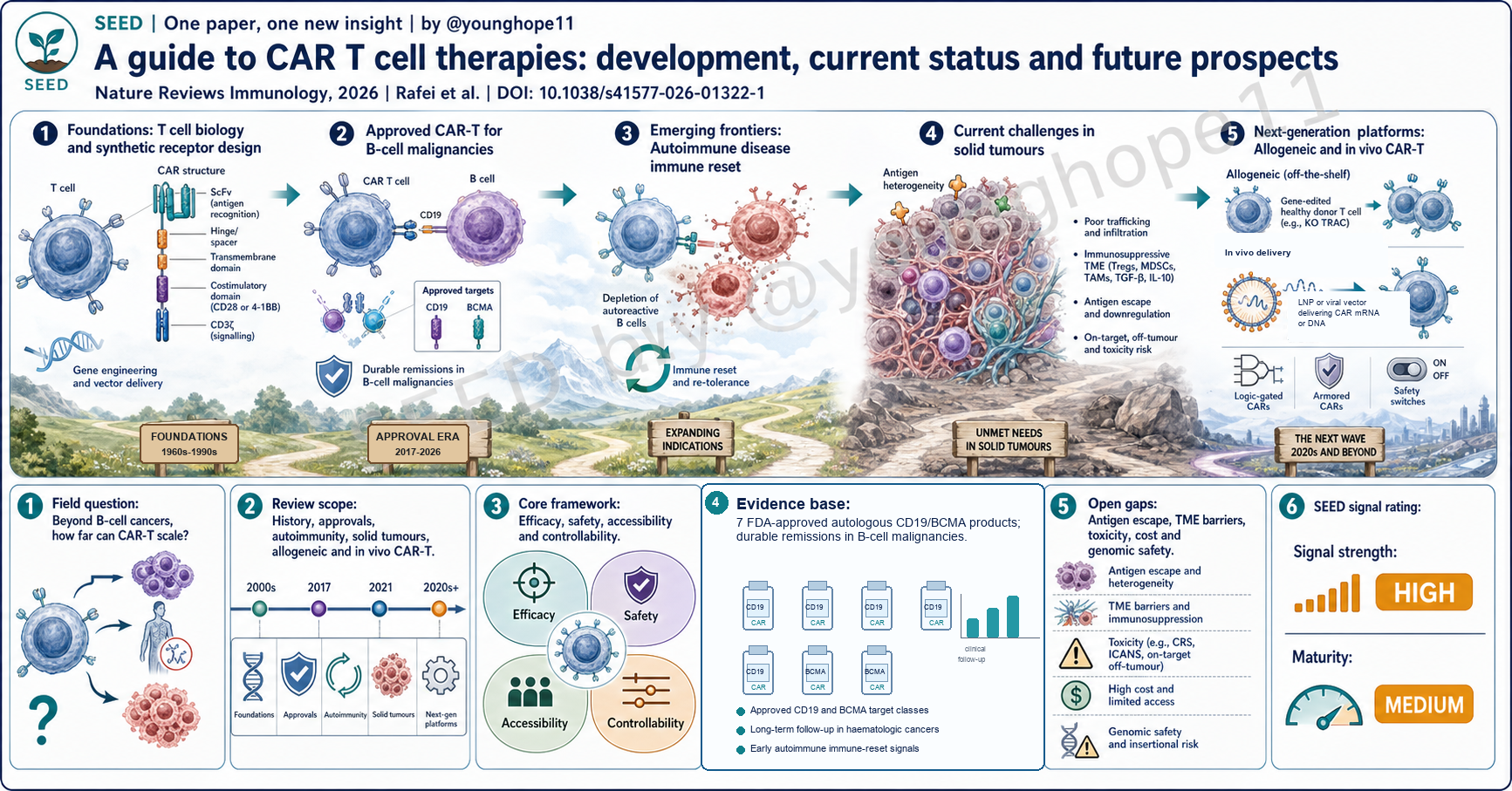
这篇 Review 问的是:CAR-T 能不能从血液肿瘤走成通用免疫平台
CAR-T 最初给领域带来的确定性,是 CD19 和 BCMA 靶向在 B cell malignancies 中可以产生深度、持久的临床缓解。自 2017 年首个 CAR-T 获批以来,它已经不再只是一个概念验证,而是进入标准治疗体系的活细胞药物类别。
这篇 Review 的问题更大:当 CAR-T 离开最适合它的场景之后,还能否继续成立?在自身免疫病中,它是否能实现短暂 B cell depletion 后的 immune reset?在实体瘤、AML 和 T cell malignancies 中,它如何面对 antigen heterogeneity、on-target/off-tumour toxicity、TME 抑制、trafficking 和 persistence 难题?在制造层面,allogeneic 和 in vivo CAR-T 是否能让这一类疗法更可及、更可控?
所以这不是一篇“哪一个 CAR 设计最好”的综述,而是一篇帮助读者判断 CAR-T 领域已经走到哪一步、下一步瓶颈在哪里的领域地图。
它整理出的框架:从杀伤细胞到可编程免疫控制
Padmanee Sharma 团队把 CAR-T 的演化放在几条轴线上读。第一条轴线是 receptor 设计:从 first-generation CAR 的 CD3ζ signal,到 CD28/4-1BB co-stimulation,再到 cytokine armouring、logic-gated receptor、switchable CAR、orthogonal cytokine system 和 precise knock-in。
第二条轴线是适应症扩张。血液肿瘤提供了最成熟的证据;自身免疫病提示 CAR-T 可能不仅是杀伤工具,也可能是免疫系统重置工具;实体瘤则暴露出 trafficking、TME、antigen escape 和 toxicity 的结构性障碍。
第三条轴线是制造和可及性。自体 CAR-T 证明了疗效,但成本、时间、个体差异和生产复杂性限制了规模化。allogeneic CAR-T 试图用健康供者细胞、gene editing 和免疫逃逸设计解决可及性;in vivo CAR-T 则更进一步,想把工程过程从体外制造转移到患者体内。
第四条轴线是安全控制。CRS、ICANS、on-target/off-tumour toxicity、insertional risk、长期 persistence 和不可控扩增,决定了 CAR-T 不能只追求“更强”,还必须变得可关闭、可定位、可剂量调节和可追踪。
证据链强在临床里程碑和工程瓶颈被放到同一张地图
这篇 Review 的强处不是做了系统综述或 meta-analysis,而是把临床事实和工程逻辑放在同一个时间轴上。文章指出,截至 2026 年 4 月,已有 7 个 FDA 批准的自体 CAR-T 产品靶向 CD19 或 BCMA,覆盖 B cell lymphomas、leukaemias 和 multiple myeloma。
临床成熟度最强的部分仍然是 B cell malignancies。Review 汇总的长期随访显示,non-Hodgkin lymphoma 和 CLL 中客观缓解率为 44-94%,完全缓解率为 20-88%;paediatric ALL 中,达到完全缓解患者的 5 年 relapse-free survival 为 49%,估计 5 年 overall survival 为 55%;adult ALL 超过 3 年随访中,总体中位 overall survival 为 25.6 个月,responders 为 38.9 个月;multiple myeloma 中,cilta-cel 治疗后有 33% 患者在 5 年或更长时间仍 alive and progression-free。
自身免疫病是最值得关注的新方向。文章梳理了 CD19-targeted CAR-T 在 refractory SLE、systemic sclerosis、myositis、myasthenia gravis、multiple sclerosis 等疾病中的早期结果。尤其是 15 例 refractory autoimmune disease case series 中,未见 high-grade CRS 或 neurotoxicity,B cell depletion 平均持续 112 天,却伴随持续临床改善,这提示“短暂清除 + 免疫重置”可能不同于肿瘤中的“长期 persistence”逻辑。
实体瘤部分则更像问题清单。文章列举了 CLDN18.2、CLDN6、GPC3、GD2、IL-13Rα2、EGFR/EGFRvIII 等方向的早期信号,但也清楚指出,多数疗效仍不如血液肿瘤,response 常常短暂,总生存获益有限,局部递送、multi-antigen targeting、cytokine support 和 TME engineering 仍需要更长期数据。
最大局限:它是领域地图,不是疗效排序
最需要批判性阅读的一点,是这篇文章是一篇 narrative Review,而不是系统综述、meta-analysis 或预先定义检索策略的证据分级。它非常适合帮助读者建立 CAR-T 的整体框架,但不能直接回答“哪一个平台最好”“哪一种工程策略最该投资”“哪一个实体瘤适应症最接近成功”。
第二个限制是证据成熟度高度不均一。CD19/BCMA 自体 CAR-T 有监管批准和长期随访;自身免疫病有非常令人关注的早期临床信号,但样本量仍小、随访仍短;实体瘤、allogeneic 和 in vivo CAR-T 则很多还在 phase I、case series 或 preclinical/early clinical 阶段。把这些放在同一张地图上很有用,但不能把它们读成同等成熟。
第三个限制是领域变化太快。文章正式发表时已经纳入到 2026 年的最新方向,但 CAR-T 现在每个月都有新的 clinical、manufacturing、gene editing 和 delivery 数据出现。Review 的价值在框架,不在穷尽最新列表。
最后,利益冲突需要作为背景来读。Padmanee Sharma 披露了多个 biotech、pharma、diagnostic 和投资相关顾问/科学顾问关系及专利申请,Hind Rafei 也披露了专利申请。这样的披露不否定文章的价值,但读者在评估具体商业平台、工程路线和可推广性时,仍需要独立临床数据。
对研究者的启发:下一代 CAR-T 的关键词是可控和可及
这篇 Review 最重要的启发,是 CAR-T 的下一章不只是把细胞做得更强,而是把它变成可编程、可追踪、可关闭、可规模化的免疫控制系统。
对血液肿瘤来说,下一步不是证明 CAR-T 有效,而是理解 curative CAR-T 的状态:什么样的 transcriptional、metabolic、epigenetic program 支持长期 persistence、antigen spreading 和免疫监视?对自身免疫来说,关键问题是如何定义 immune reset,什么疾病适合短暂 depletion,哪些患者需要长期控制,如何避免过度免疫抑制。
对实体瘤来说,真正的问题是系统工程:抗原是否足够特异?CAR-T 能否进入病灶?能否抵抗 TME?能否防止 antigen escape?能否局部释放 cytokine 或 payload 而不引发系统毒性?对 allogeneic 和 in vivo CAR-T 来说,核心则是安全边界:免疫排斥、GVHD、off-target delivery、redosing、insertional mutagenesis、长期 CAR expression 和制造一致性。
因此最值得追踪的不是单个“下一代 CAR”名词,而是能否建立更好的 patient-derived longitudinal profiling、single-cell/spatial multi-omics、functional screens、real-time tracking 和 reverse translation。CAR-T 的未来会越来越像一个跨越 synthetic biology、systems immunology、delivery science 和 clinical trial design 的平台问题。
Yang 的信号评级:High
轴一,信号强度:High。 这篇 Review 的信号强,不是因为它提出了单一新实验结论,而是因为它把 CAR-T 的历史、获批产品、适应症扩张、工程控制、安全性和可及性放进了同一张领域地图。它帮助读者从“CD19/BCMA 成功案例”切换到“可编程免疫平台”的视角。
轴二,成熟度:Medium。 成熟的部分是 CD19/BCMA 自体 CAR-T 在血液肿瘤中的临床地位;中等或偏早期的部分是自身免疫病、实体瘤、allogeneic manufacturing 和 in vivo engineering。领域方向清楚,但平台化成功还需要更长期、可比较、机制闭环的临床数据。
一句话总结:CAR-T 的核心问题正在从“能不能杀死靶细胞”转向“能不能在正确患者、正确组织、正确时间里被精确控制”。
Hind Rafei, Ranjan Upadhyay, corresponding author Padmanee Sharma and colleagues at The University of Texas MD Anderson Cancer Center recently published a Review in Nature Reviews Immunology that maps CAR-T therapy from T cell biology, synthetic receptor design and first clinical approval to autoimmune disease, solid tumours, allogeneic manufacturing and in vivo engineering. Its value is not a new experiment, but a field-level view of CAR-T as an increasingly platformized immune-engineering system.
The field question is whether CAR-T can become a general immune platform
The first certainty CAR-T gave the field was that CD19 and BCMA targeting can produce deep and durable remissions in B cell malignancies. Since the first approval in 2017, CAR-T has moved from proof of concept to a living-drug category embedded in standard treatment pathways.
This Review asks a broader question: what happens when CAR-T leaves its most favourable setting? In autoimmune disease, can short-term B cell depletion create immune reset? In solid tumours, AML and T cell malignancies, how should the field handle antigen heterogeneity, on-target off-tumour toxicity, TME suppression, trafficking and persistence? At the manufacturing level, can allogeneic and in vivo CAR-T make this therapeutic class more accessible and controllable?
This is therefore not a review about which CAR design is best. It is a field map for judging where CAR-T stands and where the next bottlenecks lie.
The framework shifts CAR-T from killing cells to programmable immune control
The Padmanee Sharma team organizes CAR-T evolution along several axes. The first is receptor design: from first-generation CD3ζ signalling, to CD28 and 4-1BB co-stimulation, to cytokine armouring, logic-gated receptors, switchable CARs, orthogonal cytokine systems and precise knock-in.
The second axis is indication expansion. Haematologic malignancies provide the most mature evidence. Autoimmune disease suggests that CAR-T may be not only a cytotoxic tool, but also a way to reset immune circuitry. Solid tumours expose structural barriers around trafficking, the tumour microenvironment, antigen escape and toxicity.
The third axis is manufacturing and access. Autologous CAR-T proved efficacy, but cost, time, patient-to-patient variability and production complexity limit scalability. Allogeneic CAR-T uses healthy donor cells, gene editing and immune-evasion design to address access. In vivo CAR-T goes further by trying to move the engineering process from ex vivo manufacturing into the patient.
The fourth axis is safety control. CRS, ICANS, on-target off-tumour toxicity, insertional risk, long-term persistence and uncontrolled expansion mean CAR-T cannot only become stronger. It also needs to become switchable, localized, dose-adjustable and trackable.
The evidence base is strongest when clinical milestones and engineering bottlenecks meet
The strength of this Review is not systematic review methodology or meta-analysis. It is the way it puts clinical facts and engineering logic on one timeline. As of April 2026, the article notes that seven FDA-approved autologous CAR-T products target CD19 or BCMA across B cell lymphomas, leukaemias and multiple myeloma.
The most mature clinical evidence remains in B cell malignancies. The long-term data summarized in the Review show objective response rates of 44-94% and complete response rates of 20-88% in non-Hodgkin lymphoma and CLL. In paediatric ALL, 5-year relapse-free survival among patients in complete response was 49%, with estimated 5-year overall survival of 55%. In adult ALL with more than 3 years of follow-up, median overall survival was 25.6 months for all treated patients and 38.9 months for responders. In multiple myeloma, 33% of patients treated with cilta-cel remained alive and progression-free at 5 years or longer.
Autoimmune disease is the most interesting new direction. The Review covers early clinical results for CD19-targeted CAR-T in refractory SLE, systemic sclerosis, myositis, myasthenia gravis, multiple sclerosis and related conditions. A particularly important signal comes from a 15-patient refractory autoimmune disease case series: no high-grade CRS or neurotoxicity was observed, mean B cell depletion lasted only 112 days, and clinical improvement persisted. That suggests a logic of short-term depletion plus immune reset, which differs from the long-term persistence logic in cancer.
The solid tumour section reads more like a map of obstacles. The article discusses early signals from CLDN18.2, CLDN6, GPC3, GD2, IL-13Rα2, EGFR and EGFRvIII strategies, but it also makes clear that responses generally remain weaker than in blood cancer, are often transient, and have limited overall survival evidence. Local delivery, multi-antigen targeting, cytokine support and TME engineering still need longer-term data.
The main limitation is that this is a map, not a ranking of platforms
The key critical point is that this is a narrative Review, not a systematic review, meta-analysis or formal evidence-grading exercise with a predefined search strategy. It is excellent for building a field framework, but it cannot directly answer which platform is best, which engineering strategy deserves the most investment or which solid tumour indication is closest to success.
The second limitation is uneven evidence maturity. CD19 and BCMA autologous CAR-T have regulatory approvals and long-term follow-up. Autoimmune disease has highly interesting early clinical signals, but sample sizes remain small and follow-up is still limited. Solid tumour, allogeneic and in vivo CAR-T approaches often remain in phase I, case-series or preclinical-to-early-clinical stages. Putting them on the same map is useful, but they should not be read as equally mature.
The third limitation is speed. The Review includes very recent directions up to 2026, but CAR-T is now generating new clinical, manufacturing, gene-editing and delivery data every month. The durable value of the article is the framework, not exhaustive recency.
Finally, competing interests matter as context. Padmanee Sharma discloses multiple biotech, pharma, diagnostic and investment advisory relationships, scientific advisory roles and patent applications, and Hind Rafei also discloses patent applications. That does not invalidate the Review, but claims about specific commercial platforms, engineering routes and generalizability still require independent clinical data.
The research takeaway is controllable, accessible and trackable CAR-T
The most important lesson from this Review is that the next chapter of CAR-T is not only about making cells stronger. It is about making them programmable, trackable, switchable and scalable.
For haematologic malignancies, the next question is no longer whether CAR-T can work, but what defines a curative CAR-T state: which transcriptional, metabolic and epigenetic programs support persistence, antigen spreading and immune surveillance? For autoimmune disease, the key issue is how to define immune reset, which diseases need short-term depletion, which patients need longer control, and how to avoid excessive immunosuppression.
For solid tumours, the problem is systems engineering. Is the antigen specific enough? Can CAR-T cells enter the lesion? Can they resist the TME? Can they prevent antigen escape? Can they deliver cytokines or payloads locally without systemic toxicity? For allogeneic and in vivo CAR-T, the central boundary is safety: immune rejection, GVHD, off-target delivery, redosing, insertional mutagenesis, long-term CAR expression and manufacturing consistency.
The most useful things to track are therefore not single next-generation CAR labels, but better patient-derived longitudinal profiling, single-cell and spatial multi-omics, functional screens, real-time tracking and reverse translation. CAR-T is increasingly a platform problem across synthetic biology, systems immunology, delivery science and clinical trial design.
Yang’s signal rating: High
Axis 1, signal strength: High. The signal is strong not because the Review provides one new experimental result, but because it places CAR-T history, approved products, indication expansion, engineering control, safety and access on a single field map. It helps readers move from the CD19/BCMA success-story view to the programmable immune-platform view.
Axis 2, maturity: Medium. The mature part is the clinical status of CD19/BCMA autologous CAR-T in blood cancers. The medium or early part is autoimmune disease, solid tumours, allogeneic manufacturing and in vivo engineering. The field direction is clear, but platform-level success still needs longer, more comparable and mechanistically closed clinical evidence.
One-sentence summary: The central CAR-T question is shifting from whether engineered T cells can kill a target cell to whether they can be precisely controlled in the right patient, tissue and time window.