SEED | 极简 RNA,也能叫醒 CD8 T 细胞 SEED | Minimal RNA can wake CD8 T cells AI-assisted · reviewed
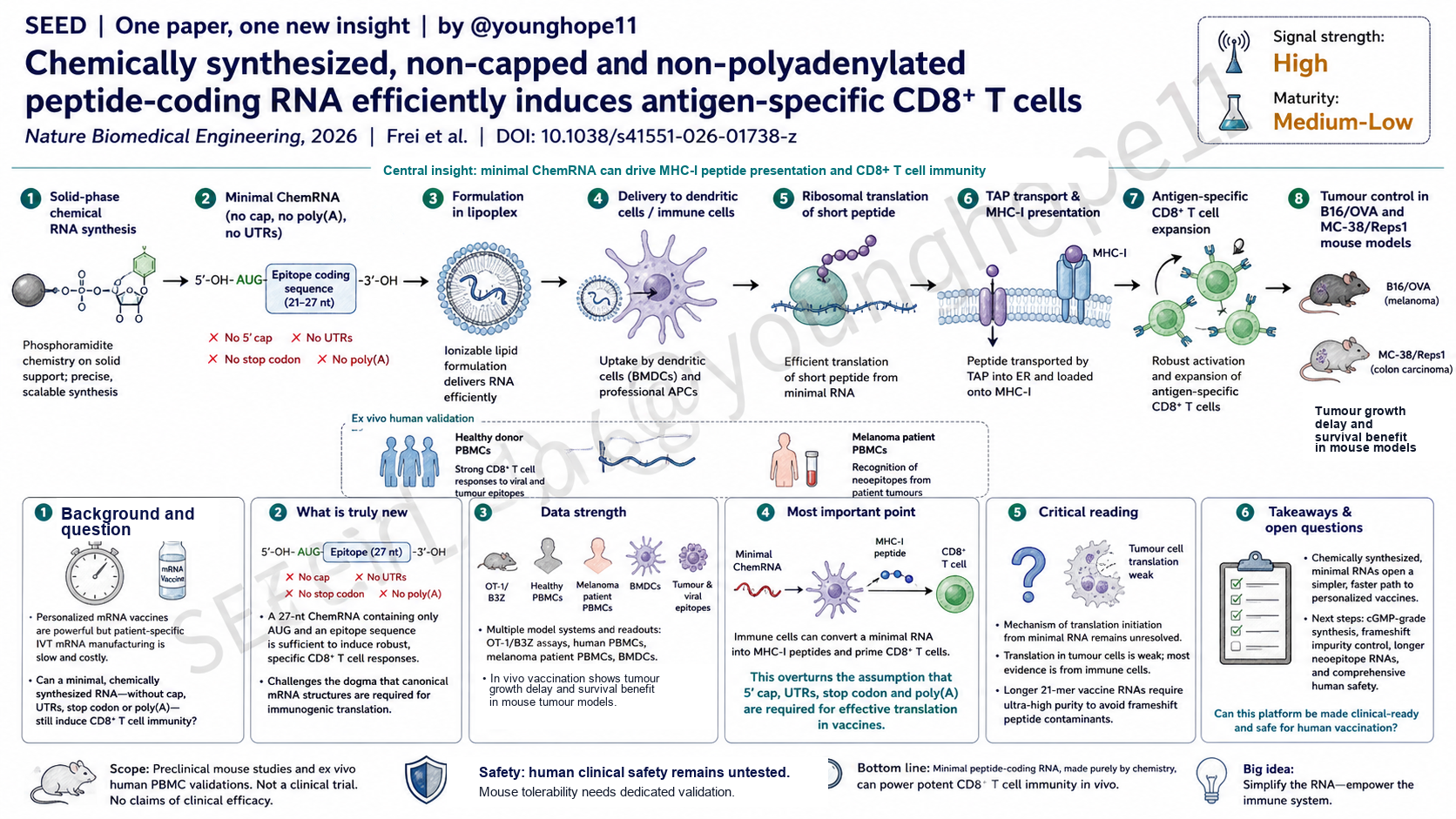
University Hospital Zurich、University of Zurich、BioNTech、TRON Mainz 等机构的 Julia Frei、Ugur Sahin、Steve Pascolo 团队近期在 Nature Biomedical Engineering 报道,一类极短、化学合成、无 5’ cap、无 UTR、无 stop codon、无 poly(A) tail 的 peptide-coding RNA,仍可在免疫细胞中被翻译并经 MHC-I 呈递,诱导抗原特异性 CD8+ T cells。作者把这种设计称为 ChemRNA,核心形式是 5’-OH-AUG-coding sequence-3’-OH。
问题不是 mRNA 疫苗能不能做,而是个体化疫苗能不能更快做
ivt mRNA 疫苗的经典结构很完整:5’ cap、5’ UTR、start codon、coding sequence、stop codon、3’ UTR 和 poly(A) tail。这套结构在 COVID-19 疫苗和肿瘤疫苗中已经证明了价值,但个体化肿瘤疫苗仍然有一个现实瓶颈:每个病人的 neoantigen 组合不同,制造端往往需要重新设计 DNA template、做 in vitro transcription、加 cap、加 poly(A)、纯化和质控。
这篇文章问的是一个更底层的问题:如果目标只是把一个 MHC-I peptide epitope 交给免疫系统,RNA 是否必须保持完整 mRNA 的全部结构?或者说,疫苗制造的最小有效单位能不能从一条复杂 ivt mRNA,缩小到一条可以化学合成的短 RNA oligonucleotide?
作者的答案很激进:在特定 CD8+ T cell epitope 场景下,一条只有 AUG 和 peptide coding sequence 的极简 RNA,也能被免疫细胞读取,并把 peptide 送进 MHC-I antigen presentation 通路。
真正的新意:27 nt ChemRNA 进入了 MHC-I 呈递通路
论文第一个核心实验围绕 SIINFEKL 这个经典 H2-Kb epitope 展开。作者设计的最短 ChemRNA 只有 27 个核苷酸,结构是 5’-OH-AUG-SIINFEKL coding sequence-3’-OH。它没有 5’ cap,没有 UTR,没有 stop codon,也没有 poly(A) tail。
结果上,这条 ChemRNA 能让抗原呈递细胞刺激 OT-1 CD8+ T cells 和 B3Z reporter cells。DNA oligonucleotide 对照不能产生同样效果,支持这个读出来自 RNA-dependent translation,而不是 DNA 或游离 peptide 污染。进一步的抑制和遗传证据显示,ChemRNA-derived peptide 的呈递依赖 ribosomal translation、TAP transport 和 MHC-I loading。
这里重要的不是“短 RNA 也能表达很多蛋白”。作者并没有证明 ChemRNA 是通用高表达平台。更准确地说,它证明了:当目标是 MHC-I peptide epitope 时,免疫细胞可以把一条极短 RNA 翻译成足够的短 peptide,并将其呈递给 CD8+ T cells。
数据强在从小鼠表位走到了人源和肿瘤表位
这篇文章的证据链不是只停在一个 model antigen。小鼠部分,作者先用 SIINFEKL 建立体系,再扩展到 MC-38 肿瘤相关突变表位,例如 Adpgk、Rpl18 和 Reps1。人源部分,作者用 HLA-A2 和 HLA-B7 健康供者 PBMCs,测试 influenza、CMV 等 viral epitopes;也用 melanoma patient PBMCs 测试 MART-1 相关 anti-cancer T cell response。
这些实验共同回答两个问题。第一,ChemRNA 不只是 SIINFEKL 特例,而是在多个 viral 和 tumour epitopes 上可见。第二,它的效应不只存在于 engineered mouse reporter 系统,也能在 human PBMC 和 melanoma patient-derived immune context 中看到 antigen-specific CD8+ T cell expansion 或 restimulation。
体内实验给了更高层级的验证。作者用 lipoplex-formulated ChemRNA 给小鼠免疫,SIINFEKL ChemRNA 能诱导 SIINFEKL-specific CD8+ T cells,并在 B16/OVA tumour challenge 中延缓肿瘤生长、延长生存。Reps1 ChemRNA 也能在 MC-38 模型中诱导 Reps1-specific CD8+ T cells 并产生保护性效应,不过整体弱于对应的 ivt mRNA。
所以这篇论文的数据强点在于跨模型一致性:cell line reporter、primary mouse immune cells、human PBMCs、patient PBMCs、BMDCs、小鼠 vaccination 和 tumour challenge 都指向同一个方向。
最重要的一点:这不是把 mRNA 做短,而是改变疫苗制造单位
如果只从免疫学读,这篇文章的结论是“非经典 RNA 结构也能产生 MHC-I peptide”。但从转化角度看,更大的信号是制造逻辑。
个体化肿瘤疫苗的核心难题之一,是速度、规模和多样性。每个病人都可能需要几十个 neoepitopes。传统 polyepitope ivt mRNA 可以把多个 epitope 串在一条 RNA 上,但需要设计连接序列,也可能引入 linker-derived 或 junction-derived unintended peptides。ChemRNA 的想法更像是把每个 epitope 变成一个可化学合成、可组合、可并行制造的短 RNA 单元。
这会带来一个潜在优势:如果化学合成、纯化和配方足够成熟,个体化疫苗可能不必为每个病人重新搭建完整 ivt mRNA 流程,而是快速合成一组 epitope-specific ChemRNAs,再通过 formulation 交给 dendritic cells 或其他 antigen-presenting immune cells。
这也是为什么这篇文章值得关注。它不是在替代所有 mRNA 药物,而是在问一个更窄、更有用的问题:对 CD8+ T cell vaccine 来说,是否存在一种比完整 mRNA 更轻、更快、更适合个体化制造的 RNA 单元?
怎样批判性地读:机制和临床制造还没有闭环
第一,翻译起始机制还没有完全解释。按照经典 mRNA 教科书,缺少 cap、UTR、stop codon 和 poly(A) 的 RNA 不应高效翻译。作者观察到免疫细胞中存在这种能力,但并没有完全定义对应的 ribosomal initiation 机制。论文讨论了 specialized ribosomes 或 immunoribosome 的可能性,但这仍然是未解决的问题。
第二,细胞类型差异很关键。ChemRNA 在 immune cells 和 interferon-stimulated non-immune cells 中更有效,而在一些 tumour cells 中 translation 较弱。对疫苗来说,这可能不是坏事,因为目标本来就是 antigen-presenting immune cells;但它也说明 ChemRNA 不是一个普遍强表达系统。
第三,Reps1 ChemRNA 在 MC-38 模型中有效,但弱于 ivt mRNA。这个差异提醒我们,ChemRNA 的优势可能主要在制造速度和模块化,而不一定在每个 epitope 的免疫强度上都超过成熟 ivt mRNA。
第四,也是最现实的瓶颈,是化学合成纯度。27 nt RNA 相对容易做到高纯度,但真实个体化肿瘤疫苗常需要编码更长的 21-mer peptides,对应 RNA 至少 66 nt。长度增加后,n-1 shortmer impurities、frameshift 和 out-of-frame unintended peptides 都会成为安全与质控问题。作者也明确指出,进入 human clinical trial 前需要优化 synthesis、purification 和 cGMP validation。
下一步该追问:ChemRNA 能否从 proof-of-concept 走到真实 neoantigen vaccine
这篇文章下一步最该追问的是三个问题。
第一,能不能稳定合成更长、更复杂的 neoepitope ChemRNAs,并做到临床级纯度?如果每条 RNA 都需要非常高纯度,平台的速度和成本优势才有机会成立。
第二,多条 ChemRNAs 混合接种时,免疫优势、表位竞争、先天免疫激活、剂量窗口和 formulation 是否可控?真实个体化疫苗不会只包含一条 SIINFEKL 或 Reps1,而会是一组 patient-specific neoepitopes。
第三,人体安全性如何证明?这篇研究是 preclinical mouse studies 加 ex vivo human PBMC validations,不是临床试验。它不能证明临床疗效,也不能证明长期安全。尤其是 longer RNA impurities、unexpected peptides、innate immune sensing 和 repeated dosing,都需要系统验证。
Yang 的信号评级:High
轴一,信号强度:High。 理由是这篇文章挑战了一个很基础的假设:CD8+ T cell epitope 的 RNA vaccine 单元,未必需要完整 mRNA 结构。证据从 SIINFEKL 走到 viral epitopes、tumour epitopes、human PBMCs、patient PBMCs 和 mouse tumour models,方向一致。
轴二,成熟度:Medium-Low。 理由是平台仍处在临床前阶段。概念很有转化潜力,但机制、长 RNA 合成纯度、cGMP 质控、多表位组合、安全性和人体免疫原性都还没有闭环。
一句话总结:这篇文章的价值,不是证明 ChemRNA 已经可以取代 ivt mRNA,而是提出了一个更轻的 CD8+ T cell vaccine 制造单位:用化学合成的极简 RNA,直接把 MHC-I epitope 交给免疫系统。
Julia Frei, Ugur Sahin, Steve Pascolo and colleagues from University Hospital Zurich, University of Zurich, BioNTech, TRON Mainz and partner institutions recently reported in Nature Biomedical Engineering that very short, chemically synthesized, peptide-coding RNAs can be translated in immune cells and presented through MHC-I. Their design, called ChemRNA, has the minimal form 5’-OH-AUG-coding sequence-3’-OH: no 5’ cap, no UTRs, no stop codon and no poly(A) tail.
The problem is not whether mRNA vaccines work, but whether personalized vaccines can be made faster
Conventional ivt mRNA vaccines are built around a full mRNA architecture: a 5’ cap, UTRs, a start codon, coding sequence, stop codon, 3’ UTR and poly(A) tail. This architecture has already proven its value in infectious disease and cancer vaccine programs.
The bottleneck for personalized cancer vaccines is different. Every patient may require a different neoantigen set. Manufacturing therefore often means rebuilding patient-specific templates, transcribing RNA in vitro, capping, polyadenylating, purifying and testing each product.
This paper asks a more minimal question: if the aim is to deliver an MHC-I peptide epitope to CD8 T cells, does the RNA unit need all the canonical mRNA features? Or can the vaccine unit be reduced to a chemically synthesized RNA oligonucleotide that simply encodes the epitope?
The answer is provocative: in this epitope-vaccine context, immune cells can read a very short RNA and generate enough peptide for MHC-I presentation.
The new idea is that 27-nt ChemRNA can enter the MHC-I pathway
The first major experiment uses the classic H2-Kb SIINFEKL epitope. The shortest ChemRNA is only 27 nucleotides long, with the structure 5’-OH-AUG-SIINFEKL coding sequence-3’-OH. It lacks a cap, UTRs, a stop codon and a poly(A) tail.
This ChemRNA activates OT-1 CD8 T cells and B3Z reporter cells through antigen-presenting cells. DNA oligonucleotide controls do not reproduce the effect, supporting an RNA-dependent translation mechanism rather than DNA or free-peptide contamination. Additional inhibition and genetic evidence place the peptide in the ribosome, TAP transport and MHC-I loading pathway.
The point is not that ChemRNA is a general high-expression platform. The more precise conclusion is narrower and more interesting: when the desired product is an MHC-I peptide epitope, immune cells can translate a minimal RNA into enough peptide to prime antigen-specific CD8 T cells.
The evidence becomes stronger because it moves beyond one model antigen
The data do not stop with SIINFEKL. In mouse systems, the authors extend ChemRNA to MC-38 tumour-associated mutated epitopes such as Adpgk, Rpl18 and Reps1. In human systems, they test HLA-A2 and HLA-B7 epitopes from influenza and CMV in healthy donor PBMCs, and MART-1-related responses in melanoma patient PBMCs.
Together, these experiments answer two concerns. First, ChemRNA is not only a SIINFEKL artifact. Second, the effect is not limited to engineered mouse reporter assays; antigen-specific CD8 T cell expansion or restimulation is also seen in human PBMC contexts.
The in vivo studies add another layer. Lipoplex-formulated SIINFEKL ChemRNA induces SIINFEKL-specific CD8 T cells in mice and delays tumour growth with survival benefit in the B16/OVA challenge model. Reps1 ChemRNA also induces Reps1-specific CD8 T cells and protective effects in the MC-38 model, although the signal is weaker than the corresponding ivt mRNA.
The strength of the paper is this cross-model consistency: reporter cells, mouse immune cells, human PBMCs, melanoma patient PBMCs, BMDCs, vaccination experiments and tumour challenge models all point in the same direction.
The most important implication is a different manufacturing unit
Read only as immunology, the paper says that non-canonical RNA structures can still generate MHC-I peptides. Read as translation science, the bigger signal is manufacturing.
Personalized cancer vaccines are constrained by speed, scale and diversity. Each patient may need a set of neoepitopes. Polyepitope ivt mRNA can place several epitopes on one construct, but it requires design of linkers and junctions, and may generate unintended linker-derived or junction-derived peptides. ChemRNA suggests a different model: treat each epitope as a chemically synthesized, modular RNA unit.
If synthesis, purification and formulation become robust enough, a personalized vaccine might be assembled from a set of epitope-specific ChemRNAs instead of rebuilding a full ivt mRNA product for every patient. That is the practical reason this paper matters.
The technology is not trying to replace all mRNA therapeutics. It asks a narrower question: for CD8 T cell vaccines, can a lighter and faster RNA unit be enough?
The critical reading is that mechanism and clinical manufacturing are still open
First, the translation initiation mechanism is not fully explained. Canonical mRNA biology would not predict efficient translation from RNA lacking a cap, UTRs, stop codon and poly(A) tail. The authors observe this capacity in immune cells, but the exact initiation machinery remains unresolved.
Second, cell type matters. ChemRNA is more effective in immune cells and interferon-stimulated non-immune cells, while translation in some tumour cells is weak. For a vaccine, that may be acceptable because the intended target is the antigen-presenting immune cell. It still means ChemRNA should not be read as a universal expression platform.
Third, the Reps1 ChemRNA signal in the MC-38 model is protective but weaker than ivt mRNA. That matters because the likely advantage of ChemRNA is manufacturing speed and modularity, not necessarily stronger immunogenicity for every epitope.
Fourth, chemical synthesis purity is the practical bottleneck. A 27-nt RNA is relatively manageable. Real personalized cancer vaccines often encode longer 21-mer peptides, requiring at least 66 nucleotides. As length increases, n-1 shortmer impurities, frameshifts and unintended out-of-frame peptides become quality and safety problems. Before human trials, the authors note that synthesis, purification and cGMP validation need optimization.
The next question is whether ChemRNA can become a real neoantigen vaccine platform
The next step is not simply to test more model epitopes. The key question is whether longer and more diverse neoepitope ChemRNAs can be synthesized at clinical-grade purity while keeping the platform fast and affordable.
A second question is combination biology. Real personalized vaccines will contain many patient-specific epitopes, not one SIINFEKL or Reps1 sequence. Multi-ChemRNA mixtures will need evaluation for immunodominance, epitope competition, innate immune sensing, dosing windows and formulation consistency.
The third question is human safety. This is a preclinical mouse and ex vivo human PBMC study, not a clinical trial. It does not establish clinical efficacy or long-term safety. Longer RNA impurities, unexpected peptides, innate immune activation and repeated dosing will need dedicated testing.
Yang’s signal rating: High
Axis 1, signal strength: High. The paper challenges a basic assumption: an RNA vaccine unit for CD8 T cell epitopes may not require full mRNA architecture. The evidence moves from SIINFEKL to viral epitopes, tumour epitopes, human PBMCs, patient PBMCs and mouse tumour models.
Axis 2, maturity: Medium-Low. The platform remains preclinical. The concept has translational potential, but mechanism, longer-RNA purity, cGMP quality control, multi-epitope combinations, safety and human immunogenicity are not yet closed.
One-sentence summary: This paper does not prove that ChemRNA can replace ivt mRNA, but it proposes a lighter CD8 T cell vaccine unit: a chemically synthesized minimal RNA that hands an MHC-I epitope to the immune system.