SEED | Biomni:把生物医学研究接上可执行工具 SEED | Biomni connects biomedical reasoning to executable tools AI-assisted · reviewed
Stanford University 的 Kexin Huang 与 Jure Leskovec 团队联合 Phylo、Genentech、Arc Institute 等机构近期在 Science 发表 Research Article,报道通用生物医学 AI agent Biomni:它把大语言模型推理、资源检索、代码执行、专业软件、数据库和实验协议组织进统一行动空间,并在生物信息学、疾病诊断、分子克隆、蛋白设计与液体处理机器人任务中展示跨域执行能力,为“AI scientist”从回答问题走向组合和执行研究工作流提供了新的平台证据。
生物医学 AI 的瓶颈,是行动空间而不只是推理能力
生物医学研究很少能靠一次问答完成。一个真实问题往往要跨越文献检索、数据库查询、数据清洗、统计建模、专业软件、实验设计、协议编写和结果解释;这些资源接口彼此不同,隐含大量领域惯例,也经常在执行过程中报错。即使基础模型会写代码,它也未必知道该选哪个数据库、怎样调用工具、何时调整计划,以及怎样保留可检查的中间结果。
已有 biomedical agents 多数围绕单一任务或模态设计,例如单细胞分析、扰动筛选或特定蛋白设计。Biomni 真正问的问题是:能否先建立一个足够广的“生物医学行动空间”,再让同一个通用 agent 根据问题动态检索资源、写出计划、执行代码并根据观察迭代,而不是为每一种研究任务预先编排固定流程?
这个问题很重要,因为“模型知道什么”与“系统能做什么”是两回事。论文的核心贡献不是再训练一个生物医学聊天模型,而是尝试把研究能力工程化为一个可检索、可组合、可执行的环境。
真正的新意:把论文中的研究动作变成可组合基础设施
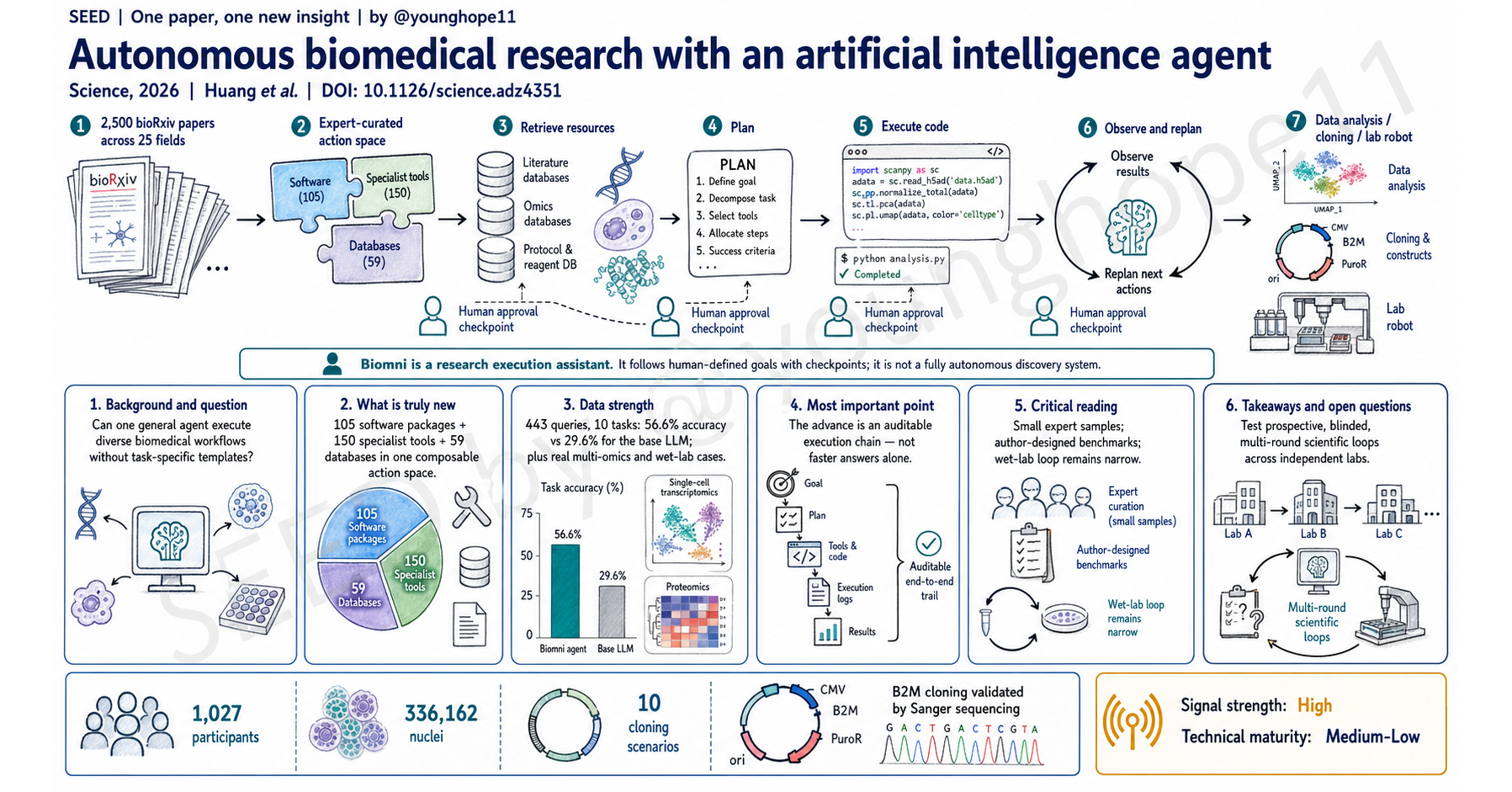
作者先从 bioRxiv 25 个主题类别中各选取 100 篇近期论文,共 2,500 篇,让 action-discovery agent 提取复现或开展这些研究所需的任务、工具、数据库和软件,再由人类专家验证和筛选。最终形成 Biomni-E1:105 个生物医学软件包、150 个专用工具以及 59 个数据库,覆盖遗传学、基因组学、细胞生物学、合成生物学、微生物学、药理学、病理学等领域。
在此之上,Biomni-A1 不依赖任务模板。面对用户问题,它先检索最相关的工具、数据库和软件,再形成逐步计划;每一步被表达为可执行代码,因此可以使用循环、并行、条件判断和原始数据操作,也能在执行错误或中间观察出现后更新计划。这种“检索资源—计划—代码执行—观察—再规划”的组合,才是 Biomni 的平台级新意。
论文还训练了 Biomni-R0:以 Qwen3 开源模型为底座,先从 Claude Sonnet 4 教师模型蒸馏,再通过与 Biomni-E1 环境交互的强化学习优化任务成功率。8B 模型平均表现从 0.318 升至 0.588,32B 模型从 0.346 升至 0.669,后者超过论文中的 Claude Sonnet 4 教师基线 0.557。这说明行动环境不仅能服务闭源前沿模型,也能成为训练专用开放模型的反馈场。
数据强在从 443 道任务走到真实数据与实验台
第一层证据是广度基准。Biomni-Eval1 包含 443 道查询,覆盖 10 类任务,包括 CRISPR delivery、因果基因检测、变异优先级、数据库与 DNA 序列查询、患者基因检测、罕见病诊断和 screen design。Biomni 平均准确率为 56.6%,高于基础 LLM 的 29.6%、TxAgent 的 25.0%、Claude Code 的 42.8%,以及接入同一生物信息环境的 coding agent 的 44.3%。在 HLE-Bio 上,把 Biomni scaffold 加到不同前沿模型后,准确率绝对提升 6-12 个百分点,提示收益不只来自某一个底座模型。
第二层是小规模人类专家对照。单细胞注释中,Biomni 准确率约 46%,处于两名专家的 41% 和 51% 之间,同时把平均分析时间从约 230 分钟降到约 75 分钟。罕见病诊断中,它达到 60% 准确率,与五名专家的 60%-70% 接近,用时约 3 分钟而专家超过 110 分钟。GWAS 因果基因检测中,它达到 80%,与专家的 70%-80% 相当,用时约 4 分钟而专家约 60-112 分钟。
第三层是异质真实工作流。Biomni 从 1,027 名参与者、14 亿余条心率和 3,700 万条步数原始记录中重建 COVID-19 相关生理分析,复现 6 个已知生物标志物,并得到 resting heart rate 与 circadian amplitude 的负相关(r = -0.34)及 steps 与 heart-rate variability 的正相关(r = +0.54)。它还对人胚胎 5-11 周、336,162 个单核 RNA/ATAC 数据执行约 5 小时、10 步的调控网络流程,重现 RUNX2 等已知关系并提出 AUTS2、ZFHX3 和 PBX1 等候选调控因子。
第四层开始触及实验执行。Biomni 在 10 个开放式分子克隆场景中获得接近一名资深专家的盲评表现;在 B2M sgRNA 克隆案例里,系统完成载体解析、sgRNA 设计、Golden Gate 协议和测序引物设计,研究者按协议操作后获得菌落,两个挑取克隆的 Sanger 测序均与目标完全一致。它还把自然语言协议转换为 PyLabRobot 代码,在 Hamilton STAR 上验证液体转移,并为 8 种化合物、12 点梯度、三重复的细胞活力实验生成完整流程。
最重要的一点:价值来自把推理接入可审计的执行链
这篇论文最值得记住的,不是“AI 速度比人快几十倍”。机器运行数据库查询和代码本来就应当更快,计时差异并不能单独证明科学能力。真正重要的是,Biomni 把模型推理放进了一个有明确资源边界、执行轨迹、中间产物和错误反馈的环境,使输出不再只是自然语言建议,而是代码、图表、协议、日志和可继续验证的候选假设。
这改变了评价 AI-for-Science 系统的方式。未来不应只问模型能否给出正确答案,而应问:它能否选择合适资源,执行长链任务,遇错恢复,留下可复现轨迹,把计算结论翻译成实验步骤,并让专家在关键节点审阅。Biomni 的强信号在于,它用一个统一架构触及了这条链上的多个环节。
但“可执行”仍不等于“自主发现”。论文中的强案例主要是复现已有分析、执行被指定的研究问题、完成设计明确的克隆任务,或产生尚待验证的候选调控因子。系统是否能自主选择一个重要而非平庸的问题、识别隐性混杂、设计有区分力的实验、解释失败结果并在多轮湿实验中收敛,仍未被证明。
怎样批判性地读:“自主研究”这个标题走在证据前面
第一,基准与专家对照的独立性有限。Biomni-Eval1、真实任务提示和多数评价均由作者团队设计或实施;专家对照中的单细胞与 GWAS 任务只有两名专家,克隆对照是一名 trainee 和一名 senior expert。443 道任务带来覆盖面,但不等于覆盖真实科研中更开放、更含糊、更难定义金标准的问题。下一步需要预注册、外部团队维护、持续更新且防数据污染的独立评测。
第二,湿实验闭环仍窄。B2M 克隆是有价值的真实验证,但本质上是一个成熟、规则清晰的分子生物学任务,且最终由人类照协议完成。蛋白稳定性案例的 -4.108 kcal/mol 是 ThermoMPNN 的预测改进,并非实测熔解温度或功能稳定性;Hamilton STAR 案例证明代码可以驱动设备,却没有展示 agent 根据实验读数自动决定下一轮实验。论文更准确地证明了“跨域研究执行助手”,而不是完整的 self-driving laboratory。
第三,通用性仍依赖人类把隐性知识写进提示。作者明确指出,复杂 scRNA-seq/scATAC-seq 流程在提示中给出中间分析步骤后更稳健;需要临床判断、实验推理或深层生物学综合的任务仍明显落后。行动空间只从每个 bioRxiv 类别的 100 篇近期论文构建,也可能高估新方法、遗漏经典但仍关键的技术与概念。
第四,可靠性与安全不能只靠“能执行”。错误数据库映射、软件版本漂移、不可重复随机性、无效统计选择和似是而非的机制解释,都可能在长链流程中累积。若系统能生成协议和机器人代码,权限控制、沙盒、试剂与设备限额、危险任务拦截、完整审计日志和人工批准节点就必须成为架构的一部分。作者提到 biosecurity 风险并选择开放源码与常用学术工具,但这还不是系统级安全验证。
最后,利益冲突值得透明阅读。Kexin Huang、Serena Zhang、Yuanhao Qu、Le Cong 和 Jure Leskovec 持有 Phylo, Inc. 股权,部分作者同时任职于 Phylo 或 Genentech;Biomni 的用户界面也由 Phylo 提供。这不否定数据,但“通用性”“专家水平”和转化价值需要由独立实验室在自己的数据、设备和失败案例中复现。
下一步应验证真正的科学闭环,而不只是更多 demo
最关键的下一步是建立前瞻性、盲法、跨机构评测:让外部生物学家提交未公开问题与原始数据,预先定义成功标准、资源预算和人工介入次数,同时记录每个工具调用、失败恢复、结论变更和最终可复现性。准确率之外,还应报告 calibration、严重错误率、无效分析率、成本、延迟和专家审阅负担。
第二,应把湿实验从“一次协议成功”推进到多轮闭环。例如让 agent 基于第一轮测量自动选择下一轮条件,与人类科学家、固定自动化 pipeline 和单一 LLM 对照,比较达到目标所需的实验次数、总成本、失败模式和最终发现质量。只有在未知问题上完成“提出假设—设计区分性实验—读取结果—修正模型—再实验”,自主科研的主张才真正成立。
第三,需要把 provenance 和 governance 设计成产品底层能力。每个结论都应能追溯到数据库版本、代码、参数、模型版本和中间文件;高风险动作要有分级权限与人工批准。论文已经开放 Biomni 代码 和 Biomni-R0 权重,这为独立复现创造了条件,也使社区可以检验:平台的价值究竟来自 agent scaffold、工具环境、底座模型,还是精心设计的提示与任务选择。
Yang 的信号评级:High
轴一,信号强度:High。 理由是 Biomni 提出的不是单任务 agent,而是一套“资源检索—计划—代码执行—观察—再规划”的通用生物医学行动环境;论文用 443 道跨域任务、多个底座模型、开放模型强化学习、真实多组学数据、分子克隆和机器人执行提供了多层证据,并开放了代码、数据和模型权重。
轴二,技术成熟度:Medium-Low。 理由是系统在结构化、可定义金标准的任务上表现强,但外部独立评测不足,专家样本很小,复杂流程仍依赖详细提示,湿实验只完成有限单轮验证,尚未证明能在开放问题上自主形成可靠的多轮科学闭环。
一句话总结:Biomni 的突破不是让 AI 更像一位“会回答的科学家”,而是第一次把通用生物医学 agent 的行动空间、执行链和训练反馈场放在同一套可扩展基础设施里。
Kexin Huang, Jure Leskovec and colleagues at Stanford University, Phylo, Genentech, the Arc Institute and partner institutions recently published a Research Article in Science describing Biomni, a general-purpose biomedical AI agent. Biomni organizes large-language-model reasoning, resource retrieval, code execution, specialist software, databases and experimental protocols into a unified action space, then demonstrates cross-domain execution in bioinformatics, disease diagnosis, molecular cloning, protein design and liquid-handling robotics. The work provides new platform-level evidence for moving an “AI scientist” from answering questions toward composing and executing research workflows.
Biomedical AI is constrained by action space, not only reasoning
Biomedical research is rarely completed with a single answer. A real problem often spans literature retrieval, database queries, data cleaning, statistical modelling, specialist software, experimental design, protocol writing and interpretation. These resources expose incompatible interfaces, embed substantial tacit knowledge and routinely fail during execution. Even a foundation model that can write code may not know which database to choose, how to call a tool, when to revise a plan or how to preserve intermediate results for inspection.
Most existing biomedical agents are designed around one task or modality, such as single-cell analysis, perturbation screening or a specific protein-design problem. Biomni asks a broader question: can one first construct a sufficiently wide biomedical “action space” and then let a general agent retrieve resources, write a plan, execute code and revise its plan from observations, rather than predefining a workflow for every research task?
That distinction matters because what a model knows and what a system can do are different. The central contribution is not another biomedical chatbot. It is an attempt to engineer research capability as a searchable, composable and executable environment.
The new idea is to turn research actions into composable infrastructure
The authors sampled 100 recent papers from each of 25 bioRxiv subject categories, for a total of 2,500 papers. An action-discovery agent extracted the tasks, tools, databases and software required to reproduce or conduct the reported work, after which human experts verified and curated the resources. The resulting Biomni-E1 environment contains 105 biomedical software packages, 150 specialist tools and 59 databases spanning genetics, genomics, cell biology, synthetic biology, microbiology, pharmacology and pathology.
Biomni-A1 operates on top of that environment without task templates. Given a question, it retrieves the most relevant tools, databases and software, then generates a stepwise plan. Each step is expressed as executable code, enabling loops, parallel execution, conditional logic and raw-data operations. The agent can update its plan after an execution error or intermediate observation. This retrieve-plan-code-observe-replan loop is Biomni’s main platform-level novelty.
The paper also trains Biomni-R0. Starting from open Qwen3 models, the authors first distil from Claude Sonnet 4 and then apply reinforcement learning through interaction with Biomni-E1. Average performance rises from 0.318 to 0.588 for the 8B model and from 0.346 to 0.669 for the 32B model; the latter exceeds the paper’s Claude Sonnet 4 teacher baseline of 0.557. The environment can therefore serve not only frontier closed models but also as a feedback field for training specialised open models.
The evidence moves from 443 queries to data and the laboratory
The first layer is benchmark breadth. Biomni-Eval1 contains 443 queries across 10 tasks, including CRISPR delivery, causal-gene detection, variant prioritisation, database and DNA-sequence queries, patient-gene detection, rare-disease diagnosis and screen design. Biomni reaches 56.6% average accuracy, above a base LLM at 29.6%, TxAgent at 25.0%, Claude Code at 42.8% and a coding agent connected to the same bioinformatics environment at 44.3%. On HLE-Bio, adding the Biomni scaffold to several frontier backbones produces absolute gains of 6-12 percentage points, suggesting that the benefit is not tied to one model.
The second layer is a small human-expert comparison. In single-cell annotation, Biomni achieves roughly 46% accuracy, between two experts at 41% and 51%, while reducing average analysis time from about 230 minutes to about 75 minutes. In rare-disease diagnosis, it reaches 60%, close to five experts at 60%-70%, in about 3 minutes versus more than 110 minutes for the experts. In GWAS causal-gene detection, it reaches 80%, comparable with experts at 70%-80%, in about 4 minutes versus roughly 60-112 minutes.
The third layer comprises heterogeneous real workflows. From raw data covering 1,027 participants, more than 1.4 billion heart-rate measurements and 37 million step records, Biomni reconstructs a COVID-19 physiological analysis, recovers six known biomarkers and obtains a negative resting-heart-rate/circadian-amplitude correlation (r = -0.34) and a positive steps/heart-rate-variability correlation (r = +0.54). It also executes a roughly five-hour, ten-stage regulatory-network workflow on 336,162 single-nucleus RNA/ATAC profiles from human embryos at 5-11 weeks, recovering known RUNX2 relationships and nominating AUTS2, ZFHX3 and PBX1 as candidate regulators.
The fourth layer reaches experimental execution. Across 10 open-ended cloning scenarios, Biomni receives blinded ratings close to one senior expert. In a B2M sgRNA cloning case, it performs plasmid analysis, sgRNA design, Golden Gate protocol generation and sequencing-primer design. Researchers following the protocol obtain colonies, and two picked clones show perfect target alignment by Sanger sequencing. Biomni also converts natural-language protocols into PyLabRobot code, validates liquid transfers on a Hamilton STAR and generates a complete workflow for an eight-compound, 12-dose, triplicate cell-viability assay.
The key value is connecting reasoning to an auditable execution chain
The most important message is not that “AI is dozens of times faster than people.” Machines should be faster at database querying and code execution, so timing differences alone do not establish scientific ability. The real advance is that Biomni puts model reasoning inside an environment with explicit resources, execution traces, intermediate artefacts and error feedback. Its outputs are no longer only prose recommendations; they include code, plots, protocols, logs and hypotheses that can be inspected and tested.
This changes how AI-for-Science systems should be evaluated. The question is not only whether a model can state the right answer. It is whether the system selects appropriate resources, executes long-horizon tasks, recovers from errors, preserves a reproducible trace, translates computational conclusions into experimental steps and lets experts review critical decisions. Biomni’s strongest signal is that one architecture touches several parts of that chain.
Execution, however, is not the same as autonomous discovery. The strongest examples reproduce published analyses, execute researcher-specified questions, complete a well-defined cloning task or produce candidate regulators that still require validation. The paper does not yet show that Biomni can select an important rather than trivial question, identify hidden confounding, design discriminating experiments, interpret failure and converge through multiple wet-lab rounds.
Read “autonomous research” more cautiously than the title suggests
First, the independence of the benchmarks and expert comparisons is limited. The author team designed or implemented Biomni-Eval1, the realistic prompts and much of the evaluation. The single-cell and GWAS comparisons use only two experts, while the cloning comparison uses one trainee and one senior expert. A 443-query benchmark offers breadth, but it does not represent open-ended research problems with ambiguous goals and disputed ground truth. The next generation of evaluation should be preregistered, externally maintained, continuously updated and designed to limit data contamination.
Second, the wet-lab loop remains narrow. The B2M cloning experiment is valuable, but it is a mature, rules-based molecular-biology task, and people still execute the protocol. The reported -4.108 kcal/mol protein-stability improvement is a ThermoMPNN prediction, not a measured melting temperature or functional-stability result. The Hamilton STAR case establishes that generated code can control equipment, but it does not show the agent using experimental readouts to choose the next experiment. The paper more convincingly demonstrates a cross-domain research execution assistant than a complete self-driving laboratory.
Third, generality still depends on people making tacit knowledge explicit in prompts. The authors state that the complex scRNA-seq/scATAC-seq workflow is more robust when intermediate analytical steps are specified. Tasks requiring clinical judgement, experimental reasoning or deep biological synthesis remain weaker. Constructing the action space from only 100 recent papers in each bioRxiv category may also overweight fashionable methods while missing older but foundational techniques and concepts.
Fourth, reliability and safety cannot be inferred from executability. Incorrect database mappings, software-version drift, irreproducible stochasticity, invalid statistical choices and plausible but wrong mechanistic interpretations can compound across a long workflow. Once a system generates protocols and robot code, permission tiers, sandboxing, reagent and instrument limits, dangerous-task filters, complete audit logs and human approval gates become part of the scientific architecture. The authors acknowledge biosecurity risk and emphasise open source and common academic tools, but this is not yet a system-level safety validation.
Finally, competing interests deserve transparent attention. Kexin Huang, Serena Zhang, Yuanhao Qu, Le Cong and Jure Leskovec hold equity in Phylo, Inc.; several authors are affiliated with Phylo or Genentech, and Phylo provides the Biomni user interface. This does not invalidate the results, but claims of generality, expert-level performance and translational value require replication by independent laboratories using their own data, instruments and failure cases.
The next test is a scientific loop, not another collection of demos
The most important next step is prospective, blinded and cross-institutional evaluation. External biologists should submit unreleased problems and raw data, with success criteria, resource budgets and the number of permitted human interventions defined in advance. Every tool call, recovery from failure, conclusion change and final reproducibility outcome should be logged. In addition to accuracy, evaluations should report calibration, severe-error rate, invalid-analysis rate, cost, latency and expert review burden.
Second, wet-lab testing should move from one successful protocol to a multi-round loop. The agent could use first-round measurements to select the next conditions and be compared with human scientists, a fixed automated pipeline and a single LLM on experiments required, total cost, failure modes and final discovery quality. The autonomous-research claim becomes persuasive only when a system can complete hypothesis-proposing, discriminating-experiment design, result reading, model revision and re-experimentation on an unknown problem.
Third, provenance and governance should become core product capabilities. Every conclusion should trace back to database version, code, parameters, model version and intermediate files; high-risk actions should require tiered permissions and human approval. The authors have released the Biomni code and Biomni-R0 weights, creating the conditions for independent replication and for testing whether value comes from the agent scaffold, tool environment, backbone model, or carefully designed prompts and task selection.
Yang’s signal rating: High
Axis 1, signal strength: High. Biomni is not a single-task agent but a general biomedical action environment built around resource retrieval, planning, code execution, observation and replanning. The paper supports this architecture with 443 cross-domain queries, several backbone models, reinforcement learning of open models, real multi-omics data, molecular cloning and robotic execution, while releasing code, data and model weights.
Axis 2, technical maturity: Medium-Low. The system is strong on structured tasks with definable ground truth, but independent external evaluation is limited, expert samples are small, complex workflows still benefit from detailed prompts, and the wet-lab evidence consists of narrow, mostly single-round validations. It has not yet demonstrated a reliable autonomous scientific loop on open problems.
One-sentence summary: Biomni’s breakthrough is not making AI look more like a scientist who can answer questions; it puts a general biomedical agent’s action space, execution chain and training feedback field into one extensible infrastructure.