SEED | N-of-1 疗法:为一个患者重写开发路线 SEED | N-of-1 therapies rewrite development for one patient AI-assisted · reviewed
University of Twente 的 Anneliene H. Jonker、Leiden University Medical Center 的 Annemieke Aartsma-Rus 等代表 International Rare Diseases Research Consortium (IRDiRC) N-of-1 Task Force 撰写的 Review,梳理了 ASO、基因与细胞疗法、个体化癌症疫苗和小分子药物在 N-of-1 治疗中的案例与平台经验,并提出“识别合适患者—开发疗法与临床前评价—评估个体疗效”的三阶段路线图,为一个传统药物开发模式无法覆盖的极端问题提供了较完整的领域框架:如何为一个或极少数患者造药,同时不放弃质量、安全、证据、公平与长期学习。
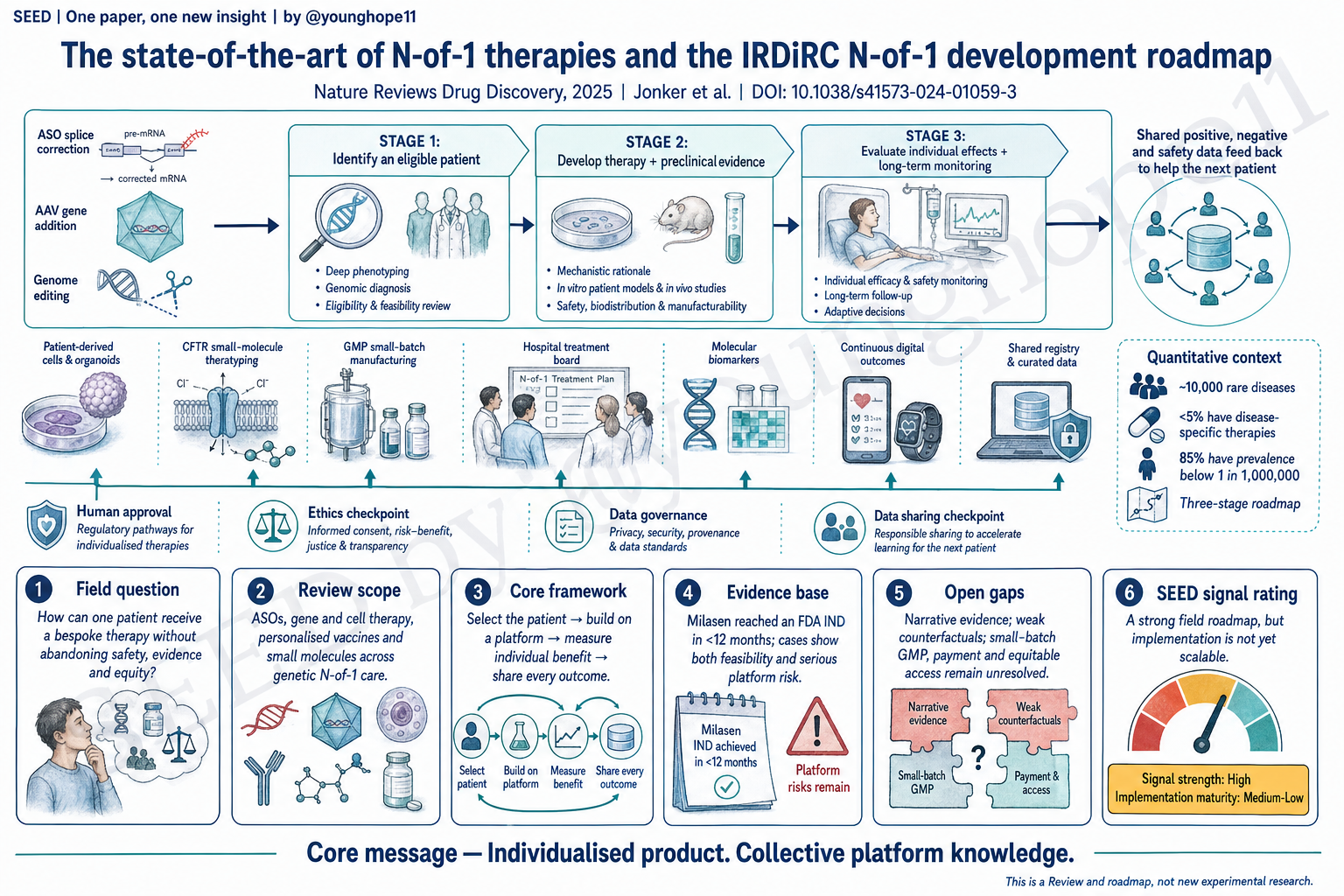
当患者只有一个,传统开发模式哪里失效
全球约有 10,000 种已识别的罕见病,估计影响 2.5 亿至 4.5 亿人,但不足 5% 有针对疾病本身的药物。更关键的是,85% 的罕见病患病率低于百万分之一,有些疾病或致病变异在诊断时只见于一个人。传统开发路线依赖可聚合的人群、分期临床试验、可复制的统一终点和足以回收成本的市场;当潜在治疗对象只有一人时,这套逻辑在统计、时间和商业上同时失效。
作者将遗传背景下的 N-of-1 therapy 定义为:针对一个或极少数患者的致病变异,通常直接修复致病机制、恢复蛋白功能或降低异常蛋白表达的个体化疗法。文章提出疗法预计最多适用于五名具有同一变异的人,但也承认“五人”是人为边界。它不同于经典 N-of-1 crossover trial:后者在单个患者中交叉比较已有药物与安慰剂,主要目标仍是产生可推广的研究信息;这里讨论的是专门为该患者开发实验性治疗,首要目标是患者福祉。
真正的难题因而不是“能否合成一条 ASO”,而是怎样在没有传统试验人群的条件下回答四个问题:这个人还有没有可挽救的治疗窗口?产品是否有足够的生物学活性与质量?不可避免的不确定性是否仍能形成可接受的 benefit-risk?个体治疗产生的经验怎样被安全地共享并帮助下一个患者?
IRDiRC 路线图:把一次救援拆成可复用的三阶段系统
第一阶段是识别真正适合 N-of-1 的患者。路线图要求确认遗传诊断、变异致病性、疾病机制、受累器官和治疗可及性;判断既有获批或在研疗法是否已经失败或不适用;评估疾病是否已造成不可逆损伤,以及患者是否仍处在有意义的治疗窗口。资格判断还包括常被忽略的现实条件:医院能否承担责任、跨学科团队能否持续管理、费用是否有来源,以及患者和家庭真正重视什么功能、能接受多大不确定性。
第二阶段是开发疗法和临床前评价。选择 ASO、AAV gene addition、genome editing、细胞疗法或小分子,并不是从零开始追求最先进技术,而是尽量依托已有平台的化学、载体、给药途径、制造与安全知识。之后要在患者来源细胞或其他相关模型中证明预期分子效应,完成适合该产品与司法辖区的安全研究,并以 GMP 或 GMP-like 标准生产少量临床级产品,至少保证纯度、无菌与无内毒素。
第三阶段是证明和持续评估个体获益。没有随机人群时,可比较患者治疗前后的自身轨迹、相似自然史患者、同时或历史对照,在特殊情况下使用未治疗的对侧器官或 digital avatar。临床终点必须对患者有意义,并尽可能加入更早、更直接的分子 pharmacodynamic readout,例如脑脊液或血液中的蛋白恢复。频繁或连续测量的数字终点可提高单患者信噪比。治疗前还应设定 start/stop criteria、独立的 readiness 或 monitoring board、数据权属与共享计划,以及长期安全随访。
这套框架真正的新意不是画出另一条线性管线,而是加入返回箭头:每一个病例的阳性、阴性和不安全结果,都应进入共享平台,反过来压缩下一个病例的设计、毒理、制造和监管工作。因此,N-of-1 的核心悖论是:产品必须个体化,平台知识必须集体化。
证据链强在跨疗法案例,也清楚暴露风险边界
ASO 是目前最成熟的 N-of-1 模态,因为序列可以改变,而骨架化学、作用机制、制剂和鞘内给药经验可从 nusinersen 等平台外推。milasen 是标志性案例:全基因组测序发现 MFSD8 隐匿剪接变异后,患者来源细胞实验显示 ASO 能恢复正常剪接和溶酶体功能,随后完成大鼠安全研究、临床级制造和伦理审查,从变异识别到 FDA IND 用时不到 12 个月。治疗后癫痫发作减少、生活质量改善,但既有神经损伤无法逆转,患者后来去世。这个病例同时证明“可以做得很快”和“治疗窗口决定上限”。
FUS-ALS 的 jacifusen 后来发展为 ulfnersen,并进入更大患者群的临床试验;针对 ATM 隐匿剪接变异的 atipeksen 从第一名患者扩展到第二名同变异患者,说明最初的 N-of-1 可能变成 N-of-few。文章发表时,n-Lorem 已建立覆盖 90 多个靶基因的管线,提交 13 项 IND,并开始治疗 8 名患者。这些案例支持平台化效率,但疗效证据仍来自少量患者、疾病自然史比较和异质终点。
基因与细胞治疗显示了更尖锐的风险边界。已有 AAV、lentiviral 和 genome-editing 平台提供可借用的制造与监管知识,但高剂量 AAV 的不可重复给药、免疫反应和长期风险更难在一个患者身上消化。文章特别讨论了为特定 DMD 变异开发的 AAV9 个体化治疗:患者在治疗后因针对载体的先天免疫反应发生急性呼吸窘迫并死亡。路线图因此没有把“罕见且致命”当作降低标准的理由,而是要求将平台风险、具体疾病状态和治疗不可逆性共同纳入判断。
小分子 CFTR modulators 则提供另一种外推路径。FDA 曾主要依据体外功能证据,把 ivacaftor 的适用变异从 10 个扩到 33 个;患者来源 organoid 等“CF avatars”可继续为极罕见变异做 theratyping。这说明 N-of-1 不一定意味着新造一种药,也可以是用可信的功能模型把已有药物扩展到未进入临床试验的单个基因型。
这篇 Review 的证据优势是覆盖多种模态、真实成败案例、患者视角以及美国、欧盟、澳大利亚和加拿大的监管差异。它的强项是构建领域地图,而不是给出某一种 N-of-1 疗法的汇总疗效估计。
最大局限:路线图比疗效证据和支付机制更成熟
首先,这是一篇由 IRDiRC Task Force 撰写的叙述性 Review 与共识路线图,不是 systematic review 或 meta-analysis。文章没有报告系统检索、纳入排除标准或证据分级;案例跨疾病、模态、年龄、终点和监管路径,无法量化比较。成功病例更容易发表,失败、无效和因时间窗错失治疗的项目可能被低估,因此不能从这些案例推断平均成功率。
其次,“N-of-1”的边界并不完全稳定。真正针对独特变异重新设计的 ASO,与患者来源但构建基本相同的 CAR-T、按 neoantigen 个体化的癌症疫苗、以及为罕见 CFTR 变异选择已有小分子的 theratyping,面对的制造、风险和证据问题并不相同。把它们放进同一领域地图有启发性,但也可能弱化每种模态需要独立回答的风险。
第三,单患者疗效判断存在难以消除的反事实问题。超罕见病常缺少自然史数据,不同变异的病程可能完全不同;临床结局会被发育、支持治疗、测量波动和观察者期待影响。分子 biomarker 可以更早提示 target engagement,却未必等同于患者真正获益。即使连续数字测量提高信噪比,也不能自动解决疾病自然波动和无对照偏倚。
第四,经济与公平仍是路线图最弱的一环。文章指出个体化疗法目前可能耗资数百万美元,美国大多数 payer 不覆盖实验性 N-of-1,欧洲医院吸收费用也不可扩展。subscription 和 pay-for-performance 只是待验证的支付思路。若准入最终依赖家庭筹款、所在医院能力或地理位置,再先进的个体化医学也可能扩大不平等。
最后,作者群本身就是该生态的建设者:部分作者参与 N = 1 Collaborative、n-Lorem、Rare Therapies Launch Pad、Creyon Bio、Cure Rare Disease 或持有相关 ASO 专利与咨询关系。文章透明披露了这些关系,且多方视角是形成路线图的优势;但平台效率、监管可行性和长期获益仍需要独立、前瞻性数据检验。
对转化的意义:不是为每个人从零造药,而是标准化可变部分
这篇 Review 对转化最重要的启发,是把 N-of-1 从英雄式救援转向 platform medicine。真正可扩展的单位不是单个药物,而是一套可重复使用的化学骨架或载体、制造流程、release criteria、毒理逻辑、监管档案、终点工具和治理模板;每位患者只改变必须改变的序列或 cargo。监管部门允许跨 IND 引用同平台资料、制造端发展 small-batch GMP、负面结果进入共享数据库,才可能让下一位患者更快、更安全、更便宜。
临床端的第一优先级应是更早诊断和更严格筛选,而不是“确诊后必造药”。渐进性神经病中,等到不可逆功能丧失后再启动一年开发,可能得到分子矫正却没有临床恢复。资格委员会需要把治疗窗口、可测量获益、替代方案、患者风险偏好、医院承载能力和资金来源放在同一次讨论中,并由独立委员会减少研发者自身投入带来的判断偏差。
证据端应建立跨病例、跨平台的模块化注册体系:既保存每位患者个体化的临床与分子终点,又用统一 adverse-event dictionary、平台批次信息、给药、实验模型和长期随访字段积累可比较证据。成功数据不够,未治疗、无效、毒性和停止治疗的原因同样必须共享。对患者而言,数据分享不能成为接受治疗的隐性条件,数据所有权、隐私和退出权需要在治疗前明确。
最终,N-of-1 的成熟标志不是出现更多“为一个孩子造药”的故事,而是形成可审计的中心网络:有明确 eligibility、可复用平台、独立 benefit-risk 审查、长期随访、透明失败数据库和不以家庭财富决定准入的支付机制。
Yang 的信号评级:High
轴一,信号强度:High。 这篇 Review 把分散的 ASO、AAV、细胞疗法、个体化疫苗和小分子案例,重新组织为一套以患者资格、平台复用、个体证据和数据回流为核心的三阶段开发框架;它没有把希望与证据混为一谈,并用 milasen 的局限和个体化 AAV 的致死事件明确标出风险边界。
轴二,实施成熟度:Medium-Low。 ASO 等平台已证明 N-of-1 可以进入临床,但总体疗效证据仍是少数异质病例,标准化制造、跨病例安全外推、单患者因果推断、全球监管协同、长期监测、支付和公平都没有可规模化答案。
一句话总结:N-of-1 疗法可以只为一个人制造,但它若想成为医学体系而不是偶发奇迹,知识、标准、失败经验与支付责任就必须被许多人共同承担。
Anneliene H. Jonker at the University of Twente, Annemieke Aartsma-Rus at Leiden University Medical Center and colleagues writing on behalf of the International Rare Diseases Research Consortium (IRDiRC) N-of-1 Task Force reviewed cases and platform experience across antisense oligonucleotides, gene and cell therapy, personalised cancer vaccines and small molecules. Their Nature Reviews Drug Discovery Review proposes a three-stage roadmap - identify an eligible patient, develop the therapy and its preclinical evidence, then evaluate effects in that individual - for an extreme problem that conventional drug development cannot cover: how to make a treatment for one or very few people without abandoning quality, safety, evidence, equity and long-term learning.
Where conventional development fails when the patient is one
Roughly 10,000 rare diseases are recognised worldwide and together affect an estimated 250-450 million people, yet fewer than 5% have disease-specific pharmacological therapies. More importantly, 85% of rare diseases have a prevalence below one in a million, and some diseases or pathogenic variants are known in only one person at diagnosis. Conventional development depends on an aggregable population, phased trials, reproducible common endpoints and a market large enough to recover costs. When the potential treatment population is one, the statistical, temporal and commercial logic fails at the same time.
In the genetic context, the authors define an N-of-1 therapy as an individualised treatment for one or very few people that typically targets the patient’s pathogenic variant directly, restores protein function or reduces expression of a dysfunctional protein. They suggest that the same variant-specific therapy would be expected to address no more than five people, while acknowledging that five is an arbitrary boundary. This is distinct from a classical N-of-1 crossover trial, which compares existing drugs and placebo within one patient to generate generalisable research information. Here, an experimental treatment is developed specifically for that patient, with the patient’s welfare as the primary goal.
The real question is therefore not whether one can synthesise an ASO. It is how to decide whether the patient still has a rescuable treatment window, whether the product has sufficient biological activity and quality, whether unavoidable uncertainty still permits an acceptable benefit-risk judgement, and how experience from one treatment can be shared safely to help the next patient.
The IRDiRC roadmap turns a rescue into a reusable three-stage system
Stage one identifies a genuinely eligible patient. The roadmap asks teams to confirm the genetic diagnosis, variant pathogenicity, disease mechanism, affected organs and treatment amenability; determine whether approved or investigational options have failed or are unavailable; and assess whether irreversible damage has already closed the treatment window. Eligibility also includes practical conditions that are often omitted: whether a hospital can assume responsibility, whether a multidisciplinary team can provide long-term care, whether funding exists, what functions the patient and family value, and how much uncertainty they accept.
Stage two covers therapy development and preclinical evaluation. Selecting an ASO, AAV gene addition, genome editing, cell therapy or small molecule should not mean choosing the newest technology from scratch. It should reuse established platform knowledge about chemistry, vectors, route of administration, manufacturing and safety wherever possible. Teams then need to demonstrate the intended molecular effect in patient-derived cells or another relevant model, complete safety work appropriate to the product and jurisdiction, and manufacture a small clinical lot under GMP or GMP-like standards, including purity, sterility and absence of endotoxin.
Stage three establishes and continuously evaluates individual benefit. Without a randomised population, investigators can compare the patient’s post-treatment course with their own pre-treatment trajectory, similar natural-history patients, concurrent or historical controls, an untreated contralateral organ in special cases, or a digital avatar. Clinical endpoints must be meaningful to the patient and should be complemented by earlier, more direct molecular pharmacodynamic readouts, such as restoration of a protein in cerebrospinal fluid or blood. Frequent or continuous digital measures may improve signal-to-noise at the single-patient level. Before treatment, the programme should also define start/stop criteria, an independent readiness or monitoring board, data ownership and sharing, and long-term safety follow-up.
The framework’s real novelty is not another linear pipeline but its return arrow: positive, negative and unsafe outcomes from every case should flow into shared platforms and reduce the design, toxicology, manufacturing and regulatory burden for the next case. The central paradox is that the product must be individualised, while platform knowledge must be collective.
The evidence base spans modalities and exposes the risk boundary
ASOs are currently the most mature N-of-1 modality because the sequence can change while backbone chemistry, mechanism, formulation and intrathecal-delivery experience can be extrapolated from platforms such as nusinersen. Milasen is the landmark case. After whole-genome sequencing identified a cryptic-splicing variant in MFSD8, patient-derived cells showed that the ASO restored normal splicing and lysosomal function. Rat safety studies, clinical-grade manufacturing and ethical review followed, and the FDA IND was opened less than 12 months after variant identification. Seizure frequency and quality of life reportedly improved, but accumulated neurological damage could not be reversed and the patient later died. The case demonstrates both that development can be rapid and that the treatment window sets a hard ceiling.
Jacifusen for FUS-ALS later became ulfnersen and moved into a trial in a larger group. Atipeksen, developed for an ATM cryptic-splicing variant, expanded from the first patient to a second patient with the same variant, showing how an N-of-1 can become an N-of-few. At the time covered by the Review, n-Lorem had built a pipeline spanning more than 90 target genes, filed 13 INDs and started treatment in eight patients. These cases support platform efficiency, but efficacy evidence still comes from small numbers, natural-history comparisons and heterogeneous endpoints.
Gene and cell therapy reveal a sharper safety boundary. Existing AAV, lentiviral and genome-editing platforms offer reusable manufacturing and regulatory knowledge, but high-dose AAV, inability to redose after immunity and long-term risks are harder to absorb in one patient. The Review highlights an individualised AAV9 treatment for a specific DMD variant: the patient developed acute respiratory distress from an innate immune response to the vector and died. The roadmap therefore does not treat rarity and lethality as reasons to lower standards; it asks teams to integrate platform risk, the patient’s disease state and the irreversibility of treatment.
Small-molecule CFTR modulators offer a different extrapolation model. The FDA expanded ivacaftor eligibility from 10 to 33 variants partly on in vitro functional evidence. Patient-derived organoids, or “CF avatars”, can extend theratyping to extremely rare variants. N-of-1 therefore does not always mean manufacturing a new drug; it may mean using a credible functional model to extend an existing therapy to one genotype absent from clinical trials.
The Review’s evidence strength is its coverage of multiple modalities, real successes and failures, patient perspectives, and regulatory differences across the United States, European Union, Australia and Canada. Its strength is field mapping, not a pooled estimate of efficacy for any N-of-1 modality.
The roadmap is more mature than the efficacy and payment evidence
First, this is a narrative Review and consensus roadmap written by the IRDiRC Task Force, not a systematic review or meta-analysis. It does not report a systematic search, inclusion and exclusion criteria or evidence grading. Cases span diseases, modalities, ages, endpoints and regulatory paths and cannot be compared quantitatively. Successful cases are more likely to be published, while failed, ineffective or time-window-missed programmes may be underrepresented, so no average success rate can be inferred.
Second, the boundary of “N-of-1” is unstable. A truly variant-specific ASO, a patient-derived but otherwise standardised CAR-T product, a personalised neoantigen vaccine and theratyping of an existing CFTR modulator face different manufacturing, risk and evidence problems. Placing them on one map is useful, but it can blur the modality-specific questions that each still needs to answer.
Third, individual efficacy assessment has a hard counterfactual problem. Ultra-rare diseases often lack natural-history data, and trajectories can differ greatly between variants. Development, supportive care, measurement noise and observer expectations can alter clinical outcomes. A molecular biomarker may show target engagement earlier but may not equal meaningful patient benefit. Continuous digital measurement can improve signal-to-noise without automatically resolving natural fluctuation or uncontrolled bias.
Fourth, economics and equity remain the weakest part of the roadmap. The Review notes that individualised therapies may currently cost millions of dollars, that most US payers do not cover experimental N-of-1 treatment and that European hospitals absorbing costs is not scalable. Subscription and pay-for-performance models remain proposals. If access depends on family fundraising, hospital capability or geography, advanced individualised medicine may widen inequality.
Finally, the authors are builders within the same ecosystem. Some participate in the N = 1 Collaborative, n-Lorem, Rare Therapies Launch Pad, Creyon Bio or Cure Rare Disease, or hold relevant ASO patents and consulting relationships. These ties are disclosed and the multi-stakeholder perspective is a strength of the roadmap, but claims about platform efficiency, regulatory feasibility and long-term benefit still require independent prospective evidence.
Translation means standardising what can vary, not starting from zero
The Review’s most important translational implication is to move N-of-1 therapy from heroic rescue toward platform medicine. The scalable unit is not one drug but a reusable chemical backbone or vector, manufacturing workflow, release criteria, toxicology logic, regulatory dossier, outcome toolkit and governance template. Only the sequence or cargo that must change should change for each patient. Cross-referencing platform data across INDs, developing small-batch GMP and sharing negative results are what can make the next case faster, safer and less expensive.
Clinically, the priority should be earlier diagnosis and stricter selection, not automatic drug building after diagnosis. In progressive neurological disease, beginning a year-long programme after irreversible function is lost can produce molecular correction without clinical recovery. An eligibility board should consider treatment window, measurable benefit, alternatives, patient risk preference, institutional capacity and funding in one decision, while an independent group limits bias from the development team’s personal investment.
Evidence infrastructure should use modular registries across cases and platforms. Each patient needs individualised clinical and molecular outcomes, but adverse events, platform batch data, dosing, experimental models and long-term follow-up require common fields. Successful outcomes are not enough: untreated cases, lack of efficacy, toxicity and reasons for stopping treatment must also be shared. For patients, data sharing cannot be an implicit condition of access; ownership, privacy and the right to withdraw should be explicit before treatment.
The mature endpoint for N-of-1 is therefore not a larger collection of stories about making a drug for one child. It is an auditable network of centres with clear eligibility, reusable platforms, independent benefit-risk review, long-term follow-up, transparent failure databases and a payment system that does not make family wealth the admission criterion.
Yang’s signal rating: High
Axis 1, signal strength: High. The Review reorganises fragmented ASO, AAV, cell-therapy, personalised-vaccine and small-molecule cases into a three-stage framework centred on patient eligibility, platform reuse, individual evidence and data feedback. It does not confuse hope with evidence and uses both milasen’s limits and a fatal individualised AAV case to mark the risk boundary.
Axis 2, implementation maturity: Medium-Low. ASO and related platforms show that N-of-1 treatment can reach patients, but efficacy evidence remains a small set of heterogeneous cases. Standardised manufacturing, cross-case safety extrapolation, single-patient causal inference, regulatory convergence, long-term monitoring, payment and equity do not yet have scalable solutions.
One-sentence summary: An N-of-1 therapy may be manufactured for one person, but it can become a medical system rather than an occasional miracle only when knowledge, standards, failures and financial responsibility are shared by many.