SEED | 地中海贫血走到基因治疗,真正的鸿沟仍在治疗门外 SEED | Thalassaemia has reached gene therapy, but access is still the gap AI-assisted · reviewed
Imperial College London 的 Frédéric B. Piel 与 Mariane de Montalembert、Reena Das、Kevin H. M. Kuo、Ali T. Taher、Khaled M. Musallam、Douglas Higgs、Elliott Vichinsky、Maria Domenica Cappellini、Lucia De Franceschi 等跨国专家近期在 Nature Reviews Disease Primers 撰写 Primer,系统梳理 α/β 地中海贫血从球蛋白链失衡、筛查诊断到输血祛铁、疾病修饰药、造血干细胞移植和基因治疗的完整照护链。这篇 Review 的核心价值,不是报道一个新疗法,而是把一个全球性遗传血红蛋白病的关键矛盾讲清楚:治疗手段正在快速变多,但决定患者结局的,仍然常常是能否进入连续、可负担、可长期维持的医疗系统。
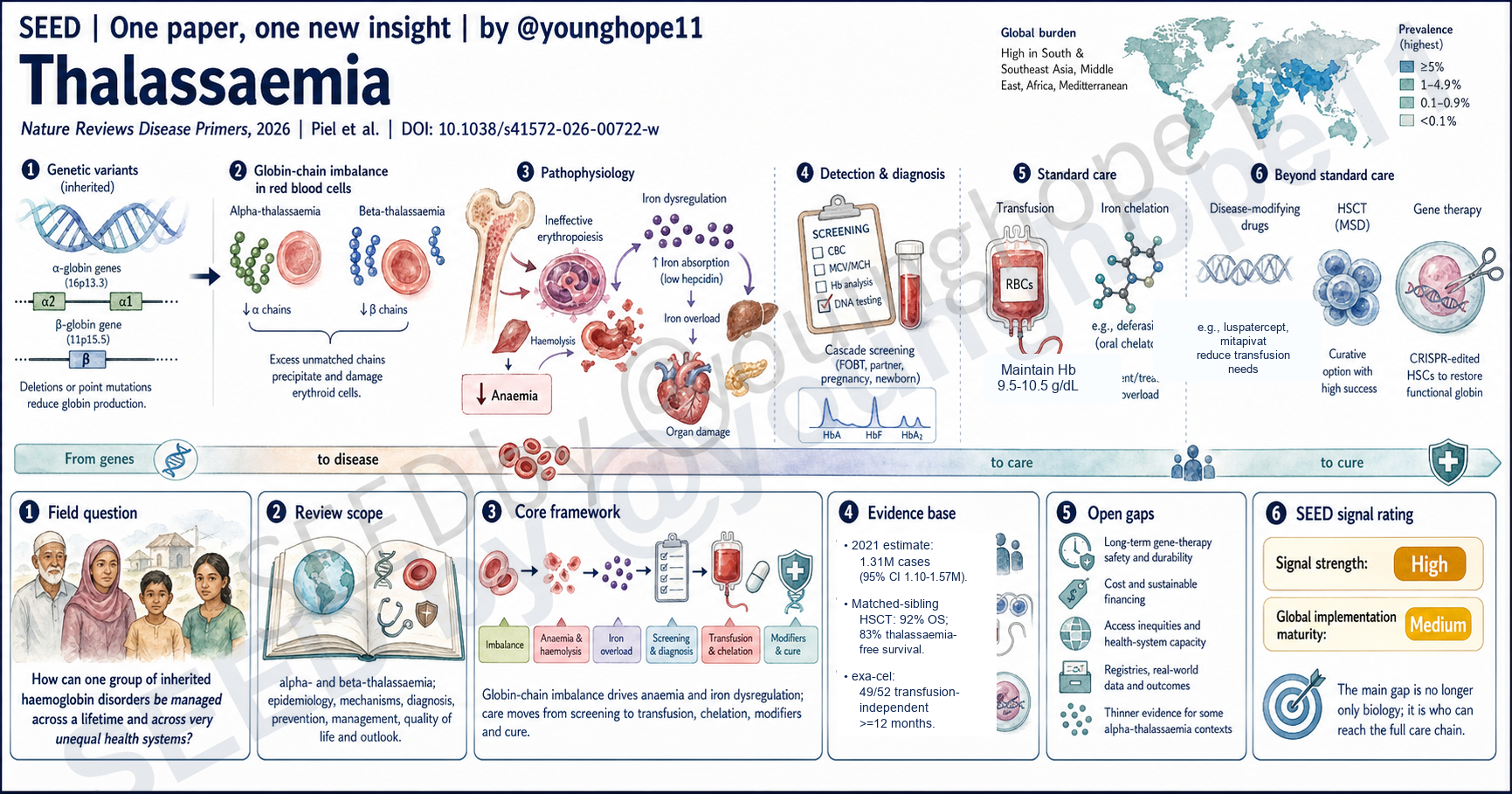
这篇 Primer 问的不是一种贫血,而是一条照护链能否接住患者
地中海贫血不是单一疾病,而是一组影响血红蛋白生成的遗传性疾病。α-地中海贫血和 β-地中海贫血都源于 α 或 β 珠蛋白生成不足,但临床表现可以从几乎无症状的携带者,到需要终身输血的重型疾病,甚至胎儿或新生儿期死亡。它的高发区集中在地中海、中东、南亚、东南亚和非洲部分地区,但人口迁移已经让它成为真正的全球性医疗问题。
文章引用 2021 年全球疾病负担估计,全球约有 1,310,407 名地中海贫血患者,95% CI 为 1,099,973 至 1,572,220;同年约有 119,679 个新发病例,95% CI 为 93,218 至 153,985。作者同时提醒,这些数字仍有很大不确定性,因为许多国家缺少完整登记系统,轻症、未诊断和死亡前未被识别的病例容易被漏掉。
这篇 Primer 真正要回答的问题是:当一个疾病从基因、红细胞、铁代谢、输血安全、药物可及性、长期器官损伤、生育筛查、心理负担和医保支付一路串起来时,我们应该怎样判断领域进步到了哪一步?如果只看基因治疗的突破,会低估仍在基础照护之外的患者;如果只看传统输血,又会错过正在改变病程的新疗法。
它整理出的框架:从球蛋白链失衡走向分层治疗
这篇 Primer 的主线很清楚:减少的 α 或 β 珠蛋白链会造成未配对链积累,损伤红细胞前体和成熟红细胞,引发无效造血、溶血和贫血。贫血又推动红细胞生成素上升,继而通过 erythroferrone、FGL1、BMP6-hepcidin 等轴影响铁稳态,使肠道铁吸收增加;反复输血则进一步叠加继发性铁过载。也就是说,地中海贫血不是简单的“血红蛋白低”,而是一套由造血压力和铁代谢失衡共同驱动的长期全身病。
诊断和预防位于照护链最前端。常规血常规、红细胞指数和血红蛋白分析可以发现许多病例,但共遗传变异、罕见突变和迁移背景会让表型解释变复杂,必要时需要分子检测确认。新生儿筛查、婚前或孕前携带者筛查、产前诊断和遗传咨询都能改变家庭和公共卫生层面的结局,但它们依赖实验室能力、文化接受度、法律环境和可获得的生育选择。
管理端则形成一条阶梯。输血依然是许多 transfusion-dependent thalassaemia 患者的生命线,国际指南通常建议维持输血前血红蛋白约 9.5-10.5 g/dL,并用铁蛋白和 MRI 监测铁过载。祛铁治疗把反复输血从短期救命变成可长期维持的方案。随后是降低输血负担或改善贫血的新药,例如 luspatercept 和 mitapivat。最上层是可能治愈的治疗,包括异基因造血干细胞移植、lentiviral gene addition 和 CRISPR-Cas9 相关的 exa-cel。
这个框架有一个重要提醒:不同治疗不是互相替代的口号,而是同一条照护链上的不同环节。没有早期诊断、安全血源、稳定祛铁和长期随访,患者不一定能等到或承受更复杂的治疗;而没有疾病修饰药、移植和基因治疗,很多患者仍被锁在终身输血和器官损伤的轨道里。
证据强在临床照护锚点,而不是单一新发现
这篇 Primer 的证据优势在于,它把传统照护和新疗法放在同一张图里,而不是只讲某一种技术。过去几十年中,安全输血、规范祛铁和 MRI 铁负荷监测已经显著改善患者寿命。文章引用意大利 50 年队列:transfusion-dependent thalassaemia 患者中位生存期为 71.2 年,non-transfusion-dependent thalassaemia 为 79.5 年,而一般人群为 83.6 年。这个数字同时说明两件事:好照护可以把疾病从儿童致死推向长期生存,但重型患者的死亡风险仍没有回到普通人群水平。
疾病修饰药给了中间层证据。luspatercept 在 BELIEVE 研究中纳入 336 名 transfusion-dependent β-地中海贫血患者,治疗组在第 13-24 周达到至少 33% 输血负担下降的比例为 21.4%,安慰剂组为 4.5%。mitapivat 在 ENERGIZE 研究中让 42% 的 non-transfusion-dependent α 或 β 地中海贫血患者血红蛋白升高至少 1 g/dL,而安慰剂组为 2%;在 ENERGIZE-T 中,30.4% 的治疗组患者在任意连续 12 周达到至少 50% 输血量下降,安慰剂组为 12.6%。这些数据不是“治愈”,但说明降低输血负担已经从愿望进入可检验的临床终点。
治愈性治疗的信号更强,也更受限制。HLA 匹配同胞供者造血干细胞移植的长期总体生存率约为 92%,thalassaemia-free survival 约为 83%,但供者、年龄、器官状态和中心经验都会影响风险。beti-cel 已证明部分 β-地中海贫血患者可实现长期输血独立,但欧洲和英国授权后来撤回,提示商业、实施和可及性本身也是疗法命运的一部分。exa-cel 在 CLIMB THAL-111 中治疗 52 名 β-TDT 患者,其中 49 名达到至少 12 个月输血独立,并且总血红蛋白可达到约 12 g/dL 以上、红细胞中 HbF 占比很高。这是强临床信号,但需要 busulfan 清髓、复杂制造、长期安全随访和高成本支付。
这篇 Review 因此强在“把强证据放在正确位置”:传统照护的证据支持寿命改善,新药支持降低输血负担,移植和基因治疗支持部分患者走向输血独立;但每一层证据都绑定了不同的风险、资源和适用人群。
最大局限:全球现实比治疗管线更不整齐
首先,这是一篇 Primer 型叙述性 Review,不是 systematic review 或 meta-analysis。它整合了遗传学、流行病学、机制、指南、队列和临床试验,但没有系统检索、纳入排除标准或定量证据分级。因此,它适合帮助读者建立领域地图,不适合被当作某种治疗策略的汇总疗效估计。
其次,全球疾病负担和真实世界照护质量仍不清楚。许多高负担地区缺少登记系统、分子诊断、MRI 铁负荷监测、规范输血和长期祛铁。相反,试验数据和长期生存数据往往来自资源更充足的中心。结果是:文章展示的治疗阶梯在医学上成立,但很多患者实际能踏上的台阶远少于图中所示。
第三,新疗法证据仍主要集中在 β-地中海贫血和 transfusion-dependent 人群。α-地中海贫血、HbH disease、非输血依赖人群、合并复杂基因型和低资源地区患者的证据相对薄弱。基因治疗和基因编辑的长期安全、继发恶性肿瘤风险、生育影响、清髓毒性和老年或器官受损患者适用性,都需要更长时间观察。
第四,可及性是最难被漂亮管线图解决的问题。文章直接指出,不应幻想所有人都能获得治愈。对许多地区而言,更现实的优先级仍是预防、早诊、安全血源、可持续祛铁、低成本移植和能降低输血需求的药物。如果一次性疗法价格达到数百万美元,而基础输血和祛铁仍不稳定,医学突破可能会在全球层面扩大而不是缩小差距。
最后,作者群包括多位与药企、基金会、患者组织或相关项目有咨询、研究资助和合作关系的专家。这不削弱他们作为领域建设者的价值,但读者需要把行业关系、指南经验和临床试验解释放在同一个批判框架里看。
对转化判断的意义:别只问能否治愈,要问谁能走完整条路
这篇 Primer 对转化最有价值的一点,是把地中海贫血从“某个疗法是否有效”重新拉回“系统能否持续交付照护”。对高资源中心而言,关键问题可能是怎样选择移植、beti-cel、exa-cel、luspatercept 或 mitapivat,怎样处理清髓风险、长期随访和患者偏好。对很多高负担地区而言,更紧迫的问题仍是筛查覆盖、血液安全、祛铁可负担性、铁负荷监测和医生/患者教育。
这也改变了我们看基因治疗的方式。基因编辑让一部分患者有机会摆脱终身输血,但它不是从天而降的单点奇迹,而是建立在诊断、输血、祛铁、感染控制、干细胞采集、清髓、住院照护和长期监测之上的最后一段路。照护链前面的环节越薄弱,越先进的疗法越难公平抵达患者。
对研究和产业来说,下一步不只是把 cure 做得更强,也要把 care 做得更稳。更好的全球登记系统、更便宜的铁负荷监测、更容易部署的祛铁方案、能减少输血但不要求复杂住院的新药、低毒性 conditioning、低成本制造和跨地区支付模型,可能比单个 headline trial 更能决定这个领域的真实影响。
Yang 的信号评级:High
轴一,信号强度:High。 这篇 Primer 把地中海贫血的遗传机制、铁代谢、筛查预防、终身管理、疾病修饰药和治愈性疗法连成一条清晰照护链,并且没有把“出现基因治疗”误写成“问题已经解决”。它帮助读者同时看见医学进展和系统缺口。
轴二,全球实施成熟度:Medium。 在高资源中心,输血、祛铁、药物减负、移植和部分基因治疗已经构成较成熟的治疗组合;但在全球层面,诊断、血液安全、祛铁、MRI、登记系统、长期随访、价格和支付仍明显不均衡。最先进的疗法已经可见,公平抵达仍未成熟。
一句话总结:地中海贫血的故事已经从“能不能活下来”走到“能不能摆脱终身输血”,但患者能走到哪一步,仍很大程度取决于他是否站在一条完整的照护链上。
Frédéric B. Piel at Imperial College London and an international group including Mariane de Montalembert, Reena Das, Kevin H. M. Kuo, Ali T. Taher, Khaled M. Musallam, Douglas Higgs, Elliott Vichinsky, Maria Domenica Cappellini and Lucia De Franceschi recently wrote a Nature Reviews Disease Primers Primer that maps alpha- and beta-thalassaemia from globin-chain imbalance and diagnosis to transfusion, iron chelation, disease-modifying drugs, haematopoietic stem cell transplantation and gene therapy. The value of the Review is not a new experiment or a single new treatment. It clarifies the central tension in a global inherited haemoglobin disorder: therapeutic options are multiplying, but outcomes still depend heavily on whether patients can enter a continuous, affordable and durable care system.
The question is not one anaemia, but whether the care chain holds
Thalassaemia is not one disease. It is a group of inherited disorders that reduce haemoglobin production. Alpha- and beta-thalassaemia both reflect insufficient production of alpha or beta globin chains, but the clinical spectrum ranges from asymptomatic carrier states to lifelong transfusion dependence and, in the most severe forms, fetal or neonatal death. The highest-burden regions include the Mediterranean, Middle East, South Asia, Southeast Asia and parts of Africa, but migration has made thalassaemia a genuinely global health issue.
The Primer cites a 2021 Global Burden of Disease estimate of 1,310,407 people living with thalassaemia worldwide, with a 95% CI of 1,099,973 to 1,572,220, and 119,679 new cases that year, with a 95% CI of 93,218 to 153,985. The authors also stress that these numbers remain uncertain because many countries lack comprehensive registries and because mild, undiagnosed or pre-diagnosis fatal cases are easily missed.
The real question is how to judge a field when the disease runs from genes, red cells and iron biology through transfusion safety, drug access, organ damage, reproductive screening, psychological burden and payment systems. If one looks only at gene therapy, one misses patients still outside basic care. If one looks only at transfusion, one misses therapies that are beginning to change the disease course.
The framework runs from globin imbalance to layered treatment
The Primer’s organising logic is straightforward. Reduced alpha or beta globin leaves unmatched chains that damage erythroid precursors and mature red cells, causing ineffective erythropoiesis, haemolysis and anaemia. Anaemia increases erythropoietin drive, which in turn influences iron homeostasis through erythroferrone, FGL1 and BMP6-hepcidin signalling, increasing intestinal iron absorption. Repeated transfusion adds secondary iron overload. Thalassaemia is therefore not simply “low haemoglobin”; it is a long-term systemic disease driven by both marrow stress and iron dysregulation.
Diagnosis and prevention sit at the front of the care chain. Complete blood counts, red-cell indices and haemoglobin analysis detect many cases, but coinherited variants, rare mutations and migration backgrounds complicate interpretation and may require molecular confirmation. Newborn screening, premarital or preconception carrier screening, antenatal diagnosis and genetic counselling can change outcomes for families and health systems, but they depend on laboratory capacity, cultural acceptance, legal context and available reproductive choices.
Management then forms a treatment ladder. Transfusion remains the lifeline for many people with transfusion-dependent thalassaemia, with international guidance typically aiming for pretransfusion haemoglobin around 9.5-10.5 g/dL and monitoring iron overload with ferritin and MRI. Chelation turns repeated transfusion from short-term rescue into a sustainable long-term strategy. A newer layer consists of drugs that reduce transfusion burden or improve anaemia, including luspatercept and mitapivat. The highest-intensity layer is potentially curative treatment: allogeneic haematopoietic stem cell transplantation, lentiviral gene addition and CRISPR-Cas9-based exa-cel.
The framework’s important message is that these treatments are not competing slogans. They are different links in the same care chain. Without early diagnosis, safe blood, stable chelation and long-term follow-up, patients may not reach or tolerate more complex interventions. Without disease-modifying drugs, transplantation and gene therapy, many patients remain locked into lifelong transfusion and organ injury.
The evidence is strongest where clinical anchors are clear
The strength of this Primer is that it puts conventional care and new therapies on the same map. Over recent decades, safe transfusion, systematic iron chelation and MRI-based iron monitoring have greatly improved survival. The article cites an Italian 50-year cohort in which median survival was 71.2 years for transfusion-dependent thalassaemia, 79.5 years for non-transfusion-dependent thalassaemia and 83.6 years in the general population. The numbers carry two messages at once: good care has shifted the disease from childhood lethality toward long-term survival, but severe disease still has not reached background risk.
Disease-modifying drugs provide the intermediate layer of evidence. In the BELIEVE trial, which enrolled 336 patients with transfusion-dependent beta-thalassaemia, 21.4% of patients receiving luspatercept achieved at least a 33% reduction in transfusion burden during weeks 13-24, compared with 4.5% on placebo. In ENERGIZE, mitapivat led to a haemoglobin increase of at least 1 g/dL in 42% of patients with non-transfusion-dependent alpha- or beta-thalassaemia, compared with 2% on placebo. In ENERGIZE-T, 30.4% of treated patients achieved at least a 50% reduction in transfusion burden during any consecutive 12-week period, compared with 12.6% on placebo. These are not cures, but they show that reducing transfusion burden is now a measurable clinical endpoint rather than only an aspiration.
Curative therapies carry stronger signals and sharper constraints. HLA-matched sibling transplantation has long-term overall survival around 92% and thalassaemia-free survival around 83%, but donor availability, age, organ status and centre experience all shape risk. Beti-cel has shown durable transfusion independence in some patients with beta-thalassaemia, but its European and UK authorisations were later withdrawn, which makes commercial implementation and access part of the therapy’s real-world fate. In CLIMB THAL-111, exa-cel treated 52 patients with beta-TDT, and 49 achieved transfusion independence for at least 12 months, with total haemoglobin around or above 12 g/dL and very high fetal-haemoglobin contribution in red cells. That is a strong clinical signal, but it comes with busulfan myeloablation, complex manufacturing, long-term safety follow-up and high-cost payment questions.
The Review is strongest when it places each form of evidence at the right level: conventional care supports survival gains, newer drugs support lower transfusion burden, and transplantation or gene therapy can make selected patients transfusion independent. Each layer also carries a different risk, resource requirement and eligible population.
The biggest limitation is that global reality is less orderly than the pipeline
First, this is a Primer-style narrative Review, not a systematic review or meta-analysis. It integrates genetics, epidemiology, mechanism, guidelines, cohorts and clinical trials, but it does not report a systematic search, inclusion and exclusion criteria or quantitative evidence grading. It is useful as a field map, not as a pooled efficacy estimate for any one treatment strategy.
Second, global burden and real-world care quality remain poorly measured. Many high-burden regions lack registries, molecular diagnosis, MRI iron monitoring, standardised transfusion and reliable long-term chelation. By contrast, trial data and long-term survival data often come from better-resourced centres. The treatment ladder is medically coherent, but many patients can access only a few of its steps.
Third, evidence is still concentrated in beta-thalassaemia and transfusion-dependent populations. Alpha-thalassaemia, HbH disease, non-transfusion-dependent populations, complex genotypes and patients in lower-resource settings have thinner evidence bases. The long-term safety of gene therapy and gene editing, secondary malignancy risk, fertility effects, conditioning toxicity and suitability for older patients or those with organ damage require longer follow-up.
Fourth, access is the hardest problem for any clean pipeline figure to solve. The article states directly that it would be an illusion to think that cure will be possible for all. In many settings, the more realistic priorities are prevention, early diagnosis, safe blood, sustainable chelation, low-cost transplantation and drugs that reduce transfusion need. If one-time therapies cost millions of dollars while basic transfusion and chelation remain unstable, biomedical progress may widen global inequality rather than close it.
Finally, several authors have consultancy, funding or collaboration relationships with companies, foundations, patient organisations or programmes in the field. That does not diminish their value as field builders, but it means readers should evaluate industry links, guideline experience and trial interpretation within the same critical frame.
Translation means asking who can complete the whole route
The most useful translational message of this Primer is that thalassaemia should not be judged only by whether a given treatment works. It should be judged by whether a health system can deliver the full care chain. In high-resource centres, the central question may be how to choose among transplantation, beti-cel, exa-cel, luspatercept and mitapivat while balancing conditioning risk, long-term follow-up and patient preference. In many high-burden settings, the more urgent questions are screening coverage, blood safety, affordable chelation, iron monitoring and education for clinicians and patients.
That also changes how gene therapy should be understood. Gene editing gives some patients a path away from lifelong transfusion, but it is not a stand-alone miracle. It sits on top of diagnosis, transfusion, chelation, infection control, stem-cell collection, myeloablation, inpatient care and long-term monitoring. The weaker the earlier links, the less fairly the most advanced therapies can reach patients.
For researchers and industry, the next task is not only to make cure more powerful. It is also to make care more stable. Better global registries, cheaper iron monitoring, deployable chelation strategies, drugs that reduce transfusion without complex hospitalisation, lower-toxicity conditioning, lower-cost manufacturing and cross-region payment models may determine the field’s true impact as much as any headline trial.
Yang’s signal rating: High
Axis 1, signal strength: High. This Primer connects thalassaemia genetics, iron biology, screening, lifelong management, disease-modifying drugs and curative therapy into a clear care chain, while avoiding the mistake of treating the arrival of gene therapy as proof that the problem is solved. It helps readers see medical progress and system gaps at the same time.
Axis 2, global implementation maturity: Medium. In high-resource centres, transfusion, chelation, transfusion-reducing drugs, transplantation and some gene therapies already form a relatively mature treatment set. Globally, however, diagnosis, blood safety, chelation, MRI access, registries, long-term follow-up, pricing and payment remain highly uneven. The most advanced therapies are visible; equitable delivery is not mature yet.
One-sentence summary: Thalassaemia has moved from “can patients survive?” toward “can some patients leave lifelong transfusion?”, but how far a patient can go still depends heavily on whether they stand on a complete care chain.