SEED | 让胞嘧啶碱基编辑躲过体内‘橡皮擦’ SEED | Helping cytosine base editing escape the cell's eraser AI-assisted · reviewed
上海科技大学的 Junjie Zhu 与 Jia Chen、复旦大学的 Li Yang 和 Jiaxu Hong 团队近期在 Nature Biotechnology 报道,病毒样颗粒(VLP)递送胞嘧啶碱基编辑器在体内效率低,并不只是颗粒装得少或进不了细胞,而是编辑产生的尿嘧啶会被细胞内源 DNA 修复系统迅速清除。团队通过同时改造 transformer base editor(tBE)与 VLP,提高尿嘧啶 DNA 糖基化酶抑制蛋白 UGI 的装载,建立 tBE-VLP4,并在小鼠肝脏和视网膜中实现高效 C→T 编辑和相应表型改善。
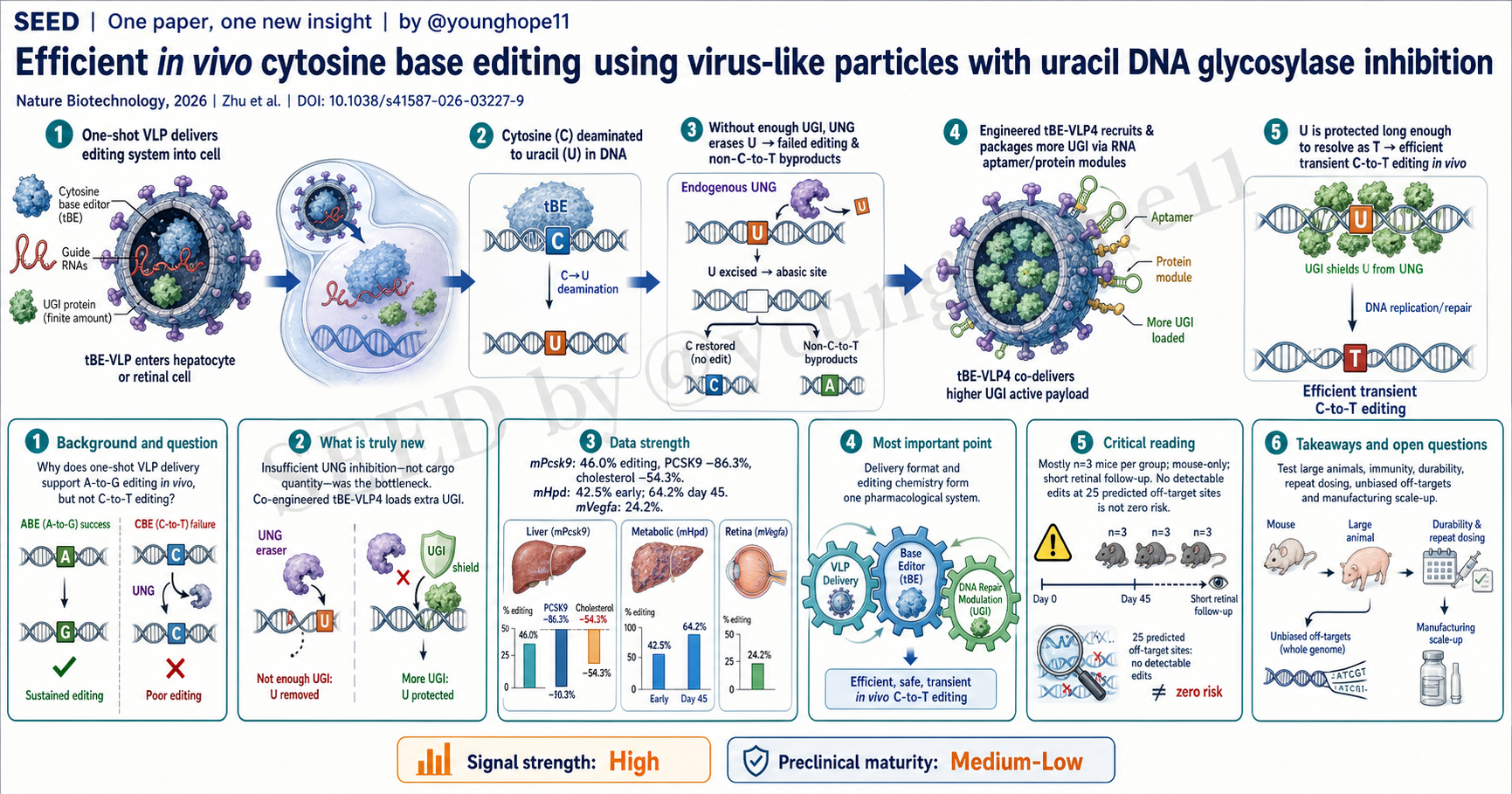
C→T 编辑进了细胞,为什么到了体内就消失
碱基编辑的吸引力,是不用制造 DNA 双链断裂,就能完成特定碱基转换。腺嘌呤碱基编辑器(ABE)把 A 变成肌苷 I,细胞随后把它读成 G;胞嘧啶碱基编辑器(CBE)则先把 C 变成尿嘧啶 U,再在复制或修复中固定为 T。两条路线看起来相似,但它们面对的细胞环境并不相同:I 通常不会被内源 DNA 糖基化酶有效移除,U 却是 DNA 修复系统熟悉的异常信号,UNG 和 SMUG1 等酶会主动把它切掉。
这在持续表达系统中不一定是致命问题。质粒和 AAV 能在细胞内持续生成编辑器及 UGI,LNP-mRNA 也能短时间产生较多蛋白;VLP 的优势恰恰是只递送预先装好的编辑器蛋白和向导 RNA,作用快、暴露短,也减少长期表达带来的脱靶和整合风险。可同一个特点也形成软肋:颗粒带来的 UGI 是有限的一次性蛋白货物,一旦降解,刚被改成 U 的位点就可能重新被“擦掉”。
作者先做了一个很有说服力的对照。tBE-VLP1 与 ABE8e-VLP 在 N2a 细胞中分别达到 41.0% 和 43.3% 编辑,说明两套颗粒在体外都能工作;尾静脉注射进入小鼠后,ABE8e-VLP 在肝脏 mPcsk9 位点达到 41.7% A→G 编辑,而 tBE-VLP1 的 C→T 编辑降到不可检测。颗粒剂量、Cas9 和向导 RNA 装载量相近,提示真正的问题不是简单的“送得不够多”。
真正的新意:把递送失败追到 DNA 修复
团队用两条互补证据把原因锁定在尿嘧啶修复。第一条是在同时敲除 hUNG 与 hSMUG1 的 293FT 细胞中递送 tBE-VLP1:C→T 效率显著上升,C→A、C→G 等非目标副产物明显下降。第二条是在普通细胞中预先过表达 UGI,同样能恢复 VLP 递送后的 C→T 编辑。两种干预分别移除“橡皮擦”或增加“橡皮擦抑制剂”,结果指向同一个机制。
在此基础上,研究没有停留在发现原因,而是连续迭代四代系统。tBE-VLP2 在主、辅向导 RNA 上加入 boxB 适配体,借助 N22p 蛋白招募更多 UGI;tBE-VLP3 尝试用 UGI-COM 模块提高装载,却因为 nCas9 进入颗粒不足而损失效率;最终的 tBE-VLP4 把 UGI-COM 与 nCas9 分别融合到 MMLV Gag,并按 1:1 比例共同包装,在不明显改变 Cas9 含量和颗粒产量的情况下增加向导 RNA 与 UGI 相关组分,取得最高 C→T 效率和最低非 C→T 副产物。
这项工作的真正新意因此不是“又做了一个更高效的 VLP”,而是识别了一种由编辑化学和瞬时递送方式共同造成的瓶颈:CBE 的中间产物会被修复,而一次性蛋白递送没有持续的 UGI 补给。解决方案必须同时设计编辑器、RNA 支架、抑制蛋白装载和颗粒组装,而不是只优化进入细胞的效率。
数据强在三条体内证据链,而不只是一条编辑率
第一条证据链是肝脏 mPcsk9。单次尾静脉注射 2 × 10^12 个 tBE-VLP4 颗粒后,小鼠肝脏平均 C→T 编辑率达到 46.0%。一周内,血清 PCSK9 蛋白下降 86.3%,总胆固醇下降 54.3%,而甘油三酯没有显著改变。与携带同一编辑器的 AAV 和 LNP 相比,VLP 的编辑效率相近但略低于 LNP,同时在所检查的心、肾、肺和脾中没有明显编辑,显示出较强的肝脏偏向性。
第二条证据链是 I 型遗传性酪氨酸血症。研究在 Fah 缺失小鼠中通过编辑 mHpd 制造提前终止密码子,从代谢通路上游绕开 FAH 缺陷。未治疗小鼠在停用 NTBC 后持续失重并于第 15 天达到处死标准;接受一次 tBE-VLP4 的小鼠则继续增重并存活到第 45 天。停药当天和第 5 天的平均编辑率分别为 42.5% 和 49.7%,第 45 天达到 64.2%。作者正确指出,后期数字会被已编辑肝细胞的选择性扩增放大,因此 42.5% 更接近颗粒本身的早期编辑能力。组织学、AST、ALT 和总胆红素也支持肝损伤被明显缓解。
第三条证据链来自激光诱导的脉络膜新生血管模型。皮下注射并不适合视网膜,因此研究在造模后进行视网膜下给药,让 tBE-VLP4 在 RPE 的 mVegfa 位点产生平均 24.2% C→T 编辑。荧光素血管造影、IB4 染色和 OCT 均显示血管渗漏及新生血管面积、宽度和高度下降;暗适应 ERG 中反映内层视网膜功能的 b-wave 得到改善,而 a-wave 变化不明显。这让论文不只报告分子编辑,还把编辑连接到影像、组织和功能终点。
安全性证据也覆盖多个层次。研究检查了每个体内靶点的 25 个计算预测 DNA 脱靶位点、用 CESSCO 测试向导 RNA 非依赖性脱靶,并做转录组范围 RNA 编辑分析,在 tBE-VLP4 条件下均未发现高于背景的信号。相同编辑器用 AAV 或 LNP 递送时,部分预测位点出现可测脱靶,支持“短暂蛋白暴露”可能带来更窄的编辑窗口。
最重要的变化:递送载体和编辑化学必须一起设计
这篇论文最值得记住的并不是 46.0%、64.2% 或 24.2% 中的某一个数字,而是递送系统不能被当成与编辑器无关的包装盒。ABE 产生的 I、CBE 产生的 U、prime editor 形成的中间结构,会遇到不同的修复酶、时间窗口和细胞状态。载体决定编辑器以 DNA、RNA 还是蛋白形态出现,也决定辅助因子能持续生成多久。两者结合后,才构成真正的药理系统。
tBE-VLP4 还展示了瞬时递送的双面性。编辑器快速出现、快速消失,使它有机会降低持续表达带来的 DNA 和 RNA 脱靶;但同样的快速消失会限制 UGI 的有效剂量,并让编辑效率略低于能在细胞内继续翻译的 LNP-mRNA。对瞬时编辑药物而言,未来优化的目标不应只是让编辑器“待得更久”,而是让正确比例的编辑器、向导 RNA 和保护性辅助因子在同一细胞、同一时间窗内相遇。
怎样批判性地读:漂亮的百分比背后仍是小鼠小样本
首先,体内比较的主要动物组通常只有 3 只小鼠。肝脏 mPcsk9 和 mHpd 的编辑、生化、脱靶与组织分布数据多以 n = 3 报告;视网膜部分虽然按病灶和视网膜增加了测量数,但核心动物数仍是 3 只。这足以建立强机制和概念验证,却不足以估计批次差异、个体变异、罕见毒性或稳定的剂量-反应关系。
其次,三种场景离人类治疗仍有不同距离。mPcsk9 是健康小鼠中的保护性基因编辑,不是疾病治疗;Fah 缺失模型中已编辑肝细胞具有选择优势,第 45 天 64.2% 不能直接代表初始递送效率;视网膜研究观察窗口很短,给药后 4 天即分析编辑、影像和功能,尚不能说明 VEGFA 长期降低对正常血管和视网膜稳态的影响。
第三,“未检测到脱靶”不等于“没有脱靶”。体内 DNA 分析集中在 25 个计算预测位点,RNA 分析和 CESSCO 增加了覆盖,但仍缺少大规模、无偏、长期的全基因组体内安全评估。论文也没有系统回答 VSV-G/MMLV 颗粒的免疫原性、重复给药、补体或炎症反应、生殖细胞暴露和长期组织毒性。AAV、LNP 与 VLP 的比较使用不同剂量单位和不同取样时间,适合展示相对特点,不是严格的等摩尔头对头药理比较。
最后,tBE-VLP4 是多组分系统,生产中需要控制 Cas9、脱氨酶、UGI、两条向导 RNA 和颗粒组分的比例。小鼠实验用到最高 2 × 10^12 个颗粒,未来放大制造、批间一致性、效价测定和组织靶向都可能成为转化瓶颈。Jia Chen、Li Yang 和 Bei Yang 是 CorrectSequence Therapeutics 的科学联合创始人,多名作者提交了与本工作相关的专利;这些关系已透明披露,但仍需要独立团队复现关键疗效与安全结论。
下一步不是再加一个位点,而是证明它能成为平台
最直接的下一步,是在更大动物中验证剂量、药代窗口、免疫反应、组织分布和耐久性,并用无偏全基因组方法补足脱靶评估。肝脏之外,VLP 是否能通过工程化包膜糖蛋白进入造血、肌肉、中枢神经或其他难递送组织,将决定它是一种局部工具还是通用平台。视网膜场景尤其需要更长随访,确认降低 Vegfa 后病理血管改善不会以正常血管维护和神经功能为代价。
平台层面还需要回答一个可制造性问题:不同 CBE、PAM 变体和靶组织究竟需要多少 UGI,是否存在可测量的最优编辑器:向导 RNA:UGI 比例,以及这一比例能否成为批次放行标准。论文已经显示 VLP4 架构兼容 SpG 和常规 TadCBE,但这些体外兼容性还需要转换成跨靶点、跨物种的体内可重复性。
更深一层的启发是,修复通路可能是所有瞬时编辑递送的隐藏变量。不同细胞类型的 UNG/SMUG1 水平、细胞周期和 DNA 修复状态,可能决定同一剂量在不同组织为何表现不同。若能把这些宿主因素做成可测 biomarker,未来的载体设计就不只是“去哪个器官”,还可以根据目标细胞的修复环境选择编辑器与辅助因子组合。
Yang 的信号评级:High
轴一,信号强度:High。 研究从 ABE/CBE 的体内差异出发,用双糖基化酶敲除和 UGI 补充两条证据锁定机制,再通过多轮工程优化、三个体内靶点、分子与功能终点以及多层脱靶分析形成较完整的证据闭环。它改变了一个重要判断:VLP-CBE 的低效率不只是递送量问题,而是递送形式与尿嘧啶修复之间的时间窗错配。
轴二,临床成熟度:Medium-Low。 tBE-VLP4 已跨过“能否在体内有效编辑并改善表型”的关键门槛,但证据仍限于小鼠、小样本和有限随访;组织范围、免疫原性、重复给药、无偏脱靶、制造放大与大动物数据尚未建立,离可预测的人体治疗还有明显距离。
一句话总结:一次性 C→T 编辑真正缺的,不一定是更强的编辑器,而可能是一块能在关键几小时里护住新生尿嘧啶的“盾牌”。
Junjie Zhu and Jia Chen at ShanghaiTech University, together with Li Yang and Jiaxu Hong at Fudan University, report in Nature Biotechnology that the low in vivo efficiency of virus-like particle (VLP)-delivered cytosine base editors is not simply a matter of poor cargo loading or cellular entry. The uracil created by editing is rapidly removed by endogenous DNA repair. By co-engineering a transformer base editor (tBE) and its VLP to increase loading of the uracil DNA glycosylase inhibitor UGI, the team built tBE-VLP4 and achieved efficient C-to-T editing with phenotypic benefits in mouse liver and retina.
Why C-to-T editing works in cells but disappears in vivo
Base editing is attractive because it can install selected nucleotide conversions without creating a DNA double-strand break. Adenine base editors (ABEs) convert A to inosine, which is subsequently read as G. Cytosine base editors (CBEs) first convert C to uracil, which must then be fixed as T during replication or repair. The two routes look analogous, but they face different cellular environments: endogenous DNA glycosylases generally do not efficiently remove inosine, whereas U is a familiar DNA damage signal that enzymes such as UNG and SMUG1 actively excise.
This distinction may be manageable in sustained-expression systems. Plasmids and AAV continuously produce the editor and UGI, while LNP-delivered mRNA can transiently generate substantial protein. VLPs derive their appeal from delivering preassembled editor protein and guide RNA: exposure is rapid and short, potentially reducing prolonged off-target activity and integration risk. The same feature creates a vulnerability. UGI arrives as a finite, one-shot protein cargo; once it degrades, newly created uracil can be erased.
The authors began with a revealing comparison. In N2a cells, tBE-VLP1 and ABE8e-VLP produced 41.0% and 43.3% editing, respectively, showing that both particles worked in vitro. After tail-vein injection in mice, ABE8e-VLP reached 41.7% A-to-G editing at hepatic mPcsk9, whereas C-to-T editing by tBE-VLP1 was undetectable. Particle dose, Cas9 content and guide-RNA loading were comparable, arguing against a simple delivery-quantity explanation.
The real advance: tracing a delivery failure to DNA repair
Two complementary experiments pinned the bottleneck on uracil repair. First, delivering tBE-VLP1 into 293FT cells lacking both hUNG and hSMUG1 markedly increased C-to-T editing and reduced non-C-to-T products such as C-to-A and C-to-G substitutions. Second, pre-expressing UGI in wild-type cells also rescued editing after VLP delivery. Removing the “eraser” or adding more of its inhibitor produced the same mechanistic answer.
The study then progressed through four system generations. tBE-VLP2 added boxB aptamers to the primary and helper guide RNAs so N22p could recruit additional UGI. tBE-VLP3 attempted to increase loading through a UGI-COM module but lost efficiency because too little nCas9 entered the particle. The final tBE-VLP4 separately fused UGI-COM and nCas9 to MMLV Gag and packaged them at a 1:1 ratio. It increased relevant guide-RNA and UGI-associated cargo without materially changing Cas9 content or particle yield, producing the highest C-to-T efficiency and the lowest fraction of non-C-to-T byproducts.
The central novelty is therefore not merely another higher-efficiency VLP. It is the identification of a bottleneck created jointly by editing chemistry and transient delivery: the CBE intermediate is actively repaired, while one-shot protein delivery cannot replenish UGI. The solution has to coordinate editor design, RNA scaffolds, inhibitor loading and particle assembly rather than optimizing cell entry alone.
Three in vivo evidence chains, not just one editing percentage
The first evidence chain targeted hepatic mPcsk9. A single tail-vein dose of 2 × 10^12 tBE-VLP4 particles produced an average of 46.0% C-to-T editing in mouse liver. Within one week, serum PCSK9 fell by 86.3% and total cholesterol by 54.3%, while triglycerides did not change significantly. Compared with AAV and LNP carrying the same editor, VLP editing was similar but modestly below LNP; no clear editing was detected in the heart, kidney, lung or spleen, indicating strong liver bias.
The second chain used hereditary tyrosinemia type I. In Fah-deficient mice, the team edited mHpd to introduce a premature stop codon and bypass the toxic metabolic block upstream of FAH. Untreated mice progressively lost weight and reached the euthanasia threshold by day 15 after NTBC withdrawal. Mice given one tBE-VLP4 dose continued gaining weight and survived to day 45. Mean editing was 42.5% on the day of NTBC withdrawal, 49.7% five days later and 64.2% at day 45. The authors appropriately note that selective expansion of edited hepatocytes inflates the late value, making 42.5% a better estimate of early particle performance. Histology, AST, ALT and total bilirubin supported rescue of liver injury.
The third chain came from a laser-induced choroidal neovascularization model. Because systemic delivery is not suited to the retina, the researchers used subretinal administration after disease induction. tBE-VLP4 produced an average of 24.2% C-to-T editing at mVegfa in retinal pigment epithelium. Fluorescein angiography, IB4 staining and OCT all showed less leakage and reduced lesion area, width and height. Dark-adapted ERG showed improvement in the b-wave, which reflects inner-retinal function, while the a-wave remained largely unchanged. The study thus links molecular editing to imaging, tissue and functional endpoints.
Safety assays also span several layers. For each in vivo target, the authors examined 25 computationally predicted DNA off-target sites, used CESSCO to test guide-independent activity and performed transcriptome-wide RNA-editing analysis. None showed signal above background with tBE-VLP4. Some predicted sites were measurably edited when the same editor was delivered by AAV or LNP, supporting the idea that transient protein exposure can narrow the editing window.
The key shift: delivery and editing chemistry are one system
The most important lesson is not any single value among 46.0%, 64.2% and 24.2%. A delivery vehicle is not a neutral box around an editor. Inosine made by an ABE, uracil made by a CBE and the intermediates of prime editing encounter different repair enzymes, time windows and cellular states. The carrier determines whether the editor appears as DNA, RNA or protein and how long its helper factors can be replenished. Together, these properties define the actual pharmacological system.
tBE-VLP4 also exposes the two sides of transient delivery. Rapid appearance and disappearance may reduce DNA and RNA off-target activity associated with sustained expression. Yet the same disappearance limits the effective UGI dose and may explain why VLP editing remained modestly lower than LNP-mRNA, which can continue translating protein inside the cell. The goal for a transient editing drug is not simply to keep the editor active longer, but to make the right amounts of editor, guide RNA and protective helper proteins meet in the same cell during the same narrow window.
How to read the study critically: strong percentages, small mouse groups
First, the principal in vivo groups typically contained three mice. Hepatic mPcsk9 and mHpd editing, biochemistry, tissue distribution and off-target measurements were generally reported at n = 3. The retinal study increased the number of measured lesions and retinas, but still derived from three mice. This is sufficient for a strong mechanism and proof of concept, not for estimating batch variability, inter-individual heterogeneity, rare toxicity or a stable dose-response relationship.
Second, the three settings sit at different distances from human therapy. mPcsk9 editing was a protective intervention in healthy mice, not disease treatment. In Fah-deficient mice, edited hepatocytes enjoy a selective advantage, so 64.2% at day 45 should not be read as initial delivery efficiency. The retinal study analyzed editing, imaging and function only four days after injection, leaving open whether chronic VEGFA reduction would affect normal vascular maintenance or retinal homeostasis.
Third, “not detected” is not “absent.” In vivo DNA analysis focused on 25 predicted sites. Transcriptomic analysis and CESSCO broadened coverage, but the study still lacks large-scale, unbiased and long-term in vivo whole-genome safety assessment. It also does not systematically address immunity to VSV-G/MMLV particles, repeat dosing, complement or inflammatory responses, germline exposure or chronic tissue toxicity. AAV, LNP and VLP were measured with different dose units and sampling times, so the comparison is informative about relative properties rather than a strict equimolar pharmacology study.
Finally, tBE-VLP4 is a multicomponent product whose Cas9, deaminase, UGI, two guide RNAs and particle components must be controlled during manufacturing. Mouse studies used doses as high as 2 × 10^12 particles, and scale-up, batch consistency, potency assays and tissue retargeting may all become translational bottlenecks. Jia Chen, Li Yang and Bei Yang are scientific cofounders of CorrectSequence Therapeutics, and several authors have filed patents related to the work. These relationships are transparently disclosed, but independent replication of the key efficacy and safety claims remains important.
The next test is whether this can become a platform
The immediate next step is validation in larger animals with better-powered dose studies, pharmacological-window measurements, immunology, biodistribution and durability, plus unbiased whole-genome off-target analysis. Whether engineered envelope glycoproteins can move the system beyond liver and locally injected retina into blood, muscle, central nervous system or other difficult tissues will determine whether tBE-VLP4 remains a specialized tool or becomes a broader delivery platform. The retinal application particularly needs longer follow-up to show that reducing Vegfa improves pathological vessels without compromising normal vascular and neural function.
At the platform level, manufacturing must answer a quantitative question: how much UGI does each CBE, PAM variant and target tissue require? Is there a measurable optimum editor:guide RNA:UGI ratio, and can that ratio become a lot-release specification? The paper shows in vitro compatibility with SpG and a conventional TadCBE, but those demonstrations still need to become reproducible in vivo performance across targets and species.
The deeper implication is that DNA repair may be a hidden variable across transient editing systems. UNG/SMUG1 abundance, cell cycle and repair state may help explain why the same cargo performs differently across tissues. If those host factors can be measured as biomarkers, future delivery design could be matched not only to the organ but also to the repair environment of the target cell.
Yang’s signal rating: High
Axis 1, signal strength: High. The study starts from an in vivo ABE/CBE discrepancy, uses dual-glycosylase knockout and UGI supplementation to establish mechanism, then closes the loop through iterative engineering, three in vivo targets, molecular and functional endpoints, and multilayer off-target assays. It changes an important diagnosis: poor VLP-CBE activity is not merely a delivery-quantity problem but a timing mismatch between transient cargo and uracil repair.
Axis 2, clinical maturity: Medium-Low. tBE-VLP4 has crossed the key threshold of efficient in vivo editing with phenotypic benefit, but the evidence remains limited to mice, small groups and short follow-up. Tissue range, immunogenicity, repeat dosing, unbiased off-target risk, manufacturing scale-up and large-animal performance remain unresolved, leaving a substantial distance to predictable human therapy.
One-sentence summary: What one-shot C-to-T editing may need most is not a stronger editor, but a shield that protects newborn uracil during the few hours when the edit can become permanent.