SEED | 给移植干细胞换一把免疫‘通行证’ SEED | Giving transplanted stem cells an immune pass AI-assisted · reviewed
Boston Children’s Hospital、Dana-Farber Cancer Institute、St Jude Children’s Research Hospital 等团队近期在 Nature 报道了一种新的造血干/祖细胞移植思路:先用碱基编辑或 prime editing 改掉供体 HSPC 表面 KIT 的抗体识别位点,再用抗 KIT 抗体清除未编辑的宿主细胞,同时保留带有 BCL11A 增强子编辑的治疗性细胞。这让清髓、移植和体内选择不再是三个彼此分开的步骤,而可能成为同一套可调节的细胞治疗流程。
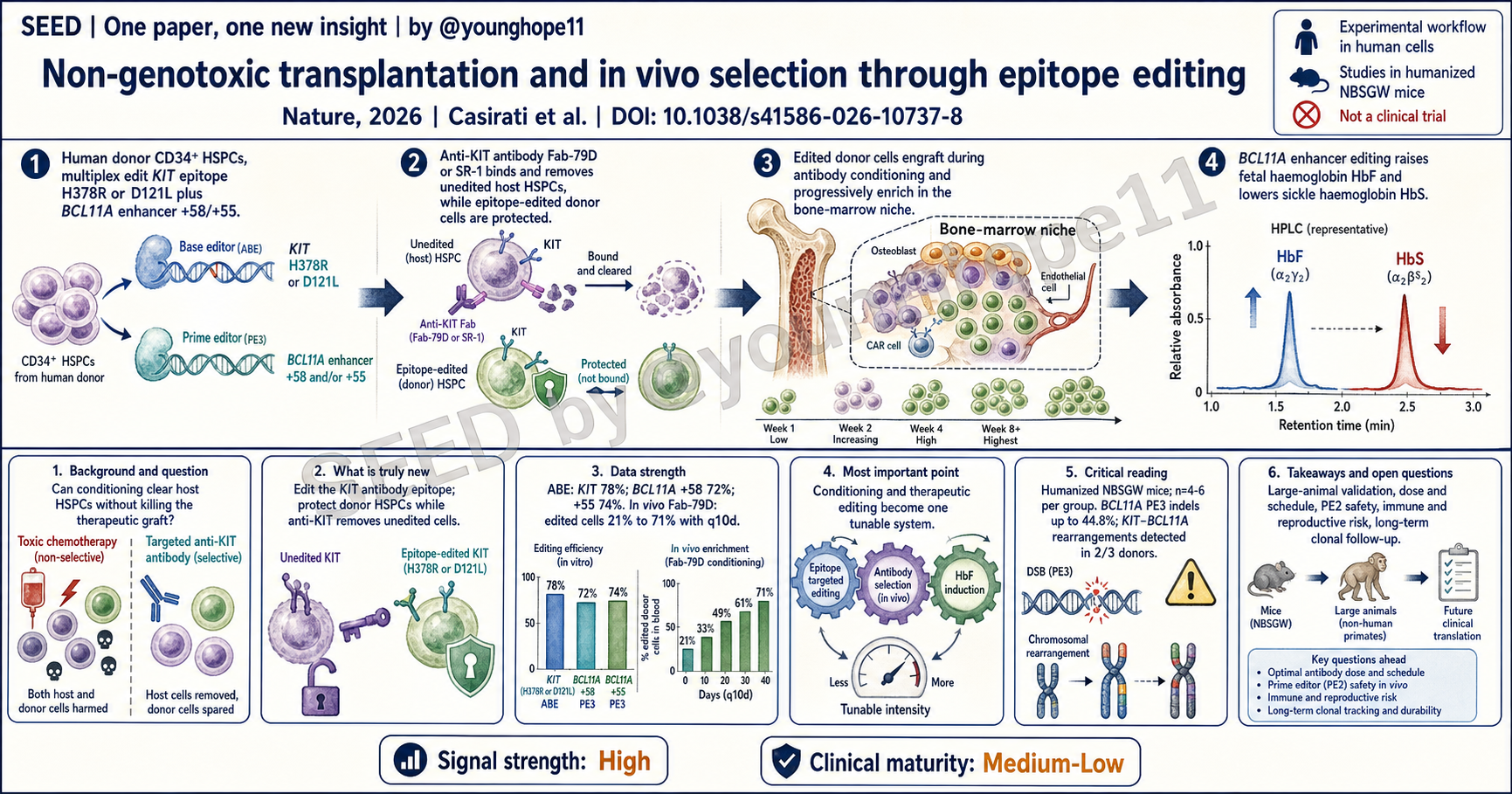
先解决移植前的“清场”问题
造血干细胞移植和 HSPC 基因治疗的第一道门槛,往往不是把细胞改好,而是给它们腾出骨髓里的生态位。传统方案依赖大剂量化疗或放疗来清除宿主造血,但这种“地毯式清场”也会伤害肺、肝、肾和神经系统,造成感染、贫血、出血、继发肿瘤、内分泌异常和不育。它还会引发炎症,增加移植物抗宿主病风险。
抗 KIT(CD117)抗体提供了更精准的替代路线:KIT 在 HSPC 上表达,抗体可以优先削弱或清除这批细胞,减少对其他器官的伤害。但问题是,抗体并不知道谁是“旧细胞”、谁是“刚输进去的好细胞”。如果抗体在血液里停留太久,供体 HSPC 也会被一起清掉;如果等抗体浓度下降后再移植,宿主细胞又可能抢回生态位。
这篇论文真正问的是:能不能给供体 HSPC 改一个很小的表位,让抗 KIT 抗体继续清除宿主细胞,却不再识别被编辑的供体细胞?如果可以,抗体还可以在移植后继续使用,逐步把治疗性细胞从混合群体中筛出来。
真正的新意:让抗体只清除旧细胞
作者首先利用 KIT 胞外结构域 4 的 H378R 变体,让细胞失去 Fab-79D 抗体的识别,却保留 KIT 表达、干细胞因子(SCF)结合和下游功能。随后,他们把这个“免疫通行证”与 BCL11A 红系增强子 +58 和 +55 位点的编辑放在同一批 CD34+ HSPC 中。BCL11A 被削弱后,红细胞可以重新表达胎儿血红蛋白(HbF),这是治疗镰状细胞病和输血依赖性 β-地中海贫血的重要路径。
三位点 ABE 编辑在原代 HSPC 中达到约 78% 的 KIT H378R、72% 的 BCL11A+58 和 74% 的 BCL11A+55 编辑,且对 CD34、CD133、CD45RA、CD90 等干/祖细胞组成没有明显扰动。单细胞和等位基因分析显示,三个位点都有较高比例的双等位编辑,因而同一个细胞可以同时获得“抗体保护”和“提高 HbF”的两种属性。
随后,作者把这套策略放入 Fab-79D 选择压力中。未编辑 KIT 的细胞受到 SCF 信号阻断而生长受抑;H378R 细胞则保持扩增。换句话说,抗体不再只是一个清除工具,也变成了一个外部选择器:它把带有治疗性编辑的细胞从混合群体中筛出来。
证据链从编辑率走到体内重建
第一条证据链来自 NBSGW 人源化小鼠。带有 KIT H378R 和 BCL11A +58/+55 编辑的 HSPC,与 AAVS1 对照编辑细胞混合移植后,接受相同累计剂量的 Fab-79D。对照组中 mtBFP 标记的编辑细胞约占 21.38%;抗体按每两天、每五天或每十天给药后,这一比例分别上升到 37.03%、64.54% 和 71.48%。较长间隔的给药反而带来更强的体内富集,提示选择压力的时间结构和总剂量同样重要。
条形码追踪是这项工作很重要的一层。抗体处理会减少未编辑细胞的条形码数量,但 KIT+BCL11A 编辑细胞的独特条形码数、Shannon 多样性和均匀度没有明显下降,说明选择主要是在清除没有保护的细胞,而不是让少数克隆异常扩张。这个区别很关键:如果只是留下一个或几个“赢家”克隆,治疗可能把克隆性风险从化疗转移到选择过程;目前的条形码结果支持更均匀的富集。
第二条证据链是更贴近临床操作的替换实验。作者先让未编辑的人源细胞在小鼠体内建立,再给两次 SR-1 抗体,并在第二次给药后 12 小时输入新的细胞。只编辑 BCL11A 的供体几乎无法建立移植物;同时编辑 KIT D121L 和 BCL11A +58 的供体则能在宿主细胞被清除的窗口中建立多谱系造血,并在后续红系分化中诱导 HbF。也就是说,表位编辑使“抗体还在体内时就完成移植”成为可能。
第三条证据链是 KIT 表位的升级。SR-1 是更高亲和力的抗 KIT 抗体,作者通过 KIT 结构域替换和饱和突变筛选,找到 ECD2 中的 D121L 和 S123P。S123P 可用 ABE 安装,但在高剂量 SR-1 下仍有残余识别;D121L 需要 prime editing,却几乎完全摆脱 SR-1 结合。优化后的 prime-editing 方案达到约 55% 的 KIT D121L 和 75% 的 BCL11A+58 编辑,并在多种 HSPC 亚群中维持类似效率。
最后,研究把这一策略放入镰状细胞病患者来源的 CD34+ HSPC。抗体选择后,三位点碱基编辑条件的 KIT、BCL11A+58 和 BCL11A+55 编辑率分别达到 83.6%、76.5% 和 84.5%,明显高于没有抗体时的 22.0%、22.7% 和 24.5%。prime-editing 条件也从无抗体时的 4.4% KIT 和 7.5% BCL11A+58,提升到 60.8% 和 59.75%。红系分化后的 HPLC 显示 HbF 上升、HbS 下降,说明选择的不只是一个表面标记,而是更接近治疗所需的细胞功能。
最关键的变化:把“选择优势”写进细胞表面
这篇论文最值得记住的不是某个编辑百分比,而是它把细胞治疗中的“选择优势”从一个偶然的生物学现象,变成了可以主动设计的产品属性。
传统基因治疗通常希望编辑后的细胞自己在体内占优势,但这种优势取决于疾病背景、细胞状态和随机的植入比例。这里的做法更像给供体细胞装上一把只对指定抗体有效的钥匙:抗体负责清除宿主和未编辑细胞,表位编辑负责保护治疗性细胞,BCL11A 编辑则负责真正的疾病修饰。三者组合后,治疗性细胞不需要无限增殖,只要在关键窗口里不被清掉,就有机会逐步接管造血系统。
更重要的是,这个选择优势是外部可调的。停用抗体后,优势理论上会消失;延长间隔、降低剂量或增加供体编辑细胞输入,又可以改变选择强度。这和化疗造成的不可逆损伤不同,也和驱动克隆带来的永久性生长优势不同。
批判性地读:非基因毒性不等于没有基因组风险
第一,主要体内证据来自 NBSGW 人源化小鼠,而不是免疫完整的人体或非人灵长类。小鼠中的抗体剂量、KIT 表达层级、造血竞争和免疫环境,都可能与患者不同。患者来源细胞的结果仍主要停留在体外红系分化,尚不能替代真实临床移植。
第二,选择压力并不对所有谱系相同。KIT 在 HSC、髓系祖细胞和髓系后代上表达更高,因此这些细胞更容易被抗体选择;淋巴系细胞在分化后会下调 KIT,因而保留更多未编辑来源。研究显示了这一点,但也意味着“富集了编辑细胞”不能简单等同于“所有血液谱系都被同样替换”。
第三,编辑安全性有清晰的好消息,也有不能忽略的坏消息。KIT 表位编辑本身的脱靶和 indel 很低;但 BCL11A +58 的 SpRY-ABE8e 在多个候选位点出现可测脱靶脱氨,PE3 则带来明显的 indel,BCL11A PE3 在 HSPC 中最高达到 44.8%,而 PE2 为 5.28%。更需要警惕的是,PE3 在 3 位供体中的 2 位检测到 KIT-BCL11A 染色体易位,ddPCR 估计约为每 1,000 个二倍体基因组 0.16 和 0.13 个事件,虽远低于 nuclease 对照,仍不能被“prime editing 更温和”一句话带过。
第四,抗体本身仍有药代和靶点风险。SR-1 高剂量下会同时减少编辑和未编辑的人源细胞,说明表位保护并非无限。KIT 在黑色素细胞、生殖细胞和 Cajal 细胞等组织也有表达,长期或高强度抗 KIT 处理的组织影响、免疫反应和生殖安全,需要在更大动物中验证。
最后,作者 Gabriele Casirati、Andrea Cosentino 和 Pietro Genovese 是相关专利申请的发明人。论文披露透明,但这一平台如果走向临床,仍需要独立团队复现选择动力学、克隆性和长期安全结论。
下一步要证明它能在真实患者身上工作
最直接的下一步,是在免疫完整的大动物和更接近临床的移植模型中优化 SR-1 或 briquilimab 的剂量、间隔、清髓深度和移植时点。要回答的不是“抗体能不能清掉宿主细胞”,而是能不能在不让编辑供体细胞数量崩溃的情况下,获得足够的长期多谱系重建。
编辑端则需要把效率和安全重新配平。KIT D121L 的 prime editing 已经显示出较好的保护效果,但 PE3 的二链切口和染色体易位风险要求更偏向 PE2、缩短 nicking 距离或采用更严格的 PAM 方案。BCL11A 编辑也需要减少 SpRY 带来的脱靶脱氨,并建立能够在临床级 HSPC 中重复的高纯度编辑流程。
还需要更大规模的条形码和长期随访来确认,抗体选择是否在几十周或更长时间后仍保持克隆多样性,是否会改变淋巴系和髓系的比例,以及停药后造血系统是否回到更自然的生态平衡。对于镰状细胞病和 β-地中海贫血,最终终点也不能只看 HbF,而要看移植后 HbS、输血需求、溶血、器官损伤和患者生活质量。
如果这些问题能够解决,表位编辑的意义可能不止是 KIT。其他造血细胞表面抗原、CAR-T、抗体药物偶联物和双特异性抗体,都可能与“保护治疗性细胞、清除宿主或恶性细胞”的双臂设计结合起来。
Yang 的信号评级:High
轴一,信号强度:High。 研究把表位编辑、抗 KIT 免疫选择、BCL11A 治疗性编辑、条形码克隆追踪、体内造血替换和患者来源 SCD 细胞串成了较完整的证据链。它提出的不是单个编辑位点,而是一种重新设计移植流程的思路:让清髓药物只对宿主有效,让治疗性细胞在体内逐步被保留下来。
轴二,临床成熟度:Medium-Low。 论文已经在多个小鼠和细胞模型中证明了“可选择、可重建、可诱导 HbF”,但真实人体仍面临抗体剂量与组织靶点、免疫完整环境、BCL11A 脱靶、PE3 indel/易位、生产一致性和长期克隆安全等问题。它更像是下一代 HSPC 治疗的工程蓝图,而不是已经准备好替代临床清髓的方案。
一句话总结:如果给移植干细胞换上抗体认不出的“通行证”,清髓就可能从一次性化疗毒杀,变成一场可以调节强度和时间的体内细胞筛选。
Teams at Boston Children’s Hospital, Dana-Farber Cancer Institute and St Jude Children’s Research Hospital report in Nature a new way to coordinate conditioning and transplantation. They edited the antibody-recognition site of KIT on donor haematopoietic stem and progenitor cells (HSPCs), then used anti-KIT antibodies to remove unedited host cells while preserving cells carrying therapeutic BCL11A enhancer edits. The result is a proposed workflow in which conditioning, graft selection and disease-modifying editing are designed as one system rather than as separate steps.
The first problem is clearing the niche before transplantation
For haematopoietic stem-cell transplantation and HSPC gene therapy, the first barrier is often not editing the cells but making room for them in the bone-marrow niche. Conventional conditioning relies on high-dose chemotherapy or radiotherapy. This broad depletion can injure the lung, liver, kidney and nervous system, cause infection, anaemia and bleeding, and create lifelong risks of secondary malignancy, endocrine dysfunction and infertility. The inflammation it provokes can also increase graft-versus-host disease.
Anti-KIT (CD117) antibodies offer a more targeted alternative. KIT is expressed on HSPCs, so an antibody can preferentially weaken or remove them while sparing other tissues. But an antibody does not know which cells are old and which have just been infused. If it persists too long, donor HSPCs can be depleted as well; if transplantation waits for the antibody to clear, host cells may reclaim the niche.
The paper asks whether donor HSPCs can be given a small epitope edit that makes them invisible to the anti-KIT antibody while leaving host cells vulnerable. If so, the antibody could continue after transplantation and progressively select therapeutic cells from a mixed graft.
The real advance: making the antibody remove only the old cells
The authors first used the KIT extracellular-domain-4 H378R variant. It removes recognition by the Fab-79D antibody while preserving KIT expression, stem-cell-factor (SCF) binding and downstream function. They then combined this immune “pass” with edits at the erythroid BCL11A +58 and +55 enhancers. Weakening BCL11A allows red cells to re-express fetal haemoglobin (HbF), a therapeutic route for sickle-cell disease and transfusion-dependent β-thalassaemia.
Multiplex adenine base editing in primary HSPCs reached approximately 78% KIT H378R, 72% BCL11A +58 and 74% BCL11A +55 editing, without obvious disruption of CD34, CD133, CD45RA or CD90 stem/progenitor composition. Single-cell and allelic analyses showed substantial biallelic editing at all three loci, allowing the same cell to carry both antibody protection and HbF-inducing potential.
The team then applied Fab-79D selection pressure. KIT-unedited cells were inhibited because SCF signalling was blocked, whereas H378R cells continued to expand. The antibody became more than a depletion reagent: it became an external selector that enriched cells carrying the desired edits.
From editing percentages to rebuilt blood systems
The first evidence chain came from NBSGW humanized mice. HSPCs carrying KIT H378R and BCL11A +58/+55 edits were mixed with AAVS1-edited control cells and transplanted before exposure to the same cumulative Fab-79D dose. In mock-treated animals, mtBFP-marked edited cells represented 21.38% of the graft. Every-other-day, every-five-day or every-ten-day dosing increased this fraction to 37.03%, 64.54% and 71.48%, respectively. Longer intervals produced stronger enrichment, showing that schedule matters alongside cumulative dose.
Barcode tracking added an important layer. Antibody treatment reduced barcode counts among unedited cells, but unique barcode counts, Shannon diversity and evenness among KIT+BCL11A-edited cells did not fall. Selection therefore mainly removed unprotected cells rather than allowing a few unusual clones to dominate. That distinction matters: otherwise, a conditioning strategy could simply exchange chemotherapy risk for clonal-risk selection.
The second chain was a more direct replacement experiment. The authors first established unedited human haematopoiesis in mice, gave two doses of SR-1, and infused new cells 12 hours after the second dose. Donor cells edited only at BCL11A barely engrafted. Donor cells carrying both KIT D121L and BCL11A +58 edits established multilineage haematopoiesis while the host graft was being depleted, and their erythroid progeny induced HbF. Epitope editing therefore made transplantation possible while antibody conditioning was still active.
The third chain upgraded the KIT epitope for the higher-affinity SR-1 antibody. By mapping KIT domains and screening a saturation library, the authors identified D121L and S123P in extracellular domain 2. S123P could be installed by adenine base editing but retained partial recognition at high SR-1 doses. D121L required prime editing but almost completely eliminated SR-1 binding. An optimized prime-editing scheme reached about 55% KIT D121L and 75% BCL11A +58 editing across HSPC subsets.
Finally, the team tested patient-derived sickle-cell CD34+ HSPCs. After antibody selection, multiplex base-editing cultures reached 83.6% KIT, 76.5% BCL11A +58 and 84.5% BCL11A +55 editing, versus 22.0%, 22.7% and 24.5% without antibody. Prime-editing cultures rose from 4.4% KIT and 7.5% BCL11A +58 without antibody to 60.8% and 59.75% after selection. Erythroid HPLC showed higher HbF and lower HbS, connecting selection to a disease-relevant functional output.
The key shift: writing a selectable advantage onto the cell surface
The most important lesson is not one editing percentage. The study turns “selective advantage” from a biological accident into a deliberately engineered product feature.
Conventional gene therapy hopes that corrected cells will eventually outcompete their neighbours, but that advantage depends on disease context, cell state and the initial graft fraction. Here, donor cells receive a molecular key that the chosen antibody cannot recognize. The antibody removes host and unedited cells; the epitope edit protects the therapeutic graft; and BCL11A editing supplies the disease-modifying function. The edited cells do not need unlimited growth. They only need to survive the critical window in which the host niche is being cleared.
The advantage is also externally tunable. Stopping antibody treatment should remove the pressure; changing dose interval, intensity or the number of edited cells should change selection strength. That is different from irreversible chemotherapy damage and from a permanent growth advantage caused by a driver clone.
How to read it critically: non-genotoxic does not mean genome-risk-free
First, the main in vivo evidence comes from NBSGW humanized mice rather than immunocompetent humans or non-human primates. Antibody dose, KIT expression, graft competition and immune context may all differ in patients. Patient-derived cells were tested mainly in erythroid differentiation cultures, not in clinical transplantation.
Second, selection is not uniform across lineages. KIT is more highly expressed on HSCs, myeloid progenitors and myeloid progeny, while lymphoid cells downregulate KIT during differentiation. The study demonstrates this biology, but it also means that “edited cells were enriched” does not imply equal replacement of every blood lineage.
Third, the genomic safety data contain both reassurance and warning. KIT epitope editing itself showed low off-target and indel rates. But SpRY-ABE8e produced measurable off-target deamination at several candidate sites, especially for BCL11A +58. PE3 generated higher indel rates: up to 44.8% at BCL11A +58 in HSPCs versus 5.28% with PE2. More importantly, UDiTaS detected KIT–BCL11A chromosomal rearrangements in two of three PE3-edited donors. ddPCR estimated roughly 0.16 and 0.13 events per 1,000 diploid genomes, lower than nuclease controls but not a finding that can be hidden behind the phrase “prime editing is safer.”
Fourth, the antibody still carries pharmacological and on-target risks. At high SR-1 doses, edited and unedited human cells both declined, showing that epitope protection is not unlimited. KIT is also expressed outside the HSPC compartment, including melanocytes, germ cells and Cajal cells; longer antibody exposure, immune responses and reproductive safety need larger-animal testing.
Finally, Gabriele Casirati, Andrea Cosentino and Pietro Genovese are inventors on patent applications related to the work. The disclosure is transparent, but independent replication of selection dynamics, clonality and long-term safety will remain important for translation.
The next test is whether it works in a real patient setting
The immediate next step is to optimize SR-1 or briquilimab dose, interval, niche depletion and infusion timing in immunocompetent large-animal and clinically realistic transplantation models. The question is not simply whether an antibody can clear host cells, but whether it can do so without collapsing the number of edited donor cells needed for durable multilineage reconstitution.
The editing side also needs a better efficiency–safety balance. KIT D121L prime editing provides strong protection, but PE3 nicking and rearrangement risks argue for PE2-like configurations, shorter nicking distances or more restrictive PAM choices. BCL11A editing needs to reduce SpRY-associated off-target deamination and produce a high-purity clinical-grade HSPC product.
Larger barcode studies and longer follow-up are needed to determine whether antibody selection preserves clonal diversity over months or years, how it changes lymphoid versus myeloid output, and whether haematopoiesis returns toward a more natural equilibrium after treatment stops. For sickle-cell disease and β-thalassaemia, the eventual endpoints must extend beyond HbF to HbS, transfusion burden, haemolysis, organ injury and quality of life.
If those hurdles can be cleared, epitope editing may extend beyond KIT. Other haematopoietic surface antigens, CAR-T cells, antibody–drug conjugates and bispecific antibodies could be paired with the same two-arm design: protect therapeutic cells while clearing host or malignant cells.
Yang’s signal rating: High
Axis 1, signal strength: High. The study connects epitope editing, anti-KIT immune selection, BCL11A therapeutic editing, barcode-based clonal tracking, in vivo haematopoietic replacement and patient-derived sickle-cell cells into a coherent evidence chain. It proposes a workflow-level redesign: make conditioning selective for host cells and allow therapeutic cells to accumulate in vivo.
Axis 2, clinical maturity: Medium-Low. The work demonstrates selection, reconstitution and HbF induction across several mouse and cell models, but patients still pose unresolved challenges involving antibody dose and extra-haematopoietic targets, intact immunity, BCL11A off-targets, PE3 indels and rearrangements, manufacturing consistency and long-term clonal safety. This is an engineering blueprint for next-generation HSPC therapy, not yet a clinical replacement for conditioning.
One-sentence summary: Give transplanted stem cells an antibody-proof pass, and conditioning could shift from one-shot chemical destruction to a tunable in vivo selection process.