SEED | 把抑郁症风险基因放回活体大脑 SEED | Putting depression risk genes back into the living brain AI-assisted · reviewed
中科院脑科学与智能技术卓越创新中心、Genemagic Biosciences 等机构的 Liansheng Zhang 与 Xinde Hu、Zhengzheng Xu、Haibo Zhou 团队近期在 Nature Genetics 报道,利用 AAV-Perturb-seq 在小鼠大脑中并行扰动 79 个重性抑郁障碍(MDD)GWAS 风险基因,再把神经元转录变化与患者数据对照,找到一个共同指向催产素信号下降的六基因亚群;以 Dennd1a 为例,作者进一步在小鼠和人源神经元中连接了 OXTR–ERK 机制与药理学救援。
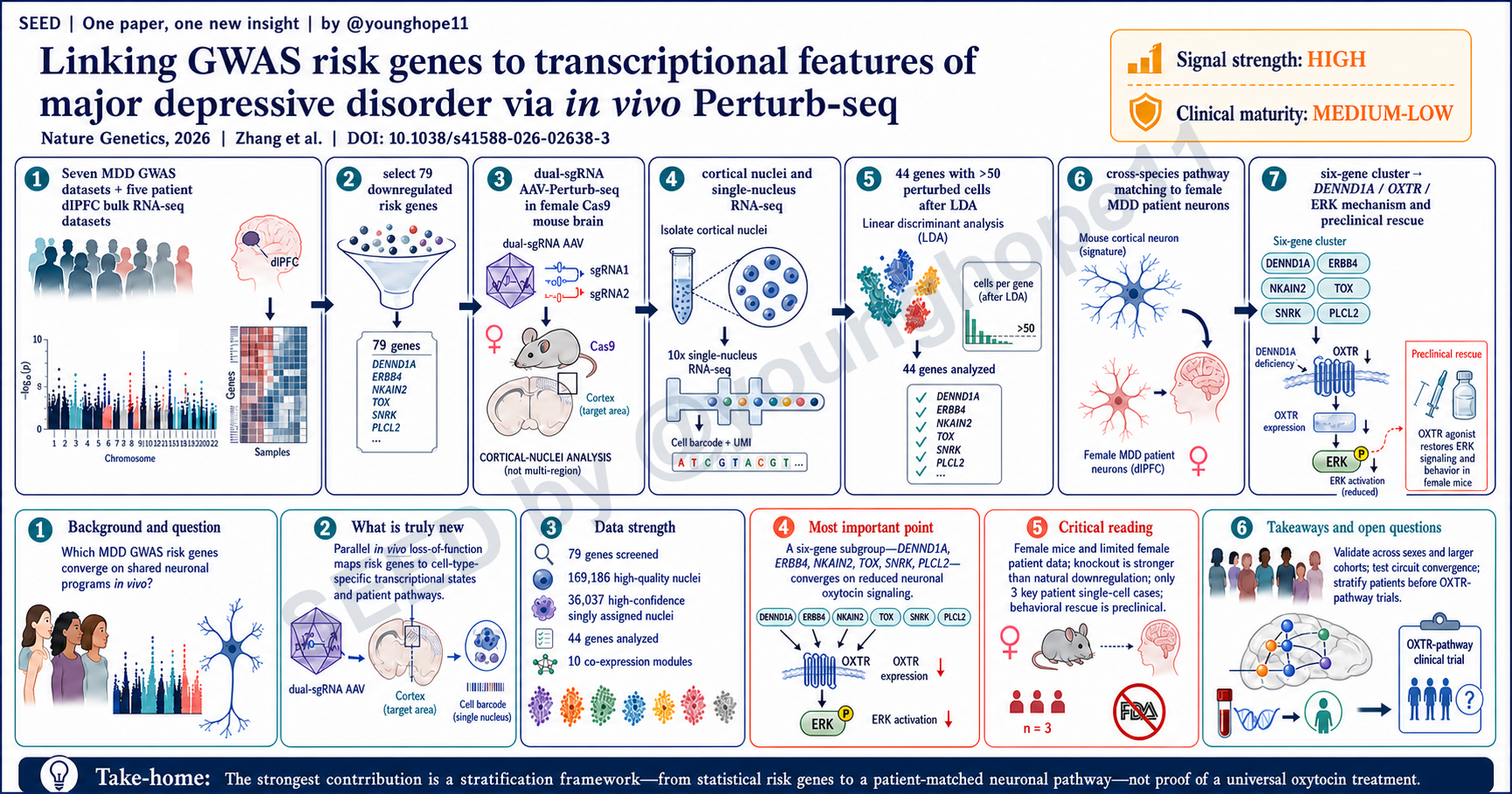
抑郁症风险基因,为什么必须放回活体大脑
GWAS 能告诉我们哪些基因区域与 MDD 风险相关,却不能直接说明这些基因在哪类神经元里起作用、改变了什么细胞状态,以及不同患者是否走的是同一条生物学路径。MDD 的诊断覆盖多种症状组合,患者对同一种治疗的反应也差异很大。若把所有风险基因压成一条平均通路,真正可治疗的亚群反而可能被掩盖。
作者先整合 7 个 GWAS 数据集与 5 个 MDD 患者背外侧前额叶 bulk RNA-seq 数据集,筛出 79 个在至少一个患者数据集中表达下降的风险基因。随后,他们在雌性 Rosa26-LSL-SpCas9 小鼠中用 PHP.eB AAV 递送双 sgRNA Perturb-seq 载体,主要从皮层分选感染细胞核并读取细胞类型特异的转录反应。
真正的新意:按扰动后的生物学,而不是基因名分组
这项研究并非把 79 个基因再排一次名次,而是观察不同基因失活后,是否在同类神经元中留下相似的转录指纹。筛选得到 169,186 个高质量细胞核,其中 36,037 个是经过 MOI=1 过滤、可高置信度归给单个 sgRNA 的细胞核;35 个细胞簇中约 95% 为神经元。经过线性判别分析(LDA)重新分类后,44 个拥有超过 50 个扰动细胞的基因进入主要下游分析。
hdWGCNA 找到 10 个神经元共表达模块,覆盖 GABA 能、谷氨酸能和多巴胺能突触等程序。作者又在兴奋性神经元以及 Lamp5+、Pvalb+、Sst+、Vip+ 抑制性神经元中解析不同扰动效应。这个层级改变了问题的问法:风险基因未必各自“造成抑郁”,而可能在特定细胞类型中汇合成少数可重复的疾病程序。
数据强在三层闭环:体内筛选、患者匹配、功能验证
第一层是体内筛选。作者用独立的 arrayed AAV 敲除加单核 RNA 测序复核 Dennd1a 与 Tox,差异表达和 GO 富集总体支持 pooled screen 的结构;部分方向不一致,也暴露了细胞数、测序深度、感染模式与补偿反应带来的噪声。
第二层是跨物种患者匹配。作者把 44 个基因按差异表达相似度聚成 5 组,再与女性 MDD 患者神经元的 GO 通路比较。只有 cluster 1 呈现较高相似度;该组包含 Dennd1a、Erbb4、Nkain2、Tox、Snrk 和 Plcl2,Dennd1a 的患者匹配度最高。将小鼠扰动数据映射到患者单细胞数据后,匹配信号主要落在兴奋性神经元。
第三层是功能与机制验证。神经元特异性敲除或敲低 Dennd1a 的小鼠在开放场、悬尾和强迫游泳测试中出现抑郁样变化,而转棒表现未见显著差异。安全位点双 sgRNA 对照与 TUNEL 结果降低了双链断裂毒性这一解释的可能。人胚胎干细胞来源神经元中,DENND1A 缺失同样降低 OXTR 表达并削弱低剂量催产素诱导的 ERK 磷酸化。
最重要的一点:催产素信号更像亚群标志,而非通用答案
Dennd1a 缺失没有显著降低 Oxt mRNA 或脑脊液催产素水平,问题更像发生在神经元接收与传递信号的一端:OXTR 表达下降,ERK 激活减弱。cluster 1 的 6 个基因失活都伴随催产素通路下调,而其余 38 个风险基因中只有 3 个呈现相似方向。
女性 MDD 数据中,DENND1A、TOX、ERBB4、SNRK 和 PLCL2 在超过一半患者中下降;NKAIN2 在不同队列间不够稳定。在 3 位关键患者的单细胞神经元中,作者又看到这 5 个基因与催产素通路共同下降。这个结果提示的不是“所有抑郁症都缺催产素”,而是某一患者亚群可能共享受体信号低下的细胞状态。
药理学救援支持机制方向,但还不是临床答案。催产素或 OXTR 激动剂 carbetocin 能改善 Dennd1a 或 Tox 缺失小鼠的部分抑郁样行为;提高催产素剂量也能在 DENND1A 缺失的人源神经元中部分恢复 OXTR–ERK 反应。这证明信号缺陷具有可干预性,却不能证明催产素对未经分型的 MDD 人群有效。
批判性地读:从强敲除到自然风险仍有距离
首先,小鼠中的 knockout 通常远强于患者中的自然表达下降;多数候选风险变异也缺少强 eQTL 支持。用 gene knockout 代替微弱调控变异,适合发现通路,却可能放大效应或遗漏等位基因特异的生物学。
其次,研究只使用雌性小鼠,最关键的人类匹配也来自有限的女性患者数据;单细胞层面的核心验证仅有 3 位患者。男性是否存在相同亚群,以及性别、脑区、病程、用药史和测序深度如何影响这一签名,都需要更大的多中心队列复现。
再次,强迫游泳与悬尾等测试只能提供有限的抑郁样行为读数,不能替代人类临床终点。催产素与 carbetocin 尚未在大规模 MDD 试验中证明疗效,其他神经精神疾病中的催产素试验也并不稳定。
最后,论文披露 Haibo Zhou 是 Genemagic Biosciences 的科学顾问。利益关系已公开,但筛选平台与潜在靶点仍需独立团队、人类样本和前瞻性分层试验验证。
下一步不是给所有人加催产素,而是先找到对的人
最值得推进的是一个可检验的分层流程:先用患者的遗传、细胞状态与临床特征判断是否属于催产素信号低下亚群,再测试恢复 OXTR–ERK 活性能否改变临床结局。研究上需要纳入不同性别、年龄、病程与治疗史的更大单细胞队列,也要在更多神经回路中检验 Dennd1a、Tox 等基因是否真正汇合到共同机制。
如果这条线索最终成立,催产素通路的价值可能不在于成为一剂“人人适用”的抗抑郁药,而在于帮助把症状相似、机制不同的 MDD 拆成可验证、可治疗的生物学亚型。
Yang 的信号评级:High
轴一,信号强度:High。 研究把 GWAS、体内 AAV-Perturb-seq、患者转录组匹配、小鼠行为学、人源神经元机制与药理学救援串成了较完整的证据链,并给出了从统计风险基因走向患者分层的可复用框架。
轴二,临床成熟度:Medium-Low。 这仍是前临床研究;患者数据规模有限,最强结论位于通路层面,催产素干预也缺乏大规模 MDD 临床疗效证据。它是一张“先分型、再选靶点”的路线图,而不是现成治疗方案。
一句话总结:抑郁症风险基因未必都指向同一条路,但其中一个患者亚群可能共享神经元催产素受体信号掉线。
Liansheng Zhang, Xinde Hu, Zhengzheng Xu, Haibo Zhou and colleagues at the Chinese Academy of Sciences’ Center for Excellence in Brain Science and Intelligence Technology, Genemagic Biosciences and partner institutions report in Nature Genetics an in vivo AAV-Perturb-seq screen of 79 major depressive disorder (MDD) GWAS risk genes in the mouse brain. By matching neuronal transcriptional responses to patient data, they identify a six-gene subgroup linked to reduced oxytocin signaling and connect DENND1A loss to OXTR–ERK dysfunction and pharmacological rescue in mice and human neurons.
Why MDD risk genes need to be tested in the living brain
GWAS can identify genomic regions associated with MDD risk, but it does not directly show which neuronal populations are affected, what cell state a risk gene changes, or whether different patients follow the same biological route. MDD encompasses diverse symptom combinations and treatment responses. Collapsing all risk genes into one average pathway can obscure the subgroups most likely to be therapeutically actionable.
The authors integrated seven GWAS datasets with five bulk RNA-seq datasets from the dorsolateral prefrontal cortex of patients with MDD, selecting 79 risk genes that were downregulated in at least one patient dataset. They then delivered dual-sgRNA Perturb-seq vectors with PHP.eB AAV into female Rosa26-LSL-SpCas9 mice, primarily sorted infected cortical nuclei, and read out cell-type-specific transcriptional responses.
What is truly new: grouping genes by perturbation biology
This is not another ranking of 79 genes. The study asks whether loss of different genes leaves similar transcriptional fingerprints in the same neuronal populations. The screen yielded 169,186 high-quality nuclei, including 36,037 high-confidence singly assigned nuclei after MOI=1 filtering. About 95% of cells across 35 clusters were neurons. Following linear discriminant analysis (LDA), 44 genes with more than 50 perturbed cells entered the main downstream analysis.
hdWGCNA identified 10 neuronal co-expression modules spanning GABAergic, glutamatergic and dopaminergic synaptic programs. The authors also resolved effects in excitatory neurons and Lamp5+, Pvalb+, Sst+ and Vip+ inhibitory neurons. This reframes the question: risk genes may not independently “cause depression” but may converge on a smaller set of reproducible, cell-type-specific disease programs.
Where the evidence is strongest: screen, patient match and function
The first layer is the in vivo screen. Independent arrayed AAV knockout plus single-nucleus RNA-seq validation of Dennd1a and Tox broadly supported the differential-expression and GO structure of the pooled screen. Directional discrepancies for some signals also reveal noise from cell number, sequencing depth, infection pattern and compensatory responses.
The second layer is cross-species patient matching. The 44 genes formed five clusters based on perturbation-profile similarity, which were then compared with neuronal GO pathways from female patients with MDD. Only cluster 1 showed high similarity. Its six genes were Dennd1a, Erbb4, Nkain2, Tox, Snrk and Plcl2, with Dennd1a showing the strongest patient match. Mapping mouse perturbation signatures onto patient single-cell data concentrated the matched signal in excitatory neurons.
The third layer is functional and mechanistic validation. Neuron-specific Dennd1a knockout or knockdown produced depression-like changes in open-field, tail-suspension and forced-swim assays, while rotarod performance was not significantly altered. Safe-harbor dual-sgRNA controls and TUNEL staining make double-strand-break toxicity a less likely explanation. In human embryonic-stem-cell-derived neurons, DENND1A loss likewise reduced OXTR expression and weakened ERK phosphorylation under low-dose oxytocin stimulation.
The most important point: a subgroup marker, not a universal answer
Dennd1a loss did not significantly lower Oxt mRNA or cerebrospinal-fluid oxytocin. The defect appears to lie at the receiving and signaling end of the neuron: OXTR expression falls and ERK activation weakens. All six cluster 1 knockouts showed reduced oxytocin signaling, compared with only three of the other 38 risk genes.
In female MDD data, DENND1A, TOX, ERBB4, SNRK and PLCL2 were reduced in more than half of patients, while NKAIN2 was inconsistent across cohorts. In single-cell neurons from three key patients, the authors again observed co-reduction of these five genes and the oxytocin pathway. The result does not imply that everyone with depression lacks oxytocin; it suggests that one patient subgroup may share a low receptor-signaling state.
Pharmacological rescue supports the mechanism but is not clinical proof. Oxytocin or the OXTR agonist carbetocin improved some depression-like behaviors in Dennd1a- or Tox-deficient mice, and higher oxytocin partly restored OXTR–ERK responses in DENND1A-deficient human neurons. This demonstrates that the signaling defect can be modulated, not that unstratified patients with MDD will benefit.
How to read it critically: knockout is not natural genetic risk
Mouse knockout is usually much stronger than the expression decrease observed in patients, and most candidate risk variants lack strong eQTL support. Knockout is useful for finding pathways, but it may amplify effects or miss allele-specific biology.
The study used only female mice, and the key human matching relies on limited female patient data. The central single-cell validation includes only three patients. Whether the subgroup exists in males, and how sex, brain region, disease stage, medication history and sequencing depth affect the signature, require replication in larger multicenter cohorts.
Forced-swim and tail-suspension tests provide limited depression-like behavioral readouts; they are not human clinical endpoints. Oxytocin and carbetocin have not demonstrated efficacy in large MDD trials, and oxytocin results in other neuropsychiatric settings have been inconsistent.
The paper also discloses that Haibo Zhou is a scientific adviser to Genemagic Biosciences. The relationship is transparent, but the screening platform and therapeutic targets still need independent replication, broader human sampling and prospective stratified trials.
The next move is to identify the right patients first
The most useful next step is a testable stratification workflow: use a patient’s genetic, cellular and clinical profile to determine whether they belong to an oxytocin-signaling-low subgroup, then ask whether restoring OXTR–ERK activity changes clinical outcomes. This will require larger single-cell cohorts across sex, age, disease course and treatment history, along with circuit-level tests of whether Dennd1a, Tox and the other cluster genes truly converge.
If the signal holds, the value of the oxytocin pathway may be less as a one-size-fits-all antidepressant and more as a way to split a symptomatically similar but mechanistically diverse diagnosis into testable biological subtypes.
Yang’s signal rating: High
Axis 1, signal strength: High. The study links GWAS, in vivo AAV-Perturb-seq, patient transcriptomic matching, mouse behavior, human-neuron mechanism and pharmacological rescue into a coherent chain, while offering a reusable framework for moving from statistical risk genes to patient stratification.
Axis 2, clinical maturity: Medium-Low. This remains preclinical. The patient datasets are limited, the strongest conclusion is pathway-level, and oxytocin-based intervention lacks large-scale MDD efficacy evidence. It is a roadmap for stratification and target selection, not a ready-made treatment.
One-sentence summary: MDD risk genes may not all follow the same route, but one patient subgroup may share a common failure of neuronal oxytocin-receptor signaling.