SEED | 给造血干细胞装上护盾,摆脱有毒预处理 SEED | Shield the stem cell, replace toxic conditioning AI-assisted · reviewed
巴塞尔大学医院与 University of Basel 的 Romina Marone、Lukas T. Jeker 团队近期在 bioRxiv 发布一篇尚未同行评议的预印本,报道了一种把 CD117 表位屏蔽、prime editing 和抗体选择结合起来的造血干细胞移植策略:先用 CIM058 清除宿主造血干细胞,再移植带有 CD117 E73K 护盾的健康 CD34+ 细胞,并在移植后继续给药,让保护细胞在体内逐步富集,最终改善人源化 β-地中海贫血小鼠的造血表型。
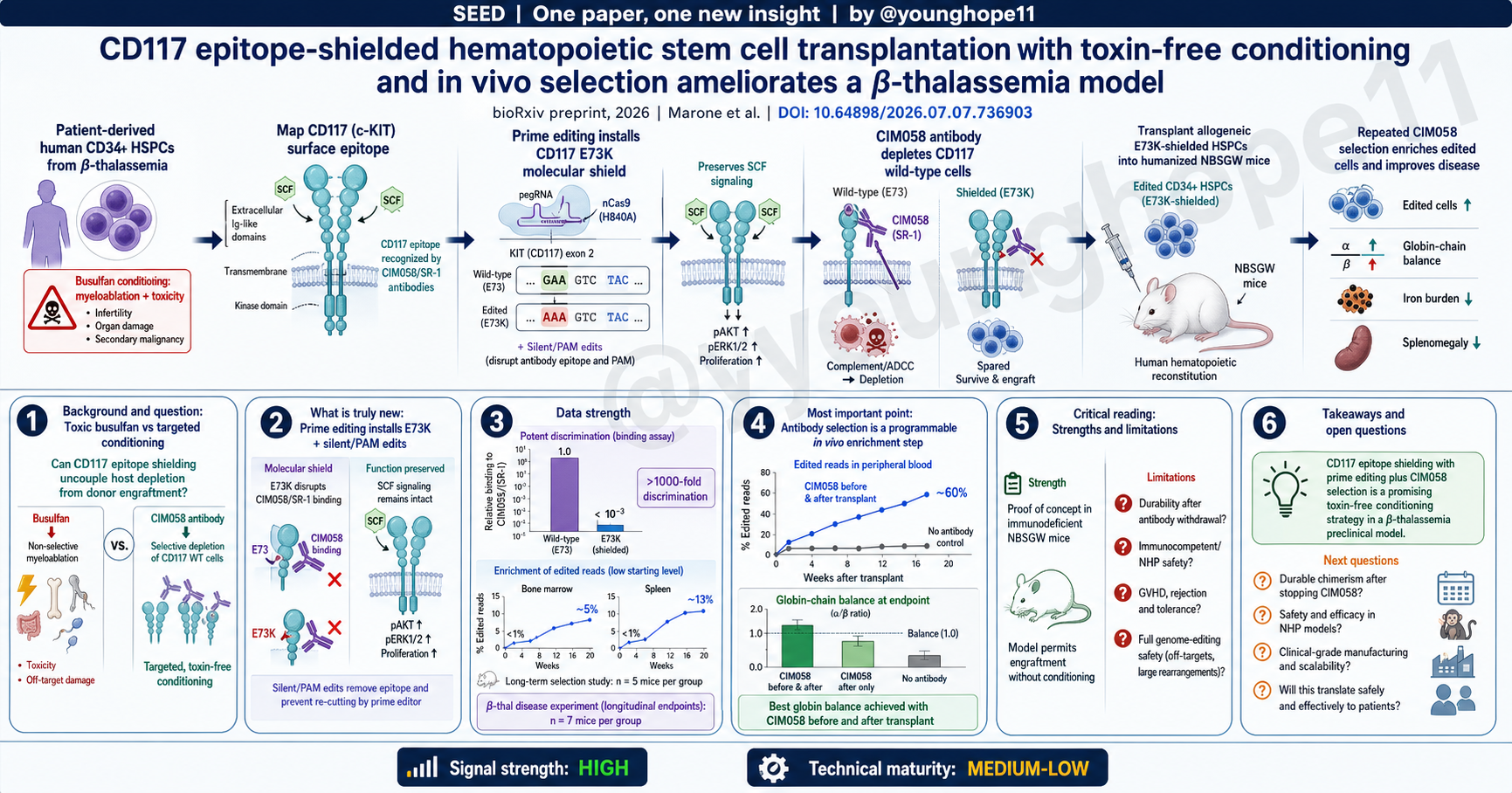
为什么造血干细胞移植仍被 busulfan 绑住
造血干细胞基因治疗已经可以把一次性纠正遗传病变成现实,但移植前的“清场”仍常依赖 busulfan 等非靶向、具有基因毒性的预处理。它会带来不育、肝肺损伤和继发肿瘤风险,也让很多儿童和年轻患者在面对潜在治愈方案时犹豫。CD117/c-KIT 是造血干细胞依赖的受体,阻断它可以压制或清除宿主细胞;问题是,强力的 CD117 抗体也可能在移植后误伤刚输入的细胞。
这篇研究要回答的核心问题是:能不能只让“要留下来的”造血干细胞看不见 CD117 抗体,同时保留 CD117 的正常 SCF 信号,使抗体既能清除宿主,又能在移植后持续选择供体细胞?
CD117 E73K:把抗体识别位点改成一个分子护盾
作者先用 alanine scanning 和结构分析定位 SR-1 抗体表位,再筛选 CD117 的单氨基酸替换。E73 位于一个暴露、但不承担关键内部相互作用的环区;把谷氨酸换成赖氨酸(E73K)后,抗体结合大幅下降,同时 SCF 结合、受体磷酸化和细胞增殖功能仍被保留。对 SR-1 而言,E73K 与野生型之间的结合区分度超过 1000 倍。
研究团队随后把更高亲和力、Fc-silent 的 CD117 阻断抗体 CIM058 与 E73K 配对。HDR 方式虽然能实现屏蔽,却带来细胞活力下降、KO 等混合编辑结果和较差的长期移植表现;prime editing 的 epeg14 设计加入 E73K、静默突变和 PAM 破坏,减少了 indel、旁观者编辑和目标位点大范围重排,在体外仍保持造血分化能力。
证据链强在哪里:从受体结合到人源化疾病模型
这不是只在一条细胞系里展示抗体不结合。研究先在 TF-1 细胞中确认 E73K 保留 SCF 依赖生长和信号传导,再在原代 CD34+ HSPCs 中验证 CIM058 能减少野生型细胞、富集带 E73K 的细胞。低起始编辑率(低于 1%)的 prime-edited 细胞,经 CIM058 处理后可在骨髓富集到接近 5%、脾脏约 13%。长期选择实验每组使用 5 只小鼠;在外周血中,早期或分次 CIM058 给药可在第 94 天把 E73K 读段推到约 60%。
最后,作者把健康供体的 CD117E73K-epeg14-PE HSPCs 移植到携带患者来源 β-地中海贫血细胞的人源化 NBSGW 小鼠中。纵向实验每组 7 只小鼠。CIM058 在移植前后都给药时,编辑细胞富集最高,β/(γ+α) 球蛋白链比例改善最明显,并伴随更好的红系成熟、较少的网织红细胞、较低的脾脏铁沉积和脾大。
最重要的一点:抗体选择变成了体内“扩增程序”
这项工作的关键不只是“找到一个不被抗体识别的 CD117 变体”,而是把预处理和细胞产品设计连成了一个闭环。CIM058 不再只是移植前的一次性清除剂;只要保护细胞还在,移植后重复给药就可以继续压低未编辑或未保护的细胞,让供体细胞获得选择性扩增的机会。换句话说,编辑效率不必一开始就接近 100%,体内选择可以把一小群有护盾的细胞放大。
这也解释了为什么移植前后都给 CIM058 的组效果最好。不过,体内选择不是无代价的放大器:它会把编辑结果、细胞适应性和抗体暴露共同转化成最终的嵌合比例,因而需要长期追踪,而不能只看某一个时间点的读段比例。
从 proof-of-concept 到临床之间,还有几道硬门槛
第一,这是 bioRxiv 预印本,尚未经过同行评议。第二,NBSGW 是免疫缺陷小鼠,且允许人 CD34+ 细胞在没有传统预处理的情况下 engraft;因此没有 CIM058 的组也出现了部分疾病改善,不能把全部效果都归因于抗体介导的“无毒预处理”。模型还偏向 B 细胞分化,不能完整模拟人类造血系统。
第三,作者展示的是初步安全信号,不是完整的临床级安全评估。HDR 版本暴露出活力和长期重建问题,prime editing 虽然没有检测到预设的 indel、旁观者编辑或大范围重排,但仍需要更全面的脱靶、克隆选择、长期肿瘤风险和免疫学评估。第四,停用 CIM058 后能否保持稳定供体嵌合仍是核心未知数;宿主 HSPCs 可能只是被暂时压制,而没有被永久清除。最后,异基因移植仍要面对 GVHD、排斥、免疫重建和临床制造一致性。
下一步不是再做一只小鼠,而是验证“停药后还能留下来”
最关键的实验是:在免疫健全的 NHP 模型中,比较移植前后不同 CIM058 给药方案,并在停药后长期观察供体嵌合、宿主 HSPC 是否反弹、血液谱系是否完整重建,以及是否出现克隆偏移。与此同时,需要优化 prime-editing 递送和编辑率,建立符合临床要求的 CD34+ 细胞生产、放行和长期安全检测流程。
平台层面,这种 CD117 护盾有两条路线:在自体基因治疗中,它可以和疾病纠正编辑共选,降低需要达到的初始编辑阈值;在异体移植中,它只需开发一个通用的护盾编辑,理论上更适合面对有数百种致病突变的 β-地中海贫血。但“通用”并不等于“已准备好”:真正的价值要等停药后稳定重建、免疫安全和临床制造都被证明。
Yang 的信号评级:High
轴一,信号强度:High。它把一个临床真实痛点——有毒的非靶向预处理——转化为可工程化的组合策略,并用受体结合、细胞功能、prime editing、体内选择、继发移植和人源化 β-地中海贫血模型串起了证据链。
轴二,技术成熟度:Medium-Low。研究已经超越概念图和单一体外实验,但仍是未同行评议的免疫缺陷小鼠 proof-of-concept;停药后的持久嵌合、免疫健全大动物、GVHD/排斥和完整基因编辑安全性都没有解决。
一句话总结:它给造血干细胞装上护盾,让“清除宿主”和“留下供体”第一次可以被设计成同一个体内选择过程;但护盾能否在停药后仍守住骨髓生态位,还要靠更严格的模型回答。
Romina Marone, Lukas T. Jeker and colleagues at University Hospital Basel and the University of Basel report a bioRxiv preprint that combines CD117 epitope shielding, prime editing and antibody-based selection in hematopoietic stem cell transplantation. CIM058 depletes host hematopoietic stem cells, while healthy donor CD34+ cells carrying the CD117 E73K shield survive repeated antibody dosing after transplant and progressively enrich in a humanized β-thalassemia mouse model.
Why hematopoietic transplantation is still tied to busulfan
Hematopoietic stem cell gene therapy can now offer one-time correction for inherited disease, but the “clearing” step before transplantation still often relies on busulfan or other untargeted, genotoxic conditioning. Infertility, liver and lung injury, and secondary malignancy risks make these regimens a major barrier, especially for children and young adults. CD117/c-KIT is a receptor required by hematopoietic stem cells, so blocking it can suppress or deplete host cells. The problem is that a potent CD117 antibody can also damage the incoming graft.
The paper asks whether the cells meant to stay could be made invisible to the antibody while preserving normal CD117-SCF signaling. In that design, the same antibody could clear the host, spare the graft and continue selecting protected cells after transplantation.
CD117 E73K: a molecular shield at the antibody epitope
The authors used alanine scanning and structural analysis to map the SR-1 antibody epitope, then screened single-amino-acid substitutions in CD117. E73 lies in an exposed loop without a key internal interaction. Changing glutamate to lysine (E73K) sharply reduced antibody binding while preserving SCF binding, receptor phosphorylation and cell growth. The binding discrimination between E73K and wild-type CD117 exceeded 1,000-fold for SR-1.
The team then paired the shield with CIM058, a higher-affinity, Fc-silent CD117-blocking antibody. HDR could install E73K but produced lower viability, mixed KI/KO outcomes and weaker long-term transplantation performance. A prime-editing epeg14 design added E73K together with silent and PAM-disrupting changes, reducing indels, bystander edits and large on-target rearrangements while preserving hematopoietic differentiation in vitro.
Where the evidence is strongest: from receptor binding to a humanized disease model
The study does more than show antibody escape in one cell line. In TF-1 cells, E73K retained SCF-dependent growth and signaling. In primary CD34+ HSPCs, CIM058 depleted unprotected cells and enriched E73K cells. When the starting prime-edited fraction was below 1%, CIM058 increased it to nearly 5% in bone marrow and about 13% in spleen. In a long-term selection study with five mice per group, early or fractionated CIM058 dosing raised E73K reads in peripheral blood to about 60% by day 94.
The final experiment transplanted healthy-donor CD117E73K-epeg14-PE HSPCs into NBSGW mice carrying patient-derived β-thalassemia cells. Longitudinal endpoint groups used seven mice per group. CIM058 before and after transplantation produced the strongest enrichment, improved the β/(γ+α) globin-chain ratio, improved erythroid maturation, reduced reticulocytes, lowered splenic iron deposition and reduced splenomegaly.
The most important point: antibody dosing becomes an in vivo expansion program
The central advance is not simply an antibody-resistant CD117 variant. It is the coupling of conditioning and cell-product design into one feedback loop. CIM058 is no longer only a one-time depletion step. As long as shielded cells survive, repeat dosing can keep suppressing unedited or unprotected cells and give the graft a selective expansion window. In principle, the editing rate need not start near 100%; in vivo selection can amplify a small protected population.
That is why the group receiving CIM058 both before and after transplantation performed best across several disease measures. But selection is not a free amplification step: the final chimerism reflects editing outcome, cell fitness and antibody exposure together, so it must be followed longitudinally rather than inferred from one endpoint.
How to read the gap between proof of concept and clinical translation
First, this is a bioRxiv preprint and has not been peer reviewed. Second, NBSGW mice are immunodeficient and permit human CD34+ cells to engraft without conventional conditioning. Some disease rescue therefore occurred even without CIM058 and cannot all be assigned to antibody-mediated toxin-free conditioning. The model also skews human differentiation toward the B-cell lineage.
Third, the safety data are preliminary rather than a clinical-grade assessment. HDR exposed viability and long-term reconstitution problems. Prime editing showed no detected indels, bystander edits or gross on-target rearrangements in the assays used, but broader off-target, clonal-selection, long-term tumor-risk and immunologic studies are still needed. Fourth, durable donor chimerism after CIM058 withdrawal is unresolved: host HSPCs may be suppressed or displaced rather than permanently eliminated. Allogeneic transplantation also brings graft-versus-host disease, rejection, immune reconstitution and manufacturing-consistency risks. The authors’ affiliations with Cimeio and related companies make independent replication particularly valuable.
The next experiment is whether the graft stays after the antibody stops
The decisive next step is a study in immunocompetent NHPs comparing pre- and post-transplant CIM058 schedules, followed by long-term withdrawal. It should measure donor chimerism, rebound of host HSPCs, multilineage reconstitution, clonal skewing and immune toxicity. In parallel, prime-editing delivery and editing efficiency need optimization, together with clinical-grade CD34+ manufacturing, release testing and long-term safety assays.
At the platform level, CD117 shielding could support two paths. In autologous gene therapy, it could be paired with a disease-correcting edit and lower the initial editing fraction needed for durable benefit. In allogeneic transplantation, a single shield edit could in principle serve disorders with hundreds of causal β-thalassemia mutations. But “generalizable” is not the same as “ready”: durable post-withdrawal reconstitution, immune safety and reproducible manufacturing still have to be demonstrated.
Yang’s signal rating: High
Axis 1, signal strength: High. The study turns a real clinical bottleneck - toxic, untargeted conditioning - into an engineerable combination strategy, linking receptor binding, cell function, prime editing, in vivo selection, secondary transplantation and a humanized β-thalassemia model.
Axis 2, technical maturity: Medium-Low. The work moves beyond a conceptual diagram and a single in vitro assay, but it remains an unreviewed proof of concept in immunodeficient mice. Durable chimerism after antibody withdrawal, immunocompetent large-animal testing, graft-versus-host disease and rejection, and comprehensive genome-editing safety remain unresolved.
One-sentence summary: The study gives hematopoietic stem cells a shield so that clearing the host and keeping the graft can become one programmable selection process; whether that shield holds after the antibody is withdrawn remains the decisive test.