SEED | NovoTag:为三种荧光染料各造一把锁 SEED | NovoTag gives each fluorophore its own lock AI-assisted · reviewed
University of Washington Institute for Protein Design 与 EMBL 的 Long Tran、Steffen Klein、Linna An、Julia Mahamid、David Baker 团队近期在 Science 报道,利用配体感知的 de novo 蛋白设计,为绿色、橙色和远红色 Janelia Fluor 染料生成三种小型、纳摩尔亲和力且彼此正交的 NovoTag,并进一步把结合口袋改造成可调荧光寿命、共价标记和染料诱导二聚的功能模块,为多重细胞成像提供了一套可编程的蛋白工具箱。
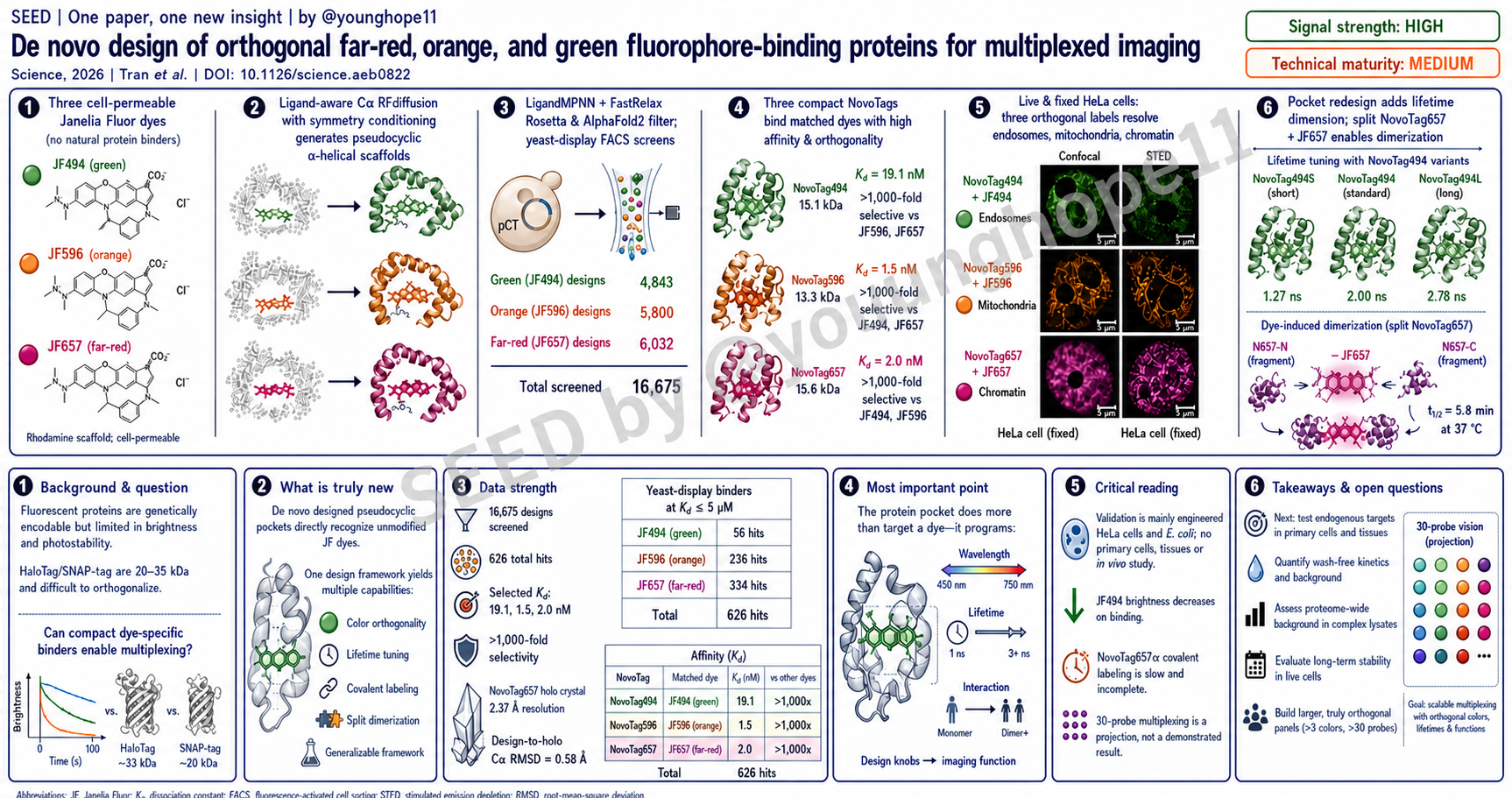
多重成像真正缺的,不只是更多颜色
荧光蛋白可以直接由基因编码,但亮度、光稳定性和光谱拥挤限制了长时间、高分辨率和多目标成像。Janelia Fluor(JF)等小分子染料更亮、更耐漂白,也能进入细胞;问题是它们需要一个把染料带到目标蛋白上的标签。HaloTag 和 SNAP-tag 很成熟,却有两个结构性限制:标签约 20–35 kDa,而且识别的是共同连接基团,不是染料本身,因此很难在同一个细胞中建立许多互不干扰的正交组合。
作者提出一个更直接的问题:能否为每一种结构相近的 JF 染料分别设计一个小蛋白口袋,让标签直接辨认染料的细微化学差异?如果可行,颜色复用就不必只依赖不同的共价反应,还可以把波长、荧光寿命和蛋白组装状态同时纳入设计。
NovoTag 的新意:直接围着染料生成蛋白口袋
研究选取 JF494、JF596 和 JF657 三种结构相近、覆盖绿色到远红色的 rhodamine 染料。团队用带有对称性条件的 Cα RFdiffusion,直接围绕配体生成封闭的伪环状 α-螺旋骨架;随后用 LigandMPNN 和 FastRelax 设计序列,再经 Rosetta 和 AlphaFold2 过滤,最后通过酵母表面展示和 FACS 实验筛选。
这与“先造一个蛋白、再把小分子塞进去”的流程不同:配体从生成起点就参与决定口袋的几何形状。三种最终 NovoTag 只有 13.3–15.6 kDa,却分别以 19.1 nM、1.5 nM 和 2.0 nM 的 Kd 结合 JF494、JF596 和 JF657,对另外两种染料的亲和力至少低 1000 倍。真正的设计目标因此不是单纯高亲和力,而是让三个相似小分子各自找到唯一的蛋白搭档。
证据链从 16,675 个设计一直走到活细胞 STED
团队为 JF494、JF596 和 JF657 分别筛选了 4,843、5,800 和 6,032 个设计,共 16,675 个;在酵母展示中,56、236 和 334 个设计达到 Kd 不高于 5 μM,共 626 个初始命中。最终入选的三个标签是可溶、单体且热稳定的。NovoTag657 的 apo 和 holo 晶体结构分辨率为 1.44 Å 和 2.37 Å,设计模型与 holo 结构的主链 Cα RMSD 仅 0.58 Å,说明模型不只预测了整体折叠,也较准确地放置了染料周围的芳香和氢键残基。
功能验证覆盖固定和活的 HeLa 细胞、共聚焦与 STED 超分辨成像:NovoTag494、596 和 657 可同时标记内体、线粒体和染色质,三组标签—染料—激发波长组合保持清晰分离。NovoTag657 与 JF657 的亮度高于文中比较的两种 HaloTag7 组合,光漂白速度则相近。研究还重新设计了 36 个 NovoTag494 口袋,得到 1.27、2.00 和 2.78 ns 三个可分离的荧光寿命,并用 phasor unmixing 在同一种 JF494 染料下分辨三个细胞结构。
最重要的一点:蛋白口袋本身就是成像控制面板
这篇论文最值得记住的,不是“AI 又做出了一个 binder”,而是一个小分子结合口袋可以同时控制多种成像属性。改变口袋的氢键、π–π stacking 和静电环境,就能改变染料亮度和荧光寿命;在 NovoTag657 中放入合适的半胱氨酸,可得到能形成共价键的 NovoTag657cv;把同一标签拆成两半,则得到 NovoSplit657,让 JF657 同时成为诱导二聚的小分子和新生复合物的荧光读出。
NovoSplit657 在 HeLa 细胞中只对 JF657 响应,1 μM 染料诱导二聚的半时间约 5.8 分钟。把染料放到固定之后再加入时,它还可以充当邻近传感器:只有两段标签已被待测蛋白带到足够近的位置,荧光复合物才会组装。由此,NovoTag 不只是标签,而是一个把小分子化学、蛋白结构和细胞操控连接起来的平台。
怎样批判性地读:平台宽度大于目前的验证边界
第一,细胞验证主要集中在工程化 HeLa 细胞,辅以 E. coli;尚未展示原代细胞、复杂组织、活体成像或内源蛋白的系统性标记。染料进入、洗涤背景、标签表达量和融合位置在这些环境中可能产生完全不同的表现。第二,JF494 与 NovoTag494 结合后亮度反而下降;NovoTag657cv 的共价反应较慢,过量染料条件下约 3 小时才达到 47.8% 标记,离快速 pulse-chase 或单分子追踪的理想动力学还有距离。
第三,论文真正展示的是三种光谱标签和同一染料的三种寿命状态;“10 种颜色 × 3 种寿命,达到 30 个探针”是合理展望,不是已经完成的实验。NovoSplit 的邻近传感也主要用设计的 LHD 异二聚体证明,是否能稳定识别较弱、瞬时或内源性相互作用尚未回答。最后,作者已提交覆盖本文发现的临时专利,多位作者与荧光染料相关专利和公司有关,后续需要独立实验室进行 head-to-head 复现。
下一步要证明的是:从三把锁扩展成真正的正交钥匙串
下一轮工作应在原代细胞、类器官和活体组织中测试内源性目标,系统比较 NovoTag 与 HaloTag/SNAP-tag 的背景、亮度、光漂白、染色速度、洗涤需求和对目标蛋白功能的扰动。同时需要做复杂蛋白组环境下的非特异结合评估,并优化共价 NovoTag 的反应动力学。
平台扩展的关键不是再做一个颜色,而是建立可量化的正交性预算:随着标签数量增加,交叉结合、光谱串扰、寿命分布重叠和细胞毒性会同时累积。若能把这些误差维度纳入联合设计,NovoTag 才可能从三色展示走向真正的高维成像工具箱,并进一步覆盖近红外、光激活和 blinking 染料。
Yang 的信号评级:High
轴一,信号强度:High。论文把生成式蛋白设计、数万规模实验筛选、纳摩尔结合、千倍正交性、晶体结构和多种细胞成像功能闭合在同一条证据链中;更重要的是,它证明口袋设计可以编程染料的寿命、共价性和诱导组装,而不只是识别。
轴二,技术成熟度:Medium。三色活细胞、固定细胞和 STED 成像已经可用,代码、结构、质粒和原始数据也较开放;但平台尚未在原代细胞、组织和活体中证明,快速共价标记、大规模正交面板和内源相互作用传感仍处在早期阶段。
一句话总结:NovoTag 的真正价值不是给染料找了一个容器,而是把蛋白口袋变成了可编程的成像控制面板。
Long Tran, Steffen Klein, Linna An, Julia Mahamid, David Baker and colleagues at the University of Washington Institute for Protein Design and EMBL report in Science that ligand-aware de novo protein design can generate compact, nanomolar-affinity and mutually orthogonal NovoTags for green, orange and far-red Janelia Fluor dyes. They further redesign the binding pockets to tune fluorescence lifetime, enable covalent labeling and create dye-induced dimerization, assembling a programmable toolkit for multiplexed cellular imaging.
Multiplexed imaging needs more than additional colors
Fluorescent proteins are genetically encodable, but limited brightness, photostability and spectral crowding constrain long-duration, high-resolution and multiplexed imaging. Small-molecule dyes such as Janelia Fluor compounds are brighter, more photostable and cell permeable, but they need a tag to bring them to a protein of interest. HaloTag and SNAP-tag are mature technologies with two structural limitations: they are roughly 20–35 kDa, and they recognize a shared linker chemistry rather than the dye itself, making large sets of mutually orthogonal combinations difficult.
The authors ask a more direct question: can a distinct small protein pocket be designed for each of several closely related JF dyes, so that the tag recognizes subtle chemical differences in the fluorophore? If so, multiplexing could combine wavelength, fluorescence lifetime and protein assembly state rather than relying only on different covalent reactions.
NovoTag is generated directly around the dye
The study targets three structurally related rhodamine dyes, JF494, JF596 and JF657, spanning green to far-red emission. Symmetry-conditioned Cα RFdiffusion generates closed pseudocyclic alpha-helical scaffolds around each ligand. LigandMPNN and FastRelax then design sequences, Rosetta and AlphaFold2 provide computational filters, and yeast display with FACS supplies the experimental screen.
This differs from designing a protein first and docking a ligand afterward: the ligand shapes the pocket from the start of generation. The three final NovoTags are only 13.3–15.6 kDa and bind JF494, JF596 and JF657 with Kd values of 19.1 nM, 1.5 nM and 2.0 nM, respectively. Each binds its matched dye with at least 1,000-fold greater affinity than the other two dyes. The objective is therefore not affinity alone, but a unique protein partner for each of three chemically similar small molecules.
The evidence runs from 16,675 designs to live-cell STED
The team screened 4,843, 5,800 and 6,032 designs for JF494, JF596 and JF657 - 16,675 in total. Yeast display yielded 56, 236 and 334 designs with Kd values no higher than 5 μM, or 626 initial hits. The three selected tags are soluble, monomeric and thermostable. Apo and holo NovoTag657 crystal structures reached 1.44 Å and 2.37 Å resolution, and the design model matched the holo backbone at a Cα RMSD of 0.58 Å, supporting both the global fold and the placement of aromatic and hydrogen-bonding residues around the dye.
Functional validation spans fixed and live HeLa cells, confocal microscopy and STED super-resolution imaging. NovoTag494, NovoTag596 and NovoTag657 simultaneously label endosomes, mitochondria and chromatin while the three tag-dye-excitation combinations remain separated. NovoTag657-JF657 is brighter than the two HaloTag7 combinations used for comparison, with similar photobleaching. The authors also redesigned 36 NovoTag494 pockets to obtain three separated lifetimes - 1.27, 2.00 and 2.78 ns - and used phasor unmixing to distinguish three cellular structures with the same JF494 dye.
The protein pocket becomes an imaging control surface
The most important result is not simply that AI produced another binder. A small-molecule pocket can control several imaging properties at once. Changing hydrogen bonding, pi stacking and electrostatics adjusts dye brightness and lifetime. Placing a cysteine at the correct position in NovoTag657 produces the covalent NovoTag657cv. Splitting the same tag creates NovoSplit657, in which JF657 both induces dimerization and reports the newly assembled complex by fluorescence.
NovoSplit657 responds selectively to JF657 in HeLa cells, with a dimerization half-time of about 5.8 minutes at 1 μM dye. When the dye is added only after fixation, it can act as a proximity sensor: the fluorescent complex assembles only when proteins of interest have already brought the two tag fragments close enough together. NovoTag is therefore not only a label, but a platform connecting small-molecule chemistry, protein structure and cellular control.
The platform is broader than its current validation boundary
First, cellular validation is concentrated in engineered HeLa cells with supporting E. coli experiments. The study does not yet establish systematic labeling of endogenous proteins, primary cells, complex tissues or living animals. Dye entry, wash background, tag expression and fusion position may behave very differently in those settings. Second, JF494 becomes dimmer upon NovoTag494 binding. NovoTag657cv is slow: under excess dye, labeling reached 47.8% after roughly three hours, leaving substantial room before fast pulse-chase or single-molecule applications.
Third, the experiments demonstrate three spectral tags and three lifetime states of one dye. The proposed “10 colors × 3 lifetimes = 30 probes” is a plausible projection, not an achieved experiment. NovoSplit proximity sensing is also demonstrated mainly with a designed LHD heterodimer; sensitivity to weak, transient or endogenous interactions remains unknown. Finally, the authors have filed a provisional patent covering discoveries in the article, and several authors have fluorophore-related patent or company interests, making independent head-to-head replication especially valuable.
The next step is to turn three locks into a truly orthogonal keyring
The next experiments should test endogenous targets in primary cells, organoids and living tissues, with systematic comparisons against HaloTag and SNAP-tag for background, brightness, photobleaching, staining speed, wash requirements and perturbation of the tagged protein. Proteome-scale nonspecific binding should be assessed in complex lysates, while the covalent NovoTag needs faster reaction kinetics.
Scaling requires more than adding another color. Cross-binding, spectral bleed-through, lifetime overlap and cellular toxicity will accumulate as the panel grows. If those error dimensions can be included in joint design and validation, NovoTag may progress from a three-color demonstration to a genuinely high-dimensional imaging toolkit, including near-infrared, photoactivatable and blinking fluorophores.
Yang’s signal rating: High
Axis 1, signal strength: High. The paper closes the loop from generative protein design and a 16,675-member experimental screen to nanomolar binding, thousand-fold orthogonality, crystal structures and multiple cellular imaging functions. More importantly, it shows that pocket design can program lifetime, covalency and conditional assembly rather than recognition alone.
Axis 2, technical maturity: Medium. Three-color live-cell, fixed-cell and STED imaging already works, and the code, structures, plasmids and raw data are relatively accessible. Primary cells, tissues and in vivo validation, faster covalent labeling, larger orthogonal panels and endogenous interaction sensing remain early.
One-sentence summary: NovoTag does not merely give a fluorophore a container; it turns the protein pocket into a programmable imaging control surface.