SEED | 重启 HbF:松开 BACH2,也要保住 NRF2 SEED | Reopening HbF: relieve BACH2, preserve NRF2 AI-assisted · reviewed
波士顿儿童医院、Dana-Farber 与 Broad Institute 等机构的 Chun-Jie Guo、Uma P. Arora 和 Vijay G. Sankaran 团队在 Nature 报道:在人群遗传学中找到的 BACH2,会限制 NRF2 激活编码胎儿血红蛋白(HbF)的 γ-globin 基因。降低 BACH2,或精确改变 HBG1/2 启动子上的特定结合位点,可以提高体外红系细胞中的 HbF;但相邻位点的另一类编辑反而会降低 HbF。这为理解“怎样真正打开 γ-globin”补上了重要的一环。论文原文,2026 年 9 月 30 日发表
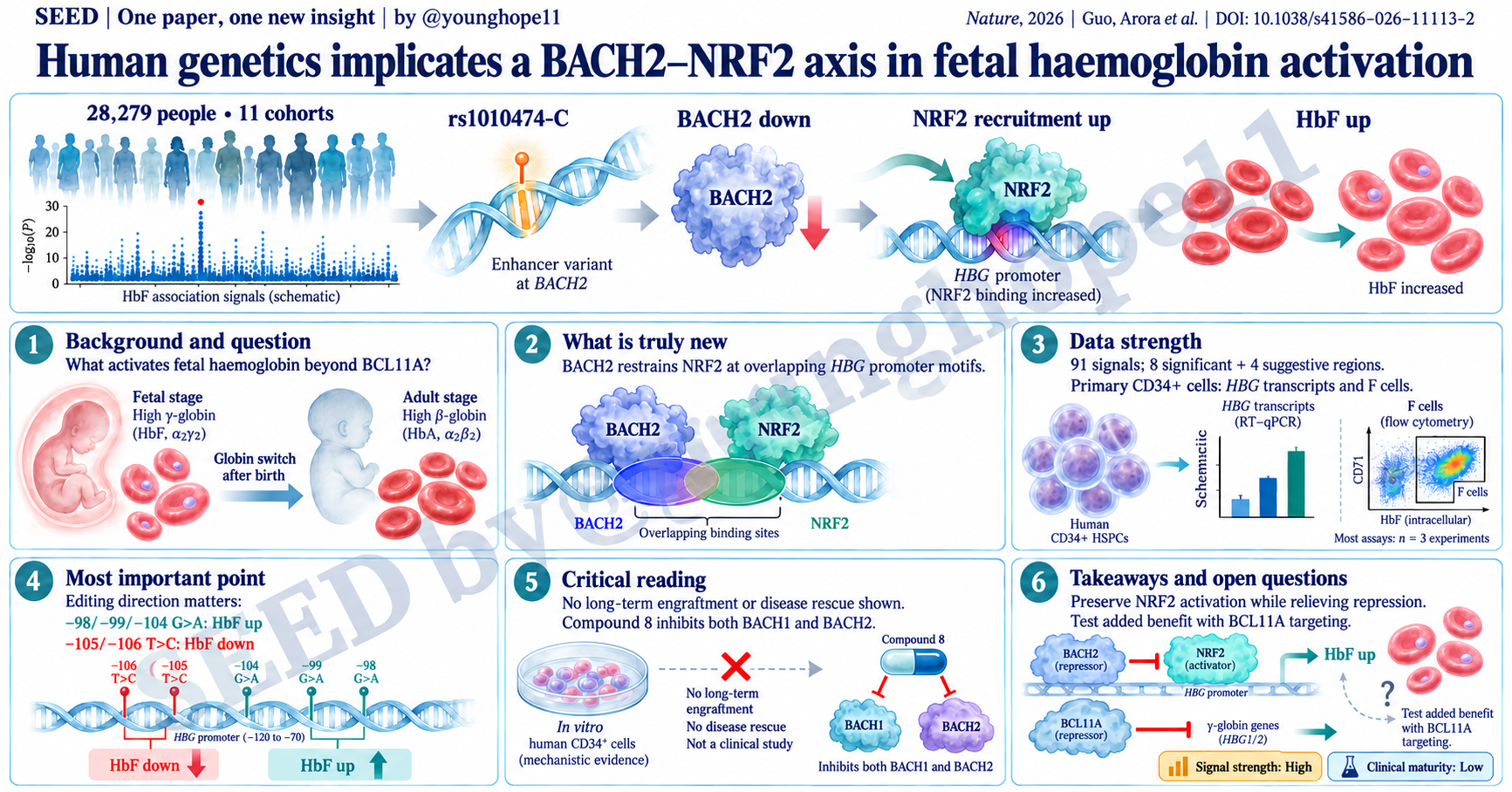
已经能解除抑制,为什么还要研究谁来激活 HbF?
提高 HbF 可以缓解镰状细胞病和 β-地中海贫血。既有调控研究及治疗开发,很大一部分围绕 BCL11A 等“关闭 γ-globin 的因子”:减少抑制蛋白,或编辑它们的结合位点,让出生后被关闭的基因重新表达。
但解除抑制之后,究竟由谁推动转录?激活因子能否顺利进入同一段 DNA?这篇原创研究的核心问题,是找到有人类遗传证据支持的激活调控机制,而不是仅增加一张 HbF 相关基因名单。研究背景与摘要
从天然变异追到 BACH2,再追到 NRF2
研究先对 28,279 人、11 个队列进行多祖源 HbF 全基因组关联分析:欧洲祖源 22,882 人、非洲祖源 4,005 人、泰国队列 1,392 人。共定位出 91 个条件独立关联信号,分布在 12 个区域;其中 8 个区域达到全基因组显著性,4 个仅达到提示性阈值,不能把 12 个都写成已确立的新位点。Fig. 1
作者重点追踪 BACH2,是因为它在人群分析中有稳定支持,同时此前未被确立为 HbF 调控因子。精细定位仍留下 32 个紧密连锁候选变异,因此单靠统计不能直接锁定因果。团队再结合染色质开放性、增强子报告实验和原代细胞编辑,把证据推进到 rs1010474-C:在 CD34+ 造血干/祖细胞中引入这一等位基因,约 40% 的总体编辑率伴随 BACH2 下调、HBG1/2 表达和 F-cell 比例上升。原文将其谨慎表述为“很可能的因果功能变异”。Fig. 2 与扩展数据 Fig. 3
机制上的新意,是把 BACH2 与 NRF2 连起来。BACH2 减少后,NRF2 在 γ-globin 启动子和远端调控区的占据增加,并在新生 HBG1/2 转录本附近形成局部聚集。经典氧化应激靶基因并未普遍上调,因此作者支持的是局部转录调控机制,而不是简单的“氧化应激越强,HbF 越高”。Fig. 3
证据最强的地方,是关联、扰动与依赖性检验接上了
这篇文章的力度主要来自不同方法指向同一方向,而非任何一个特别大的体外效应值。
| 证据层 | 关键结果 | 能支持到哪里 |
|---|---|---|
| 人群与天然变异 | 多祖源关联;重建 rs1010474-C 后 BACH2 下降、HbF 相关读数上升 | 将人群线索推进到原代细胞中的功能证据 |
| 双向扰动 | BACH2 敲低提高 HbF;过表达抑制 HbF | 支持方向性和剂量相关性;高倍过表达需谨慎解释 |
| 染色质与成像 | CUT&RUN、ChIP–qPCR、NRF2 与新生 RNA 共定位相互支持 | 将调控作用定位到 γ-globin 转录区域 |
| NRF2 依赖性 | NRF2 减少降低 HbF;同时减少 NRF2 和 BACH2,不能维持 BACH2 单独敲低时的诱导 | 支持 BACH2 的作用依赖 NRF2 激活能力 |
| 启动子编辑 | 重叠结合序列上的不同替换产生相反 HbF 方向;DNA 结合实验与之对应 | 说明这里具有可区分的激活和抑制功能 |
| 与 BCL11A 联合扰动 | BACH2 敲低联合 BCL11A +58 红系增强子破坏,产生加成效果 | 支持并行调控,但不等于治疗组合的协同效应已确立 |
多数关键原代细胞实验标注为 n=3 次独立实验,部分对照为 n=2;这不能被改写成“多个患者队列证实疗效”。主要读数是 HBG1/2 转录比例、HbF 阳性细胞比例及部分 HbF 荧光强度。F-cell 比例不是总体 HbF 蛋白百分比,HBG1/2 mRNA 比例也不是临床 HbF 浓度。Fig. 2–5 图注与 Methods
同一段启动子,少改一个方向就可能得到相反结果
最值得带走的是:编辑目标应当是改善激活与抑制之间的平衡,而不只是破坏一个看起来像抑制位点的序列。
BACH2 与 NRF2 的结合序列在 HBG1/2 启动子的约 −94 至 −106 区间重叠,位于两个 BCL11A 结合位点之间。原文按启动子参考链标注的结果如下:
| 原文报告的替换 | 使用的编辑类别 | 实验方向 |
|---|---|---|
| −98G>A、−99G>A、−104G>A | CBE,可通过互补链编辑形成所列 G>A | BACH2 结合减弱、NRF2 结合更有利,HbF 上升 |
| −105T>C、−106T>C | ABE,可通过互补链编辑形成所列 T>C | NRF2 结合减弱、BACH2 结合更有利,HbF 下降 |
这些结果属于论文所测试的编辑产物和实验条件,不能据此把所有单一替换、旁观者编辑组合都当成已经分别定量验证。它也不表示 CBE 普遍优于 ABE:同一研究中,ABE 在 BACH2 增强子引入 rs1010474-C 就提高了 HbF。决定方向的是位点和最终序列,不是编辑器类别的名称。Fig. 4
对 HbF 编辑开发而言,这提示一个容易遗漏的检查:破坏抑制因子结合的同时,是否损伤了邻近激活因子的入口?“总体编辑率很高”无法独立回答这个问题。
新调控轴成立,不代表全身抑制 BACH2 已适合治疗
首先,实验距离疾病疗效仍有明显间隔。原代细胞来自健康成人动员外周血,主要证据来自体外红系分化。本文没有展示治疗性编辑后的长期移植重建、连续移植、患者红细胞抗镰变功能或临床获益。培养中红系分化标志物大体保留,也不能替代长期 HSC 功能和多谱系安全性评估。Methods
其次,人群规模大不等于没有异质性。欧洲祖源占主体;泰国队列富集高 HbF 个体;不同队列包含普通人群和 SCD 人群;BIOS 与 GTEx 使用表达比例代理 HbF 表型。作者也指出跨祖源效应量不可直接比较,MAMA 的共享效应模型会部分诱导效应估计的相关性。因此跨祖源一致性有价值,但不能解释为完全独立、同质的三次复制。
第三,药理证据不是 BACH2 特异性治疗的证明。Compound 8 同时抑制 BACH1/2;药物实验应与遗传扰动一起读。BACH2 已与免疫和过敏相关表型联系,广泛降低 BACH2 与仅修改红系 globin 顺式元件,潜在作用范围并不相同。后者是否更安全仍需实测,不能由位置选择直接担保。
最后,BACH2 与 NRF2 的蛋白关联、结合竞争和局部聚集提供了相互支持的机制证据,但尚未排除其他 NFE2-like 因子的贡献。与 BCL11A 的加成及阴性共免疫沉淀支持并行通路,也不意味着所有细胞状态下绝对互不影响。作者披露了相关行业任职和顾问关系,包括 Sankaran 为 Ensoma、Cellarity、Beam Therapeutics 提供顾问服务,并注明与本研究无关;判断仍应落在实验设计和可复现数据上。Discussion 与利益披露
下一步应比较“每一种编辑产物”,而不只比较编辑率
以下是由论文引出的研究判断,尚不是本文已经证明的结论。
第一,建立最终序列与功能的对应关系。 将目标替换、旁观者替换和组合产物分别对应到 NRF2/BACH2 结合、HbF 蛋白水平、细胞间分布及疾病功能。论文提供了方向,尚未给出适用于所有编辑窗口的完整规则。
第二,验证与既有 BCL11A 方案的增量价值。 在可比编辑负担下比较单靶点与组合:增加的是否是真正有保护作用的 HbF,而不仅是 mRNA 或阳性细胞读数?同等效果下能否减少干预强度?论文中的加成结果使这些问题值得测试,但没有直接给出答案。Fig. 5
第三,把优势带入长期 HSC 和疾病背景。 验证重建后的持续性、谱系贡献、克隆分布及疾病相关功能,并检验不同供者和应激环境是否改变 NRF2 的可用性。对于转化开发,局部解除抑制所获得的收益,需要与编辑产物复杂性和安全性一起评价。
Yang 的信号评级:High
轴一,科学信号:High。 人类遗传学提名与原代细胞因果扰动相连接,进一步追到 NRF2 依赖性及可编辑的重叠结合序列,改变了对 HbF 激活方式的理解。
轴二,临床成熟度:Low。 已形成可信的机制和体外干预入口,但长期重建、疾病功能、安全边界和相对现有方案的优势尚未建立。
一句话:重新打开 HbF,既要松开抑制,也要给激活因子留下能工作的位点。
Chun-Jie Guo, Uma P. Arora and Vijay G. Sankaran, working with colleagues at Boston Children’s Hospital, Dana-Farber and the Broad Institute, report in Nature that BACH2 restrains NRF2-dependent activation of the γ-globin genes encoding fetal haemoglobin (HbF). Reducing BACH2 or editing selected HBG1/2 promoter motifs increases HbF-related readouts in cultured erythroid cells. Other edits at neighbouring bases have the opposite effect. The study adds an important mechanism to our understanding of how γ-globin is activated. Original paper, published 30 September 2026
After removing repression, what actually activates HbF?
Increasing HbF can ameliorate sickle cell disease and β-thalassaemia. Much of the regulatory and therapeutic work has focused on factors such as BCL11A that silence γ-globin: reduce the repressor or alter its binding sites to restore expression after the developmental switch.
But which factors drive transcription once repression is relieved, and can they still access the same DNA? This primary research study seeks a human-genetically supported activation mechanism, rather than simply extending a list of HbF-associated genes. Background and abstract
Following a natural variant from BACH2 to NRF2
The multi-ancestry genome-wide association analysis included 28,279 people across 11 cohorts: 22,882 of European ancestry, 4,005 of African ancestry and 1,392 in the Thai cohort. It identified 91 conditionally independent association signals across 12 regions. Importantly, eight regions were genome-wide significant and four met only a suggestive threshold; these are not 12 newly established loci. Fig. 1
BACH2 was prioritized because of its population-level support and previously unestablished role in HbF regulation. Fine-mapping still left 32 tightly linked candidate variants, so statistical evidence alone could not isolate the causal base. Chromatin accessibility, enhancer reporters and primary-cell editing strengthened the case for rs1010474-C. Introducing this allele into CD34+ haematopoietic stem and progenitor cells at approximately 40% bulk editing efficiency reduced BACH2 and increased HBG1/2 expression and F-cell frequency. The paper cautiously describes it as the probable causal functional variant. Fig. 2 and Extended Data Fig. 3
The mechanistic advance connects BACH2 to NRF2. BACH2 depletion increased NRF2 occupancy at γ-globin promoters and distal regulatory regions, with localized accumulation near nascent HBG1/2 transcripts. Canonical oxidative-stress target genes were not broadly induced, supporting local transcriptional regulation rather than a simple relationship between more oxidative stress and more HbF. Fig. 3
Association, perturbation and dependency form a coherent evidence chain
The strength comes from converging methods, rather than a single exceptionally large in vitro effect.
| Evidence layer | Key finding | Supported interpretation |
|---|---|---|
| Human genetics and a natural variant | Cross-ancestry association; recreating rs1010474-C lowers BACH2 and raises HbF-related readouts | Functional support for a population-derived candidate in primary cells |
| Reciprocal perturbations | BACH2 knockdown raises HbF; overexpression suppresses it | Directional and dosage-related regulation, with caution around extreme overexpression |
| Chromatin and imaging | CUT&RUN, ChIP–qPCR and NRF2–nascent RNA colocalization converge | Regulation is linked to γ-globin transcriptional regions |
| NRF2 dependency | NRF2 depletion lowers HbF; combined NRF2/BACH2 depletion does not sustain the induction seen with BACH2 knockdown alone | BACH2 acts through an NRF2-dependent activation mechanism |
| Promoter editing | Different substitutions in overlapping motifs produce opposite HbF effects and corresponding DNA-binding changes | Separable activating and repressive functions within the same region |
| Combined BCL11A perturbation | BACH2 knockdown plus disruption of the BCL11A +58 erythroid enhancer produces an additive effect | Parallel regulation, not established therapeutic synergy |
Most key primary-cell assays report n=3 independent experiments, with some controls at n=2. This must not become a claim of efficacy across patient cohorts. Principal endpoints include HBG1/2 transcript proportion, HbF-positive cell frequency and some HbF fluorescence measurements. F-cell frequency is not total HbF protein percentage, and HBG1/2 mRNA proportion is not a clinical HbF concentration. Figure legends and Methods
Neighbouring promoter edits can send HbF in opposite directions
The central lesson is to improve the balance between activation and repression, rather than merely disrupt a sequence labelled as a repressor site.
BACH2 and NRF2 motifs overlap around positions −94 to −106 of the HBG1/2 promoters, between two BCL11A sites. Using the promoter reference-strand notation reported in the paper:
| Reported substitutions | Editor class used | Experimental direction |
|---|---|---|
| −98G>A, −99G>A, −104G>A | CBE; complementary-strand editing can yield the listed G>A changes | Reduced BACH2 binding, more favourable NRF2 binding and increased HbF |
| −105T>C, −106T>C | ABE; complementary-strand editing can yield the listed T>C changes | Reduced NRF2 binding, more favourable BACH2 binding and decreased HbF |
These findings apply to the tested editing products and conditions. They do not establish a separately quantified effect for every individual substitution or bystander combination. Nor do they show that CBE is generally better than ABE: ABE introduction of rs1010474-C at the BACH2 enhancer increased HbF in the same study. The locus and final sequence determine the direction, not the editor-class name. Fig. 4
For HbF editing development, this suggests an easily missed check: does disrupting repressor binding also damage an adjacent activator site? A high bulk editing percentage cannot answer that question.
A convincing regulatory axis is not yet a systemic BACH2 therapy
First, there remains a substantial gap to disease efficacy. Primary cells came from healthy adult mobilized peripheral blood, and the main evidence is from in vitro erythroid differentiation. The study does not demonstrate long-term engraftment after therapeutic editing, serial transplantation, patient red-cell antisickling function or clinical benefit. Largely preserved differentiation markers in culture cannot substitute for long-term HSC function and multilineage safety. Methods
Second, the large population analysis remains heterogeneous. European ancestry predominates; the Thai cohort was enriched for high HbF; cohorts include both general populations and people with SCD; BIOS and GTEx used expression ratios as HbF proxies. The authors note that effect sizes cannot be directly compared across ancestries and that MAMA’s shared-effect model partly induces correlation between estimates. Cross-ancestry consistency is valuable, but is not equivalent to three entirely independent, homogeneous replications.
Third, the pharmacology does not establish a BACH2-specific treatment. Compound 8 inhibits both BACH1 and BACH2, and should be interpreted alongside genetic perturbations. BACH2 is associated with immune and allergic phenotypes, so broadly lowering BACH2 and editing a globin cis-regulatory element have different potential scopes of action. Whether the latter is safer requires testing; locus selection alone does not guarantee safety.
Finally, protein association, binding competition and localized accumulation support the mechanism without excluding contributions from other NFE2-like factors. Additivity with BCL11A and negative co-immunoprecipitation support parallel pathways, not absolute independence in every cellular state. Disclosed industry relationships include Sankaran’s advisory roles at Ensoma, Cellarity and Beam Therapeutics, stated to be unrelated to this work; interpretation should remain grounded in design and reproducibility. Discussion and competing interests
Compare editing products, not only editing percentages
The following are research implications, not conclusions already demonstrated by this paper.
First, link final sequence to function. Map intended substitutions, bystander changes and combinations to NRF2/BACH2 binding, HbF protein abundance, cell-to-cell distribution and disease-related function. The paper establishes a direction, not a complete rulebook for every editing window.
Second, establish incremental value over BCL11A strategies. Compare single and combined interventions at comparable editing burdens. Does the addition produce protective HbF rather than merely more transcript or positive cells? Could equivalent function be obtained with less intervention? The additive result makes these questions worth testing but does not resolve them. Fig. 5
Third, carry the effect into long-term HSC and disease settings. Assess persistence after engraftment, lineage contributions, clonal distribution and disease-related function, including whether donor variation and stress conditions change NRF2 availability. Translational value will depend on weighing locally relieved repression against editing-product complexity and safety.
Yang’s signal rating: High
Axis one, scientific signal: High. Human genetic nomination connects to causal perturbation in primary cells, NRF2 dependency and editable overlapping motifs, extending the mechanistic understanding of HbF activation.
Axis two, clinical maturity: Low. The mechanism and in vitro intervention points are credible; long-term engraftment, disease function, safety boundaries and advantages over existing approaches remain unestablished.
One sentence: reopening HbF requires both relief of repression and a functional site for the activator.